Join us on a literary world trip!
Add this book to bookshelf
Grey
Write a new comment Default profile 50px
Grey
Subscribe to read the full book or read the first pages for free!
All characters reduced
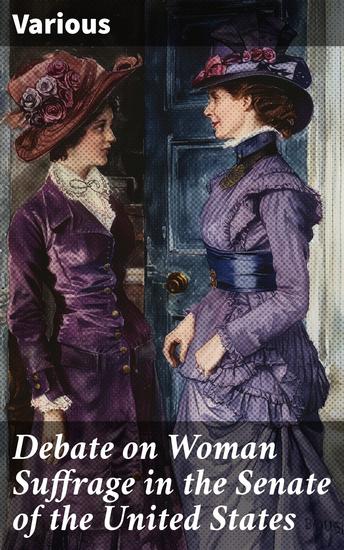
Debate on Woman Suffrage in the Senate of the United States - 2d Session 49th Congress December 8 1886 and January 25 1887 - cover

Debate on Woman Suffrage in the Senate of the United States - 2d Session 49th Congress December 8 1886 and January 25 1887

Various Various

Publisher: Good Press

  • 0
  • 0
  • 0

Summary

In the scholarly compilation "Debate on Woman Suffrage in the Senate of the United States," readers are presented with a critical examination of one of the most significant social movements in American history. This text captures the earnest discourse surrounding women's right to vote, highlighting the arguments posed by both proponents and opponents of suffrage within the Senate chambers. The language utilized reflects the era's political rhetoric, blending persuasive oratory with an analytical tone that underscores the complexities and emotional depths of the debate. Through meticulously transcribed speeches and debates, the book places these discussions within the broader context of early 20th-century American society, showcasing the intersection of gender, politics, and justice during a pivotal time in the fight for civil rights. The author, a collective of scholars and editors, includes a diverse range of voices who contributed to the national dialogue on suffrage. Their backgrounds'Äîspanning advocacy, law, and academia'Äîhave equipped them with a rich understanding of the legislative process and societal change. This multi-authored perspective is crucial in dissecting the fervent ideological divides that influenced not just policy, but also the cultural fabric of the nation. "Debate on Woman Suffrage in the Senate of the United States" is highly recommended for scholars, students, and anyone interested in the evolution of democracy and women's rights. This nuanced portrayal offers invaluable insights into the political struggles of the past while illuminating the ongoing relevance of these issues today. Engage with this text to deepen your understanding of a vital chapter in American history.
Available since: 08/12/2023.
Print length: 163 pages.

Other books that might interest you

  • A Kidnapped West - The Tragedy of Central Europe - cover

    A Kidnapped West - The Tragedy...

    Milan Kundera

    • 0
    • 0
    • 0
    “We should welcome the context Kundera gives for the struggles between Russia and Europe, and the plight of those caught between them. His defense of small languages, small cultures, and small nations feels pressing.”—Claire Messud, Harper's Magazine 
    “Kundera focuses on the relationship of Europe’s central ‘small nations’ like Czechoslovakia and Ukraine to Western culture and argues that their cultural identities were increasingly threatened.”—New York Book Review  
    A short collection of brilliant early essays that offers a fascinating context for Milan Kundera’s subsequent career and holds a mirror to much recent European history.  It is also remarkably prescient with regard to Russia’s current aggression in Ukraine and its threat to the rest of Europe. 
    Milan Kundera’s early nonfiction work feels especially resonant in our own time. In these pieces, Kundera pleads the case of the “small nations” of Europe who, by culture, are Western with deep roots in Europe, despite Russia imposing its own Communist political regimes in Hungary, Czechoslovakia, Poland, Ukraine, and elsewhere. Kundera warns that the real tragedy here is not Russia but Europe, whose own identity and culture are directly challenged and threatened in a way that could lead to their destruction. He is sounding the alarm, which chimes loud and clear in our own twenty-first century. 
    The 1983 essay translated by Edmund White (“The Tragedy of Central Europe”), and the 1967 lecture delivered to the Czech Writers’ Union in the middle of the Prague Spring by the young Milan Kundera (“Literature and the Small Nations”), translated for the first time by Linda Asher, are both written in a voice that is at once personal, vehement, and anguished. Here, Kundera appears already as one of our great European writers and truly our contemporary. Each piece is prefaced by a short presentation by French historian Pierre Nora and Czech-born French political scientist Jacques Rupnik.
    Show book
  • The Monroe Doctrine - cover

    The Monroe Doctrine

    Various

    • 0
    • 0
    • 0
    This program is read by an AI-based synthesized voice.
    Show book
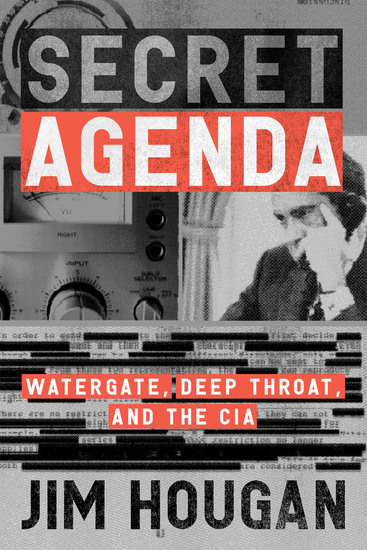
  • Secret Agenda - Watergate Deep Throat and the CIA - cover

    Secret Agenda - Watergate Deep...

    Jim Hougan

    • 0
    • 0
    • 0
    The exposé that reveals “a prostitution ring, heavy CIA involvement, spying on the White House as well as on the Democrats, and plots within plots” (The Washington Post) Ten years after the infamous Watergate scandal that brought down the Nixon presidency, Jim Hougan—then the Washington editor of Harper’s Magazine—set out to write a profile of Lou Russell, a boozy private-eye who plied his trade in the vice-driven underbelly of the nation’s capital. Hougan soon discovered that Russell was “the sixth man, the one who got away” when his boss, veteran CIA officer Jim McCord, led a break-in team into a trap at the Watergate. Using the Freedom of Information Act to win the release of the FBI’s Watergate investigation—some thirty-thousand pages of documents that neither the Washington Post nor the Senate had seen—Hougan refuted the orthodox narrative of the affair. Armed with evidence hidden from the public for more than a decade, Hougan proves that McCord deliberately sabotaged the June 17, 1972, burglary. None of the Democrats’ phones had been bugged, and the spy-team’s ostensible leader, Gordon Liddy, was himself a pawn—at once, guilty and oblivious. The power struggle that unfolded saw E. Howard Hunt and Jim McCord using the White House as a cover for an illicit domestic intelligence operation involving call-girls at the nearby Columbia Plaza Apartments. A New York Times Notable Book, Secret Agenda “present[s] some valuable new evidence and explored many murky corners of our recent past . . . The questions [Hougan] has posed here—and some he hasn’t—certainly deserve an answer” (The New York Times Book Review). Kirkus Reviews declared the book “a fascinating series of puzzles—with all the detective work laid out.”
    Show book
  • Vote With Your Phone - Why Mobile Voting Is Our Final Shot at Saving Democracy - cover

    Vote With Your Phone - Why...

    Bradley Tusk

    • 0
    • 0
    • 0
    Gun Control. Abortion. From the halls of Congress, it may seem that Americans are bitterly polarized on the biggest policy issues of the day. But Americans are not as divided as we think, and polls show that most of us largely agree on even the most divisive issues. The problem lies in how we vote. 


    Politics is more extreme because only the most extreme voters turn out in primaries. And with politicians prioritizing reelection above all else, they shun compromise, feed this extremism, and get rewarded for it. If a lot more people vote, the views of the electorate become more mainstream, and our politicians and policies will shift to the center. 


    Mobile voting is the solution. We do just about everything on our phones, and yet we still can't use them to vote. But the technology exists, provides enhanced security over traditional paper ballots, and it could exponentially increase voter turnout. 


    Including essays by Martin Luther King Jr. III, David Hogg, and other prominent political figures, Vote with Your Phone shows us that a solution to restoring faith in our representative democracy is right in the palm of our hands.
    Show book
  • DELVE-ing into Cultural Humility - How Respect and Deep Listening Can Heal a Nation - cover

    DELVE-ing into Cultural Humility...

    Cindy Anne Mathers

    • 0
    • 0
    • 0
    Creating a Nation That Is Fair for Us All 
    Cindy Mathers has experienced firsthand the impact of our traumatised, fragmented and broken systems on First Nations people, and indeed us all. She has been mentored by and worked collaboratively with First Nations people for over two decades, learning through respect, deep listening, and truth telling. 
    After repeated experiences of burnout, she began searching for solutions outside of current systems. Through personal and ancestral healing, extensive research, and study, she learned that the disrespect and disregard of human rights of the First Nations people at the time of colonization created wounds that remain in our collective psyche and are passed down through generations. 
    In DELVE-ing into Cultural Humility, Mathers shares a learning pathway forward, based on respect and deep listening. She created the DELVE formula as a collaborative way to implement change in our nation: 
    ●       Deconstruct—how did we get here as a nation? 
    ●       Explore—the impact of abuse of Human Rights on us all 
    ●       Listen—and learn, with deep presence to the stories of First Nations people 
    ●       Viable—what First Nations-led / collaborative initiatives are working? 
    ●       Energise—what works and fund community-led, place-based initiatives 
    In these pages, you will see a snapshot of what is possible when we engage the DELVE formula. By applying this pathway to her real-life projects and experiences, Mathers has created a succinct and practical resource for those who wish to learn Cultural Humility and become part of creating a new nation that respects the Human Rights of all. 
    Show book
  • Law The: Book Summary & Analysis - cover

    Law The: Book Summary & Analysis

    Briefly Summaries

    • 0
    • 0
    • 0
    This is a concise summary and analysis of The Law, by Frédéric Bastiat.
    It is not the original book and is not affiliated with or endorsed by Frédéric Bastiat.
    Ideal those seeking a quick and insightful overview.
     
    The Law is a thought-provoking treatise that delves into the principles of justice, liberty, and the role of government in society. Written during a time of political upheaval, this concise yet profound work critiques the misuse of law to infringe on individual freedoms and outlines the ideal relationship between the state and its citizens. Through sharp logic and moral clarity, it challenges readers to reconsider the purpose of law as a tool for safeguarding natural rights rather than an instrument of oppression. This classic text remains as relevant today as when it was first published, offering timeless insights into economics, governance, and human rights.
    Show book