Join us on a literary world trip!
Add this book to bookshelf
Grey
Write a new comment Default profile 50px
Grey
Subscribe to read the full book or read the first pages for free!
All characters reduced
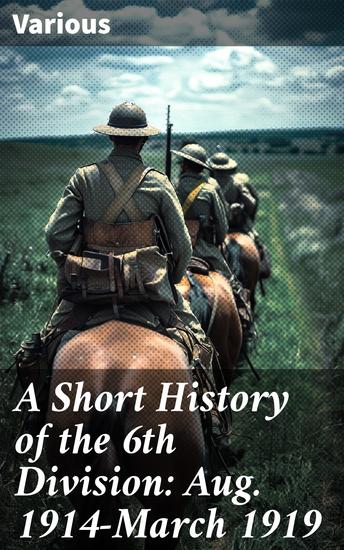
A Short History of the 6th Division: Aug 1914-March 1919 - The 6th Division in World War I: Strategies Tactics and Contributions - cover

A Short History of the 6th Division: Aug 1914-March 1919 - The 6th Division in World War I: Strategies Tactics and Contributions

Various Various

Publisher: Good Press

  • 0
  • 0
  • 0

Summary

A Short History of the 6th Division: Aug. 1914-March 1919 offers a comprehensive examination of the operational history and experiences of the 6th Division during World War I. Written in an analytical yet accessible style, this work unravels the complex military strategies, key battles, and the socio-political context that shaped the division's trajectory from its formation to demobilization. The narrative is enriched with firsthand accounts and primary documents, which not only illuminate the experiences of soldiers but also situate these events within the broader tapestry of the war, making it an invaluable resource for both military historians and general readers interested in World War I's multifaceted impact. The authorship is a collaborative effort by historians and military enthusiasts who contribute diverse perspectives rooted in diligent research and passionate engagement with the subject matter. Their collective expertise sheds light on lesser-known aspects of the 6th Division'Äôs operations, while also acknowledging the broader implications of the division's actions throughout the war, reflecting the authors' commitment to providing a nuanced understanding of this crucial military unit. For readers seeking a deeper knowledge of World War I and its key narratives, A Short History of the 6th Division serves as an essential addition to the historical discourse. It provides an engaging reading experience that balances scholarly rigor with narrative flair, making it suitable for academics, students, and history buffs alike.
Available since: 08/22/2023.
Print length: 96 pages.

Other books that might interest you

  • Complete Works of Swami Vivekananda - cover

    Complete Works of Swami Vivekananda

    Swami Vivekananda

    • 0
    • 0
    • 0
    What if true strength came from knowing who you really are?
    
    The Complete Works of Swami Vivekananda brings together the full legacy of one of the most influential spiritual teachers of modern times. A disciple of Sri Ramakrishna and a global ambassador of Vedanta, Vivekananda inspired millions with his message of fearlessness, self-belief, and universal harmony.
    
    This comprehensive collection includes Vivekananda's lectures, writings, letters, and discourses delivered across India and the West. His teachings bridge spirituality and practical life—addressing self-discipline, service, education, religion, meditation, and the unity of all beings.
    
    Clear, powerful, and deeply motivating, his words continue to guide readers seeking inner strength, purpose, and spiritual clarity in a changing world.
    
    Inside this eBook, you'll explore:
    
    All major lectures, essays, and writings of Swami Vivekananda
    
    Core teachings on Vedanta, yoga, and spiritual freedom
    
    Practical guidance for character building and self-confidence
    
    A cornerstone of modern spiritual and philosophical literature
    
    Read worldwide and studied for generations, Swami Vivekananda's works remain as relevant today as ever.
    
    Awaken the strength within. Buy now and experience the complete works of Swami Vivekananda.
    Show book
  • World War II in 1945 - The History of the Battles Fought During the War’s Final Year - cover

    World War II in 1945 - The...

    Editors Charles River

    • 0
    • 0
    • 0
    After resisting the German attack during the Battle of the Bulge, the Allied armies began advancing, and with that, the race to Berlin was truly on. While much has been written of the Battle of the Bulge, Okinawa, Midway, Stalingrad, and many other conflicts of the Second World War, the Battle for Berlin has remained in the shadows for many historians. Its importance in toppling Hitler cannot be denied, despite the fact that some thought its strategic value unnecessary to the war itself. The capture of the city and the red Soviet banner hanging victorious over the Reichstag is one of history’s most famous (an ominous) images. In the weeks it took for the Battle of Berlin to be fought, an American president passed away, a British Prime Minister had to make concessions he did not desire, a Russian leader fought his way into Western Europe to stay, and a German one took his own life. The battle’s implications would be felt for the next 50 years. 
    The Battle of Iwo Jima, code name “Operation Detachment,” is more of a misnomer than anything. It was fought as part of a large American invasion directed by steps toward the Japanese mainland, and it was more like a siege that lasted 36 days from February-March 1945, with non-stop fighting every minute. In fact, the iconic flag-raising photo was taken just four days into the battle, and as that picture suggests, the battle was not a pristine tactical event but an unceasing horror with no haven for protection.  
    Okinawa witnessed every conceivable horror of war both on land and at sea. American ground forces on Okinawa had to deal with bad weather (including a typhoon), anti-tank moats, barbed wire, mines, caves, underground tunnel networks, and fanatical Japanese soldiers who were willing to use human shields while fighting to the death. Allied naval forces supporting the amphibious invasion had to contend with Japan’s notorious kamikazes, suicide pilots who terrorized sailors.
    Show book
  • The Synesthesia Experience - Tasting Words Seeing Music and Hearing Color - cover

    The Synesthesia Experience -...

    Maureen Seaberg

    • 0
    • 0
    • 0
    “Explores a dimension of synesthesia long encountered in reports of synesthetes: its relation to mystical and artistic vision . . . fascinating accounts.” —Patricia Lynne Duffy, author of Blue Cats and Chartreuse Kittens   “The Synesthesia Experience will open up for you a whole new world in our universe.” —The Amazing Kreskin   What does blue taste like to you? A violinist sees a scarlet form when he plays a certain note; a rock star sees waves of blue and green as he composes a ballad; an actress tastes cake when she utters the word “table.” Described by some as a superpower, this mingling of the senses is called synesthesia, and the people who possess this amazing gift are called synesthetes.   What happens when a journalist turns her lens on a mystery happening in her own life? Maureen Seaberg did just that and spent a year exploring her synesthesia. What she learned is that synesthesia is not an idle “brain tick” but a unique ability to tap into and reveal a greater creative universe and even the divine.   Join her as she visits top neuroscientists, rock stars, violinists, other synesthetes, philosophers, savants, quantum physicists, and even Tibetan lamas on her journey toward the truth. Famous synesthetes and experts interviewed in the book include Billy Joel, Itzhak Perlman, Pharrell Williams, Dr. Dean Radin, Dr. Amit Goswami, and Dylan Lauren.
    Show book
  • The Witch of Delray - Rose Veres & Detroit’s Infamous 1930s Murder Mystery - cover

    The Witch of Delray - Rose Veres...

    Karen Dybis

    • 0
    • 0
    • 0
    An immigrant woman and her son are accused of murder and witchcraft in this powerful true crime story of corruption in 1930s Detroit. 


    In 1931, the tensions of the Great Depression took hold of Detroit at every level—even spilling over into the investigation of a mysterious murder at the Delray boardinghouse. Amid accusations of witchcraft, Hungarian immigrant Rose Veres and her son Bill were convicted of the brutal killing and suspected in a dozen more. Their cries of innocence went unheeded—until one lawyer, determined to seek justice, took on the case. 


    Following the twists and turns of this shocking story, The Witch of Delray explores the tumultuous 1930s in a city notorious for corruption and reveals the truth of Detroit's own Hex Woman.
    Show book
  • Think And Grow Rich - cover

    Think And Grow Rich

    Napoleon Hill

    • 0
    • 0
    • 0
    Unlock the secrets to success and abundance with "Think And Grow Rich" by Napoleon Hill, now available as an empowering audiobook. In this timeless classic, listeners will discover the principles and strategies that have helped countless individuals achieve their dreams and attain financial prosperity. 
    As the narrative unfolds, listeners will be guided through Hill's proven formula for success, drawn from interviews with over 500 of the most successful people of his time, including Andrew Carnegie, Thomas Edison, and Henry Ford. Through Hill's insightful analysis and practical advice, "Think And Grow Rich" offers a roadmap to mastering the mindset and habits necessary to manifest wealth and achievement. 
    Perfect for listeners aspiring to reach their full potential and create a life of abundance, this audiobook delivers a compelling performance that will inspire and motivate you to take action towards your goals. Whether you're looking to improve your finances, advance your career, or pursue your passions, "Think And Grow Rich" provides the tools and guidance you need to turn your dreams into reality. 
    So, if you're ready to unleash your potential and create the life you desire, start listening to "Think And Grow Rich" today and embark on a transformative journey towards success and fulfillment. Start Listening to "Think And Grow Rich" today!
    Show book
  • The Religious Instruction of the Negroes in the United States - cover

    The Religious Instruction of the...

    Charles Jones

    • 0
    • 0
    • 0
    This work is an extended exhortation urging white ministers and slaveowners to attend to the spiritual needs of slaves and free blacks. The book is broken into four parts. The first part is an historical sketch of slavery in the Colonies and the United States, with a focus on missionary and religious efforts directed towards the African slaves. This account goes from 1620 to 1842. Jones closes this first part with a summary of each denomination and each state. The second part treats the "Moral and Religious Condition" of slaves and free blacks, blaming their circumstances for their lack of virtue. Jones especially calls attention to their poverty and lack of education. He describes their ignorance of Christianity, their general lack of character, and their prevailing vices, noting that in the end, they are totally dependent on white men for the ability to overcome these limitations. In light of this description, Jones goes on in the third part to describe the obligations of the Christian church to rectify these problems. He asserts that the religious education of the African part of the population is a duty no Christian can ignore. In addition, he lists several benefits of religious instruction. The final part of the book proposes some strategies for implementing programs of religious instruction for slaves, making recommendations for Sabbath services as well as weekday plantation meetings. Jones says that the Christian gospel must be presented in a way that is intelligible to uneducated slaves, and must be inculcated early in childhood when possible. The guiding principle he describes for dealing with the condition of the slave is to be only concerned with the spiritual, not the secular, political, or civil. Jones concludes with pointed exhortations to masters, ministers, and the church at large, calling them all to devote more attention to the religious instruction of the African part of the American population.
    Show book