Join us on a literary world trip!
Add this book to bookshelf
Grey
Write a new comment Default profile 50px
Grey
Subscribe to read the full book or read the first pages for free!
All characters reduced
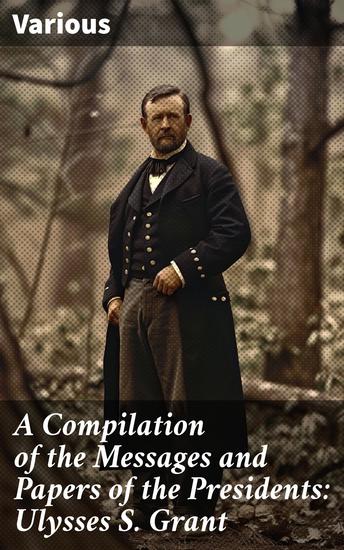
A Compilation of the Messages and Papers of the Presidents: Ulysses S Grant - Insights into Grant's Presidency: Presidential Messages and Historical Documents - cover

A Compilation of the Messages and Papers of the Presidents: Ulysses S Grant - Insights into Grant's Presidency: Presidential Messages and Historical Documents

Various Various

Publisher: Good Press

  • 0
  • 0
  • 0

Summary

A Compilation of the Messages and Papers of the Presidents: Ulysses S. Grant meticulously curates the significant writings and proclamations of the 18th President of the United States, Ulysses S. Grant. The text is structured to provide a comprehensive overview of Grant's administration from 1869 to 1877, presenting a blend of formal speeches, state papers, and correspondence that reflect the literary gravitas of the period. This compilation not only sheds light on the political climate following the Civil War but also frames Grant'Äôs vision for a unified nation grappling with profound socio-economic changes. Its scholarly rigor and chronological arrangement allow for an insightful exploration of the complexities of presidential governance during a pivotal time in American history. Ulysses S. Grant, renowned for his pivotal role as a Union general during the Civil War, transitioned from military leadership to political office, embodying the tumultuous spirit of Reconstruction. His background as a soldier and statesman profoundly influenced his approach to governance, focusing on civil rights for freedmen and enforcement of law in a fractured nation. However, his presidency also faced significant challenges, including corruption scandals and economic hardship, making his written communications all the more important for understanding his legacy. This compilation is an essential resource for historians, students, and general readers alike, offering a profound insight into the mind of one of America's most complex leaders. Those interested in political history and presidential studies will find this work invaluable, as it not only illuminates Grant's presidency but also serves as a mirror to the evolving American identity in the post-Civil War era.
Available since: 08/12/2023.
Print length: 536 pages.

Other books that might interest you

  • The Great School Rethink - cover

    The Great School Rethink

    Frederick M. Hess

    • 0
    • 0
    • 0
    In The Great School Rethink, education policy sentinel Frederick M. Hess offers a pithy and perceptive appraisal of American schooling and finds, in the uncertain period following pandemic disruption, an ideal moment to reimagine US education. Now is the time, he asserts, to ask hard questions about how schools use time and talent, how they work with parents, what they do with digital tools, and how they meet the needs of their communities. 


    As Hess explains, to rethink is to acknowledge the realities of the education system while opening one's mind to possibility. With characteristic verve and wit, Hess guides listeners through his rethink process, a versatile and easily implemented approach to identifying issues and brainstorming possible responses. He encourages listeners to explore what improvements might alleviate current pressures and frustrations, such as teacher shortages and burnout, declining student performance, and compromised learning time. Whether their goal is to achieve better student engagement, increase parent involvement, or implement personalized learning, listeners will develop the mindset to ask the right questions, to fully understand the problem that's being solved, and to evaluate the probable effectiveness of proposed solutions.
    Show book
  • America's Silent Crimes - What Justice Doesn't Speak Of - cover

    America's Silent Crimes - What...

    Darius Robinson

    • 0
    • 0
    • 0
    Explore the Shadows of the American Justice System 
     
    "America's Silent Crimes: What Justice Doesn't Speak Of" delves deep into the unspoken transgressions woven into America's legal fabric. This gripping exploration uncovers systemic failures and silent miscarriages of justice, exposing untold stories hidden behind the facade of legal fairness. 
     
    The book meticulously researches the Foundation of Silence, revealing selective enforcement and societal blindness in the justice system's evolution. Heart-wrenching accounts of Victims without a Voice, battling socioeconomic disenfranchisement, emerge from the shadows. The Illusion of Fair Trial is unveiled, exposing rushed decisions and a skewed path to justice. The preference for Punishment over Rehabilitation perpetuates incarceration cycles, hindering successful reintegration. 
     
    Controversies surrounding the War on Drugs are reexamined, exposing intertwined roots of policy and prejudice leading to mandatory minimums and the mistreatment of addiction. Policing the Unseen scrutinizes law enforcement dynamics shifting from protection to aggression. The Specter of Mental Health reveals the consequences of criminalizing mental illness and the harsh reality of solitary confinement. 
     
    Explore critical issues in chapters on Juvenile Justice and the gendered nuances in The Gendered Gavel. White Collar Silence and The Digital Shadow delve into seldom-discussed realms, addressing cybercrime and the privacy paradox. The book concludes by envisioning a reformed system, where Breaking the Silence demands action and accountability. 
     
    "America's Silent Crimes" is a vital read for those confronting uncomfortable truths in the justice system, offering a path towards genuine reform.
    Show book
  • Fifth Crusade The: The History of the Christian Campaign to Retake Jerusalem - cover

    Fifth Crusade The: The History...

    Charles River Editors

    • 0
    • 0
    • 0
    In the 50 years following the First Crusade, the Latin states in the East were consolidated, but there were also growing tensions and new challenges. Against this backdrop, the fall of the County of Edessa in December 1144 at the hands of Zengi, the atabeg of Aleppo and Mosul, was a catastrophic event. Founded in 1098 by the future King Baldwin of Boulogne, Edessa was the first Crusader state, as well as the northernmost, weakest, and least populated. It was constantly exposed to Muslim attacks, and news of its fall reached Europe at the beginning of 1145, and the fall was the catalyst for the Second Crusade. Furthermore, the Crusader States were also concerned about their relationship with the Byzantine Empire, as relations with the Byzantines were often tense. Indeed, efforts to strengthen and then retake parts of the collapsing Crusader States would fuel subsequent Crusades, and the Fourth Crusade notoriously ended with the Crusaders sacking Constantinople instead of proceeding to Jerusalem.  
    	Naturally, the Fifth Crusade was launched as a result of the Fourth Crusade’s failure to retake Jerusalem, and Pope Innocent III’s goal of reclaiming Jerusalem, which had been lost in 1187, remained unchanged.[1] At the same time, there was a truce between the Kingdom of Jerusalem and the Ayyubid Sultan al-‘Adil I, which was due to expire in 1217. The timing seemed favorable for a new initiative, particularly given the strengthening of Christendom in other regions such as Spain, where the victory at Las Navas de Tolosa in 1212 had secured much of the Iberian Peninsula against the Moors. The turning point for the proclamation of the Fifth Crusade was the Fourth Lateran Council in 1215, where Innocent III established a model for future Crusades, providing the enterprise with consistent legal, liturgical, and fiscal provisions.
    Show book
  • Rethinking Fandom - How to Beat the Sports-Industrial Complex at Its Own Game - cover

    Rethinking Fandom - How to Beat...

    Craig Calcaterra

    • 0
    • 0
    • 0
    “Modern fandom is rubbish, and Calcaterra explains why, but in so doing, also shows us the way out of our desensitized, corporate, laundry-hugging ways.” —Keith Law, The Athletic   Sports fandom isn’t what it used to be. Owners and executives increasingly count on the blind loyalty of their fans and too often act against the team’s best interest. Sports fans are left deliberating not only mismanagement, but also political, health, and ethical issues.   In Rethinking Fandom, sportswriter (and lifelong sports fan) Craig Calcaterra outlines endemic problems with what he calls the Sports-Industrial Complex, such as intentionally tanking a season to get a high draft pick, scamming local governments to build cushy new stadiums, actively subverting the players, bad stadium deals, racism, concussions, and more. But he doesn’t give up on professional sports. In the second half of the book, he proposes strategies to reclaim joy in fandom: rooting for players instead of teams, being a fair-weather fan, becoming an activist, and other clever solutions.   With his characteristic wit and piercing commentary, Calcaterra argues that fans have more power than they realize to change how their teams behave.  “If you’re like me and love sports but have become increasingly dismayed by the ‘sports-industrial complex,’ Calcaterra’s book will prove a balm that allows you to hold onto that fandom without turning a blind eye to the myriad problems and sources of exploitation on the field.” —John Warner, The Chicago Tribune  “Rather than simply criticizing, Calcaterra provides positive solutions to help us form a healthier and more thoughtful relationship with the sports we love. A vital book for any sports fan in the 21st century.” —Mike Duncan, New York Times–bestselling author
    Show book
  • Darkest Christmas - December 1942 and a World at War - cover

    Darkest Christmas - December...

    Peter Harmsen

    • 0
    • 0
    • 0
    December 1942 saw the bloodiest Christmas in the history of mankind. Men were killing each other in greater numbers than ever before. The Holocaust continued, and innocent civilians were murdered by the thousands throughout the evil Nazi empire, even as the perpetrators celebrated the birth of Christ. 


    Millions stationed in far-off lands amid the greatest conflict in human history feared this was their last Christmas in freedom, or their last Christmas alive. At the same time as the slaughter continued unabated, throughout the world there were random acts of kindness. These gestures also straddled religious barriers and sometimes included those of non-Christian faiths. 


    At the same time, Christmas 1942 saw the injunction of "good will to man" distorted in ugly and callous ways. In Berlin, Propaganda Minister Joseph Goebbels spent time with his family while still buried in feverish fantasies about the Jewish world conspiracy. 


    Christmas 1942 saw the entire range of man's conduct towards his fellow man, reflecting the extremes of behavior, good and bad, that World War II gave rise to. The way the holiday was marked around the world tells a deeper, more universal story of the human condition.
    Show book
  • World War III: Humanity Sacrificed - The Hidden Architecture of Global Collapse - cover

    World War III: Humanity...

    Murat Aibassov

    • 0
    • 0
    • 0
    World War III: Humanity Sacrificed is a chilling yet deeply analytical exploration of how the modern world collapsed into global conflict — and why it was inevitable. Written by Murat Aibassov, an engineer who predicted the war more than a decade before it began, the book exposes the hidden architecture of global systems, the cyclic nature of civilizational collapse, and the elite mechanisms that shape history behind the scenes. 
    Blending geopolitics, economics, technology, and ritual dynamics, Aibassov reveals why global crises unfold with mathematical precision — and what humanity must understand to survive what comes next. 
    This is not a book of fear. 
    This is a book of patterns, truth, and the last chance to prepare for the world after the catastrophe.
    Show book