Join us on a literary world trip!
Add this book to bookshelf
Grey
Write a new comment Default profile 50px
Grey
Subscribe to read the full book or read the first pages for free!
All characters reduced
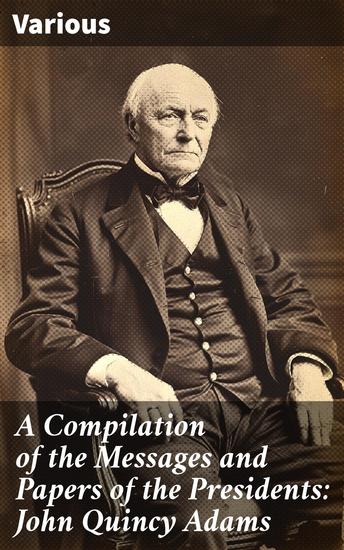
A Compilation of the Messages and Papers of the Presidents: John Quincy Adams - Insights into a Visionary Leader's Presidency and Legacy - cover

A Compilation of the Messages and Papers of the Presidents: John Quincy Adams - Insights into a Visionary Leader's Presidency and Legacy

Various Various

Publisher: Good Press

  • 0
  • 0
  • 0

Summary

In "A Compilation of the Messages and Papers of the Presidents: John Quincy Adams," readers are presented with a meticulously curated collection of primary documents that illuminate the intricate political landscape of the early 19th century. This compilation encompasses Adams'Äô significant speeches, letters, and official documents that reflect his staunch advocacy for civil liberties, education, and foreign affairs. Literary in style yet rich in historical context, the work offers deep insights into Adams' philosophies and the evolving American identity during a tumultuous period marked by burgeoning nationalism and ideological conflict. John Quincy Adams, the sixth President of the United States, was not only a politician but also a diplomat, a Senator, and a fervent abolitionist. Growing up immersed in the revolutionary fervor of his father, John Adams, he was shaped by a legacy of public service and intellectual rigor. His diverse experiences, including his tenure as Minister to the Netherlands and Russia, informed his complex views on governance and human rights, making this compilation essential for understanding both his presidency and the era. This collection is highly recommended for students of American history and politics, as well as general readers seeking to grasp the foundational ideas that shaped the nation. It invites exploration into the mind of one of America'Äôs most dedicated public servants, illuminating the challenges and triumphs that marked the presidency of John Quincy Adams.
Available since: 08/12/2023.
Print length: 174 pages.

Other books that might interest you

  • How to Interpret the Constitution - cover

    How to Interpret the Constitution

    Cass R. Sunstein

    • 0
    • 0
    • 0
    From New York Times bestselling author Cass Sunstein, a timely and powerful argument for rethinking how the U.S. Constitution is interpreted 
     
    The U.S. Supreme Court has eliminated the right to abortion and is revisiting other fundamental questions today—about voting rights, affirmative action, gun laws, and much more. Once-arcane theories of constitutional interpretation are profoundly affecting the lives of all Americans.  
    In this brief and urgent book, Harvard Law School professor Cass Sunstein provides a lively introduction to competing approaches to interpreting the Constitution—and argues that the only way to choose one is to ask whether it would change American life for the better or worse. If a  
    method of interpretation would eliminate the right of privacy, allow racial segregation, or obliterate free speech, it would be unacceptable for that reason. 
     
    But some Supreme Court justices are committed to “originalism,” arguing that the meaning of the Constitution is settled by how it was publicly understood when it was ratified.  
     
    Originalists insist that their approach is dictated by the Constitution. That, Sunstein argues, is a big mistake. The Constitution doesn’t contain instructions for its own interpretation.  
     
    Any approach to constitutional interpretation needs to be defended in terms of its broad effects—what it does to our rights and our institutions. It must respect those rights and institutions—and safeguard the conditions for democracy itself. 
     
    Passionate and compelling, How to Interpret the Constitution is essential reading for anyone who is concerned about how the Supreme Court is changing the rights and lives of Americans today.
    Show book
  • A Poet in the House: Patrick Kavanagh at Priory Grove - cover

    A Poet in the House: Patrick...

    Elizabeth O'Toole

    • 0
    • 0
    • 0
    Patrick Kavanagh (1904–67) was one of Ireland's foremost poets, best known for 'The Great Hunger' and novel Tarry Flynn. He is also remembered for his cantankerous, sometimes volatile nature, fuelled by alcohol.
    
    
    In A Poet in the House: Patrick Kavanagh at Priory Grove, a memoir by Elizabeth O'Toole, we encounter a new Patrick Kavanagh. In 1961, the poet lived with the O'Toole family in Stillorgan for six months at a crucial point in his life, when he was sober, industrious and, as the accompanying photographs will show, much loved by her children. Until now, no one has been aware of how close Kavanagh was to O'Toole and to her husband, James Davitt Bermingham O'Toole. Born and raised in China, Jim O'Toole was the author of Man Alive, a play about the inner workings of the ESB that created a storm of controversy in 1961. On the first night, Kavanagh told the audience that the press was 'lily-livered'.
    
    
    This was not just 'a local row'. One of the ESB's top executives, Jim O'Donovan, was the IRA leader who negotiated a deal with the Nazis that threatened the existence of the State in 1940. Kavanagh's relationship with O'Donovan and Jim O'Toole's escape from Germany at the outbreak of the war are here revealed for the first time.
    
    Amongst many other revelations in the book is a hitherto unknown connection between the poet and Patricia Avis, novelist wife of the poet Richard Murphy, and lover of Philip Larkin and Desmond Williams.
    
    
    Although Elizabeth O'Toole is now ninety-six, her decidedly down-to-earth voice is that of a much younger woman. Her vivid recollections deepen and challenge the way we view Patrick Kavanagh. The influence of her book will tilt our perception of this passionate man.
    
    
    A contextual essay by the editor of the volume, playwright and novelist Brian Lynch, accompanies the memoir along with photographs from the early sixties.
    Show book
  • Cognitive Behavioral Therapy - Basic and advanced CBT techniques to manage anxiety depression and panic attacks - cover

    Cognitive Behavioral Therapy -...

    David Lawson PhD

    • 0
    • 0
    • 0
    Do intrusive thoughts stifle your days? 
    Are you overwhelmed and paralysed by constant doubts? 
    Are anxiety and depression preventing you from living the life you want? 
      
    Anger, fear, sadness and shame are notoriously difficult emotions to manage, because nature has forged their purpose purely to protect us. Sometimes trauma can interfere with your ability to regulate your emotions, amplifying them and generating devastating effects for you and others. 
    It is very difficult to ignore these emotions. Sometimes they get in the way, impede your progress and make an intimate relationship or career advancement impossible. Although we can't control many of the things that happen to us, we can certainly control how we react to those things. 
      
    From this book you will learn:How CBT works.How mental patterns are established and vicious circles are blocked.What emotional levers are, and how to react to them.To eliminate anxiety, depression and panic attacks.How to set goals and begin to use CBT.Basic and advanced techniques of CBT.How to challenge (and beat) negative and automatic thoughts.How to prevent relapses. 
      
    CBT has incredible benefits, and perhaps the most encouraging aspect is that you do not need to spend anything on drugs and therapists, both of which can be an impediment to your progress. 
      
    This book will most likely not be the ‘complete cure’ for all your problems. HOWEVER, I GUARANTEE that if you read and re-read every single chapter carefully, ABSORB all the advice and APPLY the techniques provided by this manual, you will immediately experience a feeling of relief, and you will see significant improvements and progress in every aspect of your life.
    Show book
  • Mary Sheridan's From Birth to Five Years - Children's Developmental Progress 5th Edition - cover

    Mary Sheridan's From Birth to...

    Lucy Sanctuary, Ajay Sharma,...

    • 0
    • 0
    • 0
    This new edition of a classic is the go-to reference for anyone concerned with the developmental progress of pre-school children. It provides the knowledge required for understanding children's developmental progress with age and within each developmental domain. 


    Including new sections on atypical development for each of the core domains of development and additional material on the development of attention and self-regulation, this fifth edition integrates findings from the latest research throughout. 


    Fully aligned with current child development philosophies and practices, Mary Sheridan's From Birth to Five Years: Children's Developmental Progress is designed to support the wider group of practitioners—including those from health professions, social work, and early years—that are now required to take steps for promoting children's development as part of their assessment and management plans.
    Show book
  • Voices of All-Time Baseball Greats - cover

    Voices of All-Time Baseball Greats

    Multiple Authors

    • 0
    • 0
    • 0
    Hear the voices of all-time baseball greats, including Babe Ruth, Lou Gehrig, Carl Hubbell, Johnny Vander Meer, and broadcaster Mel Allen. Also, includes the radio call of Brooklyn Dodgers' Cookie Lavagetto's 1947 World Series game-winning double against the New York Yankees, Babe Ruth's final goodbye at Yankee Stadium, and the New York Giants' Bobby Thomson's three-run walk off 'Shot Heard Run The World' home run off Brooklyn's Ralph Branca to win the 1951 National League pennant.
    Show book
  • Why Do We Want to Dominate Or Be Subservient to Another? - Ojai 1949 - Public Talk 11 - cover

    Why Do We Want to Dominate Or Be...

    Jiddu Krishnamurti

    • 0
    • 0
    • 0
    "Why do we want to dominate or be subservient to another? - 20 August 1949  
    • Why is it that we dominate, consciously or unconsciously? 
    • To submit oneself to another is the negative form of domination. We shall not 
    be able to solve this problem by thinking in terms of opposites. 
    • Is not domination a process of isolation, which denies relationship? 
    • Can there be relationship between two people if there is any sense of 
    domination or submissiveness? 
    • Q: Is not the experience of the past a help towards freedom and right action in 
    the present? 
    • Q: Is my believing in survival after death a hindrance to liberation through self- 
    knowledge? 
    • Q: Why is it certain individuals identify themselves with you or with your state 
    of being and thereby gain authority for themselves?"
    Show book