Join us on a literary world trip!
Add this book to bookshelf
Grey
Write a new comment Default profile 50px
Grey
Subscribe to read the full book or read the first pages for free!
All characters reduced
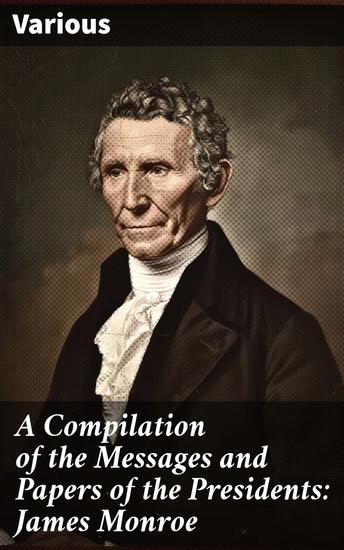
A Compilation of the Messages and Papers of the Presidents: James Monroe - Insights into Presidential Governance: A Historical Compilation - cover

A Compilation of the Messages and Papers of the Presidents: James Monroe - Insights into Presidential Governance: A Historical Compilation

Various Various

Publisher: Good Press

  • 0
  • 0
  • 0

Summary

A Compilation of the Messages and Papers of the Presidents: James Monroe offers a thorough examination of the pivotal era of American history during Monroe's presidency (1817-1825). The text is meticulously curated, combining primary sources such as speeches, letters, and executive documents that reveal Monroe's vision for the nation. Written in a formal yet accessible style, the collection illuminates his key policies, including the Monroe Doctrine, and showcases his diplomatic maneuvers that shaped the U.S. as an emerging power on the global stage. This compilation serves as an invaluable resource for scholars and historians, contextualizing Monroe's contributions amidst the broader narrative of post-colonial America. The author of this compilation, various scholars, have drawn on a wealth of historical records and academic insights to produce a comprehensive portrait of Monroe as both a statesman and a visionary. Their collaborative effort reflects the intricate tapestry of 19th-century American politics, demonstrating how Monroe's presidency set critical precedents that would influence future administrations. The project underscores a commitment to preserving and interpreting the legacy of American leadership during a formative period in the nation'Äôs history. This compilation is highly recommended for anyone seeking to deepen their understanding of early American governance and the pivotal role of James Monroe. It is an essential resource for students, educators, and history enthusiasts alike, providing clear insights into the formative policies and ideals that forged the path of the United States.
Available since: 08/15/2023.
Print length: 383 pages.

Other books that might interest you

  • The History of Brazil - A Comprehensive Overview of Brazilian History - cover

    The History of Brazil - A...

    Days of History

    • 0
    • 0
    • 0
    Step into the enchanting world of Brazil's history, where passion and adventure abound, and the echoes of a bygone era still linger. Our latest book takes you on a journey through the rich and diverse history of Brazil, from its earliest origins to the present day. Through its engaging narrative and evocative imagery, readers will be transported to a world of samba, carnival, and colorful culture. 
    This book includes: 
    • A vivid and colorful portrayal of Brazil's history and culture: With its richly drawn characters, immersive settings, and engaging storytelling, this book captures the essence of Brazil and its people. 
    • A comprehensive overview of Brazil's political, social, and cultural evolution: From the early Portuguese colonies to the modern era of globalization, this book offers a detailed and nuanced account of the events that shaped Brazil's unique identity. 
    • A celebration of the richness and diversity of Brazil's people and culture: With its vibrant art, music, and literature, Brazil has long been a source of inspiration for people around the world. Through this book, readers will gain a deeper appreciation for the beauty and complexity of Brazil's cultural heritage. 
    Don't miss out on this enchanting journey through Brazil's history and culture. Order your copy today and prepare to be transported to a world of passion and adventure.
    Show book
  • European Empires - Understanding the Waves of Colonial Ambition and Exploitation (4 in 1) - cover

    European Empires - Understanding...

    Kelly Mass

    • 0
    • 0
    • 0
    This book consists of 4 books, which are the following: 
    1 - British Empire - The British Empire was an extensive network of dominions, colonies, protectorates, mandates, and territories ruled or administered by the United Kingdom and its predecessor governments. This sprawling empire evolved from England's early ventures into overseas territories and trading ports, beginning in the late 16th century and continuing through the early 18th century. The empire grew to become the largest in recorded history, dominating global affairs for more than a century. 
    2 - Carolingian Empire - The Carolingian Empire, which existed from 800 to 888, was a dominant force in western and central Europe during the early Middle Ages. Founded by the Carolingian dynasty, this empire emerged from the Frankish kingdom, which had been ruled by this lineage since 751 and included control over the Lombards in Italy starting in 774.  
    3 - Portuguese Empire - The Portuguese Empire comprised a vast network of colonies, factories, and overseas territories established by Portugal. Beginning with the capture of Ceuta in North Africa in 1415 and continuing until the handover of sovereignty over Macau to China in 1999, it stands as one of the longest-lasting empires in European history.  
    4 -  Spanish Empire - The marriage of Ferdinand of Aragon and Isabella of Castile in the late 15th century laid the foundation for what would become the Spanish Empire. Their union created a personal alliance between the two powerful kingdoms, forming the basis for modern Spain. This confederation of the Crowns of Castile and Aragon brought together Iberia's economic and military strength under the House of Trastámara, although the two crowns remained legally distinct.
    Show book
  • The Poverty of Philosophy - cover

    The Poverty of Philosophy

    Karl Marx

    • 0
    • 0
    • 0
    Marx started work on this book in January 1847, as can be judged from Engel's letter to Marx on January 15, 1847. By the beginning of April 1847, Marx's work was completed in the main and had gone to the press. On June 15, 1847, he wrote a short foreword. 
     
    Published in Paris and Brussels in 1847, the book was not republished in full during Marx's lifetime. Excerpts from section five of Chapter Two appeared in different years, mostly between 1872 - 1875 in papers such as La Emancipacion, Der Volksstaat, Social-Demokrat, and others. In 1880 Marx attempted to publish the Poverty of Philosophy in the French socialist newspaper L'Égalité, the organ of the French Workers' Party, but only the foreword and section one of Chapter One were published. 
     
    This translation is from the original 1847 French edition. It has been updated to also include the changes/corrections Marx made in the copy of the book he presented to N. Utina in 1876, as well as the corrections made by Frederick Engels in the second French edition and the German editions of 1885 and 1892. The first English edition of this work was published in 1900 by Twentieth Century Press. 
    Show book
  • Britons: A Captivating Guide to the Ancient People Living in Britain Before the Anglo-Saxon Invasions - cover

    Britons: A Captivating Guide to...

    Captivating History

    • 0
    • 0
    • 0
    Step into the lost world of ancient Britain, where fierce warriors painted themselves blue and wise Druids practiced mysterious magic. 
    This audiobook uncovers the untold story of the Britons—an ancient people often overshadowed by Roman invaders and Anglo-Saxon conquerors. Yet, their legacy, filled with culture, strength, and resilience, is the true foundation of modern Britain. 
    Explore the hidden secrets of their hill forts, learn about their battles against the powerful Roman Empire, and see how they survived in a harsh and ever-changing world. From the daily lives of the tribes to the mystical rituals of the Druids, this audiobook brings the Britons' world to life in a way that’s easy to understand and hard to forget. 
    What you'll find inside:The Britons' unique way of living and how their tribes sometimes clashed and sometimes came togetherThe spiritual world of the Druids and the myths that shaped their beliefsClever battle strategies, including their famous chariot warfareDaily life, from the colorful crafts they made to the traditions they cherishedThe lasting impact of the Roman conquest and how it changed their worldSurprising archaeological findings that show the Britons' skills in art and building.The lasting influence of the Britons on modern British culture and languageInspiring stories of leaders who fought against all odds to protect their peopleAnd much more 
    Don't let this important chapter of history stay hidden. Discover the remarkable world of the Britons and see how their legacy still touches our lives today. 
    Click "Add to Cart" now to uncover the mysteries of ancient Britain!
    Show book
  • The Unabomber Manifesto and Other Essays by Theodore Kaczynski - cover

    The Unabomber Manifesto and...

    Theodore J. Kaczynski

    • 0
    • 0
    • 0
    Theodore Kaczynski, also known as the Unabomber, is a United States murderer, mathematician, and neo-Luddite social critic who carried out a campaign of mail bombings. He was born in Chicago, Illinois, where, as an intellectual child prodigy, he excelled academically from an early age. 
    A considerable amount of credible circumstantial evidence suggests that Kaczynski was the unwitting victim of top secret CIA-sponsored 'MK-ULTRA' mind-control experiments conducted at Harvard University from the fall of 1959 through the spring of 1962. Some experts suggest that these experiments may have been the cause of his emotional problems. 
    Kaczynski eventually received an undergraduate degree from Harvard University and earned a PhD in mathematics from the University of Michigan. He became an assistant professor at the University of California, Berkeley at age 25 but resigned two years later. 
    In 1971, he moved to a remote cabin without electricity or running water, in Lincoln, Montana, where he began to learn survival skills in an attempt to become self-sufficient. 
    He decided to start his bombing campaign after watching the wilderness around his home get destroyed by development. 
    From 1978 to 1995, Kaczynski sent 16 bombs to targets including universities and airlines, killing three people and injuring 23. Kaczynski sent a letter to The New York Times on April 24, 1995 and promised "to desist from terrorism" if the Times or The Washington Post published his manifesto. In his Industrial Society and Its Future (also called the "Unabomber Manifesto"), he argued that his bombings were extreme but necessary to attract attention to the erosion of human freedom necessitated by modern technologies requiring large-scale organization. 
    included in this volume: 
    -Unnamed Essay 
    -When Non-Violence is Suicide 
    -Hit Where It Hurts 
    -Industrial Society and Its Future (aka The Unabomber Manifesto)
    Show book
  • Higher Admissions - The Rise and Fall of Standardized Testing - cover

    Higher Admissions - The Rise and...

    Nicholas Lemann

    • 0
    • 0
    • 0
    In the 1930s, American colleges and universities began to screen applications using the SAT, a mass-administered, IQ-descended standardized test. The widespread adoption of the test accompanied the development of the world's first mass higher education system—and served to promote the idea that the United States was becoming a "meritocracy." In Higher Admissions, Nicholas Lemann reflects on the state of America's aspirational meritocracy and the enduring value and meaning of standardized testing. 


    Lemann writes that the anticipation of the Supreme Court's 2023 decision banning affirmative action, plus the Covid pandemic, led hundreds of universities to stop requiring standardized admissions tests; now a handful of elite universities are reinstituting test requirements. The country is preoccupied with the admissions policies of the most selective universities, but Lemann redirects our attention to an alternate path that American higher education can still take—one that emphasizes a significant upgrade of the entire higher education system. Lemann argues that to improve the state of higher education overall, we should focus not on the narrow chokepoint of admission to highly selective colleges, but on efforts to create as much meaningful opportunity for flourishing in our vast higher education system for as many people as possible.
    Show book