Join us on a literary world trip!
Add this book to bookshelf
Grey
Write a new comment Default profile 50px
Grey
Subscribe to read the full book or read the first pages for free!
All characters reduced
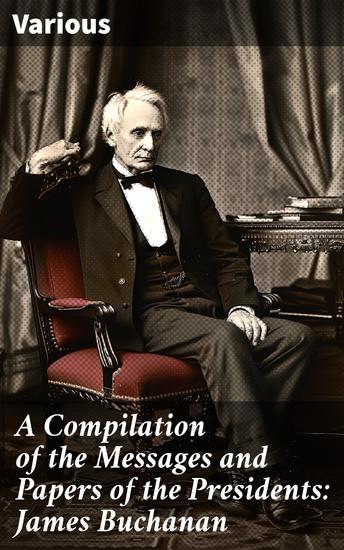
A Compilation of the Messages and Papers of the Presidents: James Buchanan - An In-Depth Look at President Buchanan's Presidency - cover

A Compilation of the Messages and Papers of the Presidents: James Buchanan - An In-Depth Look at President Buchanan's Presidency

Various Various

Publisher: Good Press

  • 0
  • 0
  • 0

Summary

A Compilation of the Messages and Papers of the Presidents: James Buchanan presents a comprehensive anthology of the political philosophy, policies, and significant events of Buchanan's presidency (1857-1861). Written in a formal, historical style, the collection emphasizes primary source documents that illuminate the challenges faced by Buchanan during a tumultuous pre-Civil War era. This compilation includes inaugural addresses, state of the union messages, and letters that provide valuable context about the nation'Äôs divisive issues, including slavery and states' rights. The literary style is characterized by its somber, reflective tone, accurately mirroring the weight of the decisions that would shape America'Äôs trajectory. James Buchanan, the 15th President of the United States, has often been critiqued for his perceived indecisiveness and ineffective leadership in the lead-up to the Civil War. His background as a lifelong politician, diplomat, and lawyer informs the breadth of his writings. Facing deepening national discord, Buchanan sought to maintain the Union while grappling with both internal strife and external pressures, elements that obviously energize his communications within this compilation. This book is recommended for historians, political science students, and anyone interested in the detailed study of American presidential history. Through Buchanan's own words, readers gain unique insights into the complexities of governance during one of America's most critical periods, making it an essential addition to any scholarly collection.
Available since: 08/12/2023.
Print length: 309 pages.

Other books that might interest you

  • Peak of the Devil: 100 Questions About Peak Oil Answered - cover

    Peak of the Devil: 100 Questions...

    Chip Haynes

    • 0
    • 0
    • 0
    What’s that peak oil thing you keep jabbering on about? 
    “Peak oil” is the phrase used to describe the point where the world’s oil supply, well, peaks. A fairly easy concept there. It’s the best we can do, and the best we will ever do, when it comes to pumping conventional crude oil out of the ground. After peak oil, it’s all downhill, production-wise. 
    Too many people think that peak oil means that the oil is going to run out, and that’s not quite right. The oil will not run out. Not ever. It will, over time, get increasingly rare and probably expensive (before it’s worthless), but there will always be at least a little bit of oil for us to use. Well, for someone to use. Probably not you and me, unless I sell a whole shipload of books. No pressure.
    Show book
  • Supporting Student Executive Functions - Insights and Strategies for Educators - cover

    Supporting Student Executive...

    Lisa Carey, Alexis Reid

    • 0
    • 0
    • 0
    In Supporting Student Executive Functions, two clinical and classroom experts deliver an insightful and accessible guide to executive functioning skills. Lisa Carey, Ed.D., and Alexis Reid, M.A., explain how these skills develop, how executive functioning challenges show up in the classroom, and how, if unaddressed, those challenges interfere with student learning. 
    Part I builds an understanding of the science of executive functioning and how it develops during the K–12 years. Part II offers a practical, example-rich approach to help educators develop and support students’ executive functions with tips, suggestions, and action steps.  
    Building on the research-backed Universal Design for Learning (UDL) Guidelines, the authors pay special attention to the Guideline “Provide options for Executive Functions” to show which types of supports are most meaningful at different stages of a student’s K–12 journey. 
    Educators—but also medical professionals, caregivers and parents, and students themselves—will gain a deeper understanding of the latest science on executive functioning as well as valuable, easy-to-implement strategies to use in the classroom today.
    Show book
  • AI: A Great Equalizer in life - How AI Levels the Playing Field - cover

    AI: A Great Equalizer in life -...

    jimmy d swearnegen

    • 0
    • 0
    • 0
    AI: A Great Equalizer in Life explores the transformative power of artificial intelligence through the inspiring story of Alex. From struggling in school to becoming a trailblazer in his community, Alex's journey is a testament to the power of determination, resilience, and the right tools. This book delves into how AI can level the playing field, opening doors to new opportunities and empowering individuals to achieve their full potential. It's not just about technology; it's about hope, empowerment, and the human spirit. Discover how AI can be a force for good, helping us build a brighter, more equitable future for all.
    Show book
  • Ming Dynasty - Exploration Great Walls and Forbidden Cities - cover

    Ming Dynasty - Exploration Great...

    Rolf Hedger

    • 0
    • 0
    • 0
    The Ming Dynasty emerged from the ashes of the Yuan Dynasty, a Mongol-led empire that had ruled China for nearly a century. By the late 14th century, the Yuan government had become weak and corrupt, plagued by heavy taxation, famines, and widespread unrest. The Chinese population, weary of foreign rule, began to rise in rebellion. Among the many insurgent leaders, one man would rise to power and change the course of Chinese history—Zhu Yuanzhang. 
    Born into a poor peasant family, Zhu Yuanzhang experienced hardship early in life. Orphaned as a child, he spent years in a Buddhist monastery before joining the Red Turban Rebellion, a movement dedicated to overthrowing the Yuan. His military prowess and strategic mind quickly elevated him through the ranks. As he consolidated power, he systematically eliminated rival factions, eventually establishing himself as the dominant leader of the rebellion. In 1368, Zhu marched his forces into Beijing, forcing the last Yuan emperor to flee northward. Declaring the end of Mongol rule, he proclaimed himself emperor and founded the Ming Dynasty, choosing the name "Ming," meaning "brilliant" or "bright," to symbolize a new era of Chinese rule. 
    As the first Ming emperor, Zhu Yuanzhang, now known as the Hongwu Emperor, sought to restore Chinese traditions and repair the damage caused by Mongol rule. He reestablished Confucian principles as the foundation of government, reinstating the civil service examination system to ensure that officials were selected based on merit rather than birthright. He also implemented strict laws to reduce corruption, often resorting to harsh punishments to maintain order. His administration worked to rebuild agriculture, improve irrigation systems, and distribute land to farmers, strengthening the economy and ensuring food security.
    Show book
  • School as a community - Researching leadership in Waldorf schools - cover

    School as a community -...

    Hans Passenier

    • 0
    • 0
    • 0
    In search of leadership in Waldorf schools.
    Leadership in Waldorf schools has a specific history. Whereas 40 years ago it was hardly allowed to formally exist because it represented power and hierarchy, now it is commonplace to have a headmaster, rector or director. In this book, Hans Passenier examines the development of leadership and organisation in Waldorf schools. He starts at the origins and finds principles that can help develop school organisations and their leadership in the future. In four parts, he unfolds the foundations, the tools to develop leadership and organisations and finally describes exercises to support that development as a school community.
    His thesis is that education is about children being diverse, having different abilities. Also that the educator should not be a carpenter, but a gardener. The image of the school as an organism is guiding, in which the school community is a place for the inner development of each individual in that school community.
    The horizontal and vertical dimensions guide the view of both leadership and organisational design.
    Show book
  • Memoirs of a Kamikaze - A World War II Pilot's Inspiring Story of Survival Honor and Reconciliation - cover

    Memoirs of a Kamikaze - A World...

    Kazuo Odachi, Shigeru Ohta,...

    • 0
    • 0
    • 0
    **Independent Publisher Book Award (IPPY) Winner**Now Available on Audio. An incredible, untold story of survival and acceptance that sheds light on one of the darkest chapters in Japanese history.This book tells the story of Kazuo Odachi who—in 1943, when he was just 16 years-old—joined the Imperial Japanese Navy to become a pilot. A year later, he was unknowingly assigned to the Kamikaze Special Attack Corps—a group of airmen whose mission was to sacrifice their lives by crashing planes into enemy ships. Their call sign was ""ten dead, zero alive.""As you listen to Memoirs of a Kamikaze, you will experience the hardships of fighter pilot training—dipping and diving and watching as other trainees crash into nearby mountainsides. you will witness the psychological trauma of coming to terms with death before each mission, and breathe a sigh of relief with Odachi when his last mission is cut short by Japan's eventual surrender. You will feel the anger at a government and society that swept so much of the sacrifice under the rug in its desperation to rebuild.Odachi's innate ""samurai spirit"" carried him through childhood, WWII and his eventual life as a kendo instructor, police officer and detective. His attention to detail, unwavering self-discipline and impenetrably strong mind were often the difference between life and death. Odachi, who is now well into his nineties, kept his Kamikaze past a secret for most of his life. Seven decades later, he agreed to sit for nearly seventy hours of interviews with the authors of this book—who know Odachi personally. He felt it was his responsibility to finally reveal the truth about the Kamikaze pilots: that they were unsuspecting teenagers and young men asked to do the bidding of superior officers who were never held to account.This book offers a new perspective on these infamous suicide pilots. It is not a chronicle of war, nor is it a collection of research papers compiled by scholars. It is a transcript of Odachi's words.
    Show book