Join us on a literary world trip!
Add this book to bookshelf
Grey
Write a new comment Default profile 50px
Grey
Subscribe to read the full book or read the first pages for free!
All characters reduced
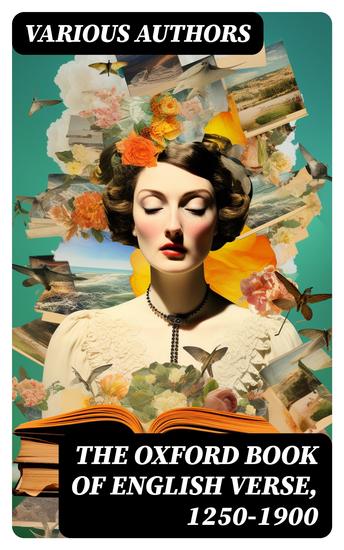
The Oxford Book of English Verse 1250-1900 - Enriched edition - cover

The Oxford Book of English Verse 1250-1900 - Enriched edition

Various Authors

Publisher: DigiCat

  • 0
  • 0
  • 0

Summary

The Oxford Book of English Verse, 1250-1900 is an anthology that meticulously compiles a rich tapestry of English poetry spanning over six centuries. Including works from celebrated poets such as Geoffrey Chaucer, John Milton, and Elizabeth Barrett Browning, this volume showcases a diverse range of themes, styles, and forms, reflecting the evolution of English literature. The selections highlight the interplay between historical context and artistic expression, emphasizing the transitions from medieval lyricism to the complexities of Victorian romanticism. The book's editorial precision ensures that each poem not only stands alone but also contributes to a broader understanding of the poetic continuum in English history. Edited by various literary scholars, this anthology gathers insights from multiple perspectives, illustrating the collaborative nature of literary scholarship. The diverse backgrounds of the authors involved in its curation enrich the compilation, allowing for a multifaceted interpretation of the selected verses. Their scholarly endeavors reflect a deep appreciation of the craftsmanship inherent in poetry and underscore the societal influences that shaped each poet's work. The Oxford Book of English Verse is an indispensable resource for students, teachers, and poetry aficionados alike. Its comprehensive scope provides a profound glimpse into the heart of English literary tradition, making it a compelling read for those eager to explore the intricacies of verse across time. Readers will find themselves not only captivated by the beauty of the poetry but also enlightened by its historical significance.

In this enriched edition, we have carefully created added value for your reading experience:
- An Introduction draws the threads together, discussing why these diverse authors and texts belong in one collection.
- Historical Context explores the cultural and intellectual currents that shaped these works, offering insight into the shared (or contrasting) eras that influenced each writer.
- A combined Synopsis (Selection) briefly outlines the key plots or arguments of the included pieces, helping readers grasp the anthology's overall scope without giving away essential twists.
- A collective Analysis highlights common themes, stylistic variations, and significant crossovers in tone and technique, tying together writers from different backgrounds.
- Reflection questions encourage readers to compare the different voices and perspectives within the collection, fostering a richer understanding of the overarching conversation.
Available since: 11/21/2023.
Print length: 547 pages.
Other books that might interest you

  • Charles Dickens' Poor Relations Story - cover

    Charles Dickens' Poor Relations...

    Carles Dickens

    • 0
    • 0
    • 0
    Charles Dickens The Poor Relations Story Was adapted for Audio and Produced by Alex FreemanIt features the voice talents of Ronnie Cosmos as John, Hollyn Gayle as Christiana, and all other roles were played by Alex Freeman.Music was by Axletree, tracks included Drops of Melting Snow, Cotswold Snow, The Sighful Branches, and The Curios Roe.
    Show book
  • Ten Bridges I've Burnt - A Memoir in Verse - cover

    Ten Bridges I've Burnt - A...

    Brontez Purnell

    • 0
    • 0
    • 0
    In Ten Bridges I've Burnt, Brontez Purnell—the bard of the underloved and overlooked—turns his gaze inward. A storyteller with a musical eye for the absurdity of his own existence, he is peerless in his ability to find the levity within the stormiest of crises. Here, in his first collection of genre-defying verse, Purnell reflects on his peripatetic life, whose ups and downs have nothing on the turmoil within. "The most high-risk homosexual behavior I engage in," Purnell writes, "is simply existing." 


    The thirty-eight autobiographical pieces pulsing in Ten Bridges I've Burnt find Purnell at his no-holds-barred best. He remembers a vicious brawl he participated in at a poetry conference and reckons with packaging his trauma for TV writers' rooms; wrestles with the curses, and gifts, passed down from generations of family members; and chronicles, with breathless verve, a list of hell-raising misadventures and sexcapades. Through it all, he muses on everything from love and loneliness to capitalism and Blackness to jogging and the ethics of art, always with unpredictable clarity and movement. 


    With the same balance of wit and wisdom that made 100 Boyfriends a sensation, Purnell unleashes another collection of boundary-pushing writing with Ten Bridges I've Burnt, a book as original and thrilling as the author himself.
    Show book
  • The Poetry of John Milton - Sparkling poems from the famed man behind Paradise Lost - cover

    The Poetry of John Milton -...

    John Milton

    • 0
    • 0
    • 0
    John Milton was born in Bread Street, London, on December 9th, 1608.  His early years were privately tutored before gaining a place at St Paul’s School and in 1625 he matriculated at Christ's College, Cambridge, earning a BA in 1629 and an MA in 1632. At Cambridge he had developed a reputation for poetic skill but also experienced alienation from his peers and university life as a whole.  
    The next 6 years were spent in private study. He read both ancient and modern works of theology, philosophy, history, politics, literature and science, in preparation for a poetical career.  Milton mastered Latin, Greek, Hebrew, French, Spanish, and Italian. To these he would add Old English (whilst researching his History of Britain) and also acquired more than a passing acquaintance in Dutch.  
    Although he was studying, some of his poetry from this time is remarkable; L’Allegro and Il Penseroso in 1631 and Lycidias in 1638. 
    In May 1638, Milton embarked upon a 15 month tour of France and Italy. These travels added a new and direct experience of artistic and religious traditions, especially Roman Catholicism.  He cut the journey short to return home during the summer of 1639 because of what he claimed were "sad tidings of civil war in England."  
    Once home, Milton wrote prose tracts against episcopacy, in the service of the Puritan and Parliamentary cause.  
    He married 16-year-old Mary Powell in June 1643 but she left him after only a few months during which he wrote and published several writings on divorce. Mary did return after 3 years and their life thereafter seemed harmonious.  Milton received a hostile response to the divorce tracts and drove him to write Areopagitica, his celebrated attack on pre-printing censorship.  
    With the parliamentary victory in the Civil War, Milton wrote The Tenure of Kings and Magistrates (1649) which defended popular government and implicitly sanctioned the regicide which led to his appointment as Secretary for Foreign Tongues by the Council of State.  
    On 24 February 1652 Milton published his Latin defense of the English People, Defensio Pro Populo Anglicano, also known as the First Defense. Milton's Latin prose and intellectual sweep, quickly gained him a European reputation.  
    Tragically his first wife, Mary, died on May 5th, 1652 following the birth of their fourth child.   The following year Milton had become totally blind, probably due to glaucoma.  He then had to dictate his verse and prose to helpers, one of whom was the poet Andrew Marvell. 
    He married again to Katherine Woodcock but she died in February 1658, less than four months after giving birth to a daughter, who also tragically died.  
    Though Cromwell’s death in 1658 caused the English Republic to collapse Milton stubbornly clung to his beliefs and in 1659 he published A Treatise of Civil Power, attacking the concept of a state-dominated church. Upon the Restoration in May 1660, Milton went into hiding for his life. An arrest warrant was issued and his writings burnt. He re-emerged after a general pardon was issued, but was nevertheless arrested and briefly imprisoned before influential friends, such as Marvell, now an MP, intervened 
    His third marriage was to Elizabeth Mynshull. Despite a 31-year age gap, the marriage seemed happy and Milton spent the remaining decade of his life living quietly in London, apart from a short spell in Chalfont St. Giles, during the Great Plague of London.  
    Milton was to now publish his greatest works, which had been gestating for many years.
    Show book
  • Word Petals - cover

    Word Petals

    Carla L Ibanzo

    • 0
    • 0
    • 0
    Disappointment, hope, struggle, love, failure and resilience are every day themes that occupy our thoughts and constitute our inner monologue.  In this book, the writer takes you on a journey of self-reflection. It invites each of us to pause and reflect on the beauty,  simplicity and complexity of life.  To reconnect with ourselves and nature.  And to rediscover ties and pure feelings with our families, friends, and the world around us... "The water gliding forming ripples on the lake. Above the cloud, blue skies,  pure air... You are you... time to get happy,  smile and laugh again. "...  And " silence, alone with my thoughts again, inviting and familiar, like communing with an old friend... "
    Show book
  • Poems Every Child Should Know - cover

    Poems Every Child Should Know

    Joseph Pearce

    • 0
    • 0
    • 0
    Poetry is meant for everyone. 
    For you. For your child. But where to start? 
    Poems Every Child Should Know is here to help. 
    Selected and accompanied by commentary from bestselling author and literature professor Joseph Pearce, this exciting collection of verse contains classic poems that every child should know to begin a poetic ascent towards God. Not only that, but these poems are chosen so as to help all "become as little children," and are ones everyone should know, regardless of age. These timeless treasures form a foundation upon which to build poetic knowledge and to see the world through the eyes of a poet, the way God intended it. 
    Culled from the rich history of English poetry, these gems of the English language’s inheritance are meant to enrich our children’s cultural treasure chest. Verse, like virtue, is often most beautiful when it is most simple. A good beginning makes a good end all the more likely, so immersing children in beautiful words—words which so powerfully and continually shape our world, our thoughts, our prayers—and teaching them to take a minute and stop to observe a beautiful sentence is of the utmost importance. Appreciating beauty in even the most ordinary of life’s moments is a lesson that will prepare their minds to receive Truth, Beauty, and Goodness Himself. 
    Throughout the book, readers will find “things to think about,” inviting them to engage more deeply with individual poems. These should be seen as an invitation to an adventure into unknown territory, an opportunity to go further up and further in. Be fearless, be adventurous, and enjoy this journey into the realm of the good, the true, and the beautiful of our English language.
    Show book
  • Remotely Annoying - cover

    Remotely Annoying

    Larry Enright

    • 0
    • 0
    • 0
    This 1 hour, 3 actor, 3 scene comedy is meant to be enjoyed with friends around the dinner table after a good meal and plenty of libations.  
    The premise: The two main characters, Albert and Larry, are 80 year-old twins who have been picking at each other all their lives. They share an apartment, have just purchased a new TV, and are having some difficulty getting it to work. Sounds simple, but things go downhill fast from there and eventually off the cliff when the landlord arrives. The play has a lot of quick back-and-forth dialog so it reads like a comedy routine. It can be performed sitting around the table if someone is reading the stage directions. Actual age of actors is not important. 
    Minimum props required: TV remote, cell phone, two pieces of paper with Awww! and Clap! written on them, two foldout brochures of any kind to function as TV Quick Start Guide and headphone guide. The rest can be mimed. 
    If your plan is to perform it onstage, go for it. You have my blessing as long as you credit the work. Posting a review with a pic of the production would be possibly hilarious, but definitely cool. 
    ​​​​​​​Reviews: The Lansdowne Times might call Remotely Annoying the funniest thing since sliced bread, but nobody thinks sliced bread is funny and there is no Lansdowne Times. However, this play has been fully tested and approved by 8 brave souls who, shall they rest in peace, died laughing. 
    Show book