Join us on a literary world trip!
Add this book to bookshelf
Grey
Write a new comment Default profile 50px
Grey
Subscribe to read the full book or read the first pages for free!
All characters reduced
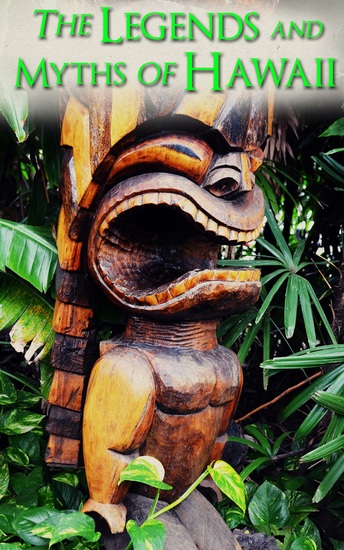
The Legends and Myths of Hawaii - Complete Legends of Maui of Old Honolulu Gods and Ghost-Gods Myths of Volcanoes and Historical Legends - cover

The Legends and Myths of Hawaii - Complete Legends of Maui of Old Honolulu Gods and Ghost-Gods Myths of Volcanoes and Historical Legends

Various Authors

Publisher: e-artnow

  • 0
  • 0
  • 0

Summary

Hawaiian Legends & Myths is a collection of books by William Drake Westervelt, one of Hawaii's foremost authorities on island folklore. It contains five books Westervelt wrote about Hawaiian legends, folklore and mythology.
"Legends of Maui" includes numerous myths of Māui, Polynesian demi god of Polynesia and Hina who is sometimes in myths his mother, and sometimes his wife. These myths and legends originate from various island groups around the Pacific and they are pesented in a clear and thorough manner.
"Legends of Old Honolulu" is collection of ancient Hawaiian folktales  which also includes some information about where the Hawaiians came from and the sacred places in Honolulu. As might be expected in stories originating on a small island, many of them feature the sea, boats, sea creatures or water.
"Legends of Gods and Ghost-Gods" focuses on Polynesian mythology, taking a close look at Hawaiian folktales, mythology, and the history of the polytheistic practices still in place to this day.
"Hawaiian Legends of Volcanoes" – The first part of this book focuses on the legends of Hawaii and its volcanoes. The second part considers the geology of the region and discusses the crack in the floor of the Pacific, Hawaiian volcanoes, volcanic activity and the changes in the Kilauea crater. It also looks at the foundation of the observatory.
"Hawaiian Historical Legends" take the reader through Hawaiian history from ancient times to becoming an American state. He adds that Hawaiian people are not overly concerned with dates but that these stories are all related one to another.
Available since: 08/17/2022.
Print length: 684 pages.


Other books that might interest you

  • A Rare Recording of TS Eliot Reading His Poem The Love Song of J Alfred Prufrock - cover

    A Rare Recording of TS Eliot...

    TS Eliot

    • 0
    • 0
    • 0
    Thomas Stearns Eliot (September 26, 1888 - January 4, 1965) was an American-British poet, essayist and playwright. He is considered to be one of the 20th century's greatest poets, as well as a central figure in English-language Modernist poetry. His use of language, writing style, and verse structure reinvigorated English poetry. He is also noted for his critical essays, which often re-evaluated long-held cultural beliefs.
    Show book
  • On Dreams - cover

    On Dreams

    Aristotle

    • 0
    • 0
    • 0
    In his treatise On Dreams, Aristotle offers a detailed analysis of the phenomenon of dreaming. He begins by outlining the different types of dreams that people experience, before going on to explore the causes and purposes of dreaming. Aristotle's account of dreaming is both nuanced and insightful, offering a rich understanding of this common human experience. His work remains relevant today, as it provides a valuable perspective on the nature of dreams and their significance in our lives. Read in English, unabridged.
    Show book
  • Productivity for Distracted Minds - Time Hacks for the Neurodivergent Brain - cover

    Productivity for Distracted...

    Dale Mclaughlin

    • 0
    • 0
    • 0
    This audiobook is narrated by an AI Voice.   
    Focus isn’t about forcing discipline — it’s about designing systems that fit how your brain actually works. 
    In Productivity for Distracted Minds, Dale McLaughlin shares practical time-management tools created for the ADHD, anxious, or easily overstimulated mind. 
    Learn how to build attention anchors, beat decision fatigue, and structure your day around natural energy waves instead of arbitrary schedules. With short, compassionate chapters, this audiobook helps you work smarter, finish what you start, and finally feel in control of your time — without pretending to be someone you’re not.
    Show book
  • Save Our Souls - The True Story of a Castaway Family Treachery and Murder - cover

    Save Our Souls - The True Story...

    Matthew Pearl

    • 0
    • 0
    • 0
    INTERNATIONAL BESTSELLER 
    From the bestselling author of The Taking of Jemima Boone, the unbelievable true story of a real-life Swiss Family Robinson (and their dog) who faced sharks, shipwreck, and betrayal. 
    On December 10, 1887, a shark fishing boat disappeared. On board the doomed vessel were the Walkers—the ship’s captain Frederick, his wife Elizabeth, their three teenage sons, and their dog—along with the ship’s crew. The family had spotted a promising fishing location when a terrible storm arose, splitting their vessel in two and leaving those onboard adrift on the perilous sea. 
    When the castaways awoke the next morning, they discovered they had been washed ashore—on an island inhabited by a large but ragged and emaciated man who introduced himself as Hans. Hans appeared to have been there for a while and could quickly educate the Walkers and their crew on the island’s resources. But Hans had a secret . . . and as the Walker family gradually came to learn more, what seemed like a stroke of luck to have the mysterious man’s assistance became something ominous, something darker. 
    Like David Grann and Stacy Schiff, Matthew Pearl unveils one of the most incredible yet little-known historical true stories, and the only known instance in history of an actual family of castaways. Save Our Souls asks us to consider who we might become if we found ourselves trapped on a deserted island.
    Show book
  • Modern Social Problems - Analyzing Contemporary Issues through a Sociological Lens - cover

    Modern Social Problems -...

    Fred Grandsen

    • 0
    • 0
    • 0
    Social problems are complex issues that affect individuals, communities, and societies on a broad scale. They arise when a significant number of people recognize a condition as harmful and in need of change. Social problems can range from economic inequality and racial discrimination to climate change and healthcare disparities. Understanding these issues from a sociological perspective allows for a deeper analysis of their causes, consequences, and potential solutions. 
    One of the key aspects of understanding social problems is recognizing that they are socially constructed. This means that what is considered a problem can vary across different societies, cultures, and historical periods. For example, while issues like poverty and crime are widely recognized as social problems, their definitions and solutions may differ depending on cultural norms, political ideologies, and economic conditions. Sociologists examine how these definitions change over time and how power dynamics influence which issues receive public attention and policy action. 
    Another crucial factor in understanding social problems is identifying their root causes. Many social problems are not isolated incidents but rather symptoms of deeper structural issues within society. Economic inequality, for instance, is often linked to factors such as wage disparities, lack of access to education, and systemic discrimination. Similarly, crime rates may be influenced by socioeconomic conditions, community resources, and the effectiveness of law enforcement policies. By looking beyond individual behaviors and examining broader social structures, sociologists aim to uncover the fundamental reasons why these problems persist.
    Show book
  • Healing Trauma With Emdr - cover

    Healing Trauma With Emdr

    Jim Colajuta

    • 0
    • 0
    • 0
    We all have a natural emotional healing process, just as we do a natural physical healing process within us. When we get a wound, our bodies' natural healing process takes care of it. When emotionally painful events occur in our lives, we usually manage to overcome them and move on with our lives. On the other hand, a cut does not always heal until it has been cleaned and an antibiotic has been applied. Similarly, when something emotionally upsetting occurs, the brain's processing system isn't always able to absorb it and put it into the context of our entire lives without assistance. Sometimes we are completely unaware of what is going on.Although the image of the incident may not come to us consciously, we may feel unworthy, sad, afraid, or nauseous. We may be unaware that we are being swamped with dysfunctionally stored material from the past. We may act in ways we later regret and not wholly comprehend why. The EMDR method recognizes that you aren't reacting on purpose; the triggered memories are at the root of your actions that aren't consistent with who you are now. EMDR can assist the brain's processing system repair emotional wounds in the same way that an antibiotic ointment can help cure a cut. It's still your own internal process conducting the healing; EMDR simply "jump starts" it when it's needed and speeds it up.Once the isolated "land mine" of trauma has been reprocessed using EMDR, it is neutralized, meaning it will no longer go off and flood into the present. It's woven into the fabric of your existence, so it appears to be over and cannot derail you from your current state of bliss.The information appears to be stimulated, and the brain can reprocess the situation due to eye movements or other bilateral stimulation. Eye movements are only a tiny part of EMDR. In processing traumatic memories, current concerns, or future fears, integrates imagery, beliefs, emotions, and physical sensations.
    Show book