Join us on a literary world trip!
Add this book to bookshelf
Grey
Write a new comment Default profile 50px
Grey
Subscribe to read the full book or read the first pages for free!
All characters reduced
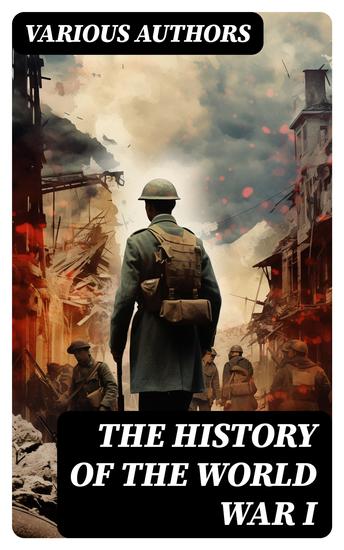
The History of the World War I - cover

The History of the World War I

Various Authors

Publisher: DigiCat

  • 0
  • 0
  • 0

Summary

The History of the World War I is a comprehensive anthology that intricately weaves together the perspectives of various authors to provide a multifaceted analysis of the Great War. This collaborative work delves into the political, social, and military intricacies that defined the era, employing a narrative style that balances meticulous research with vivid storytelling. The book contextualizes the conflict within the broader scope of early 20th-century geopolitics, exploring not only the battlefield strategies but also the cultural shifts that arose in its wake. With contributions from historians, soldiers, and civilians, it presents a rich tapestry of experiences and insights that reflect the enormity of the war's impact across continents. The authors, each bringing their unique backgrounds and expertise, reflect a diverse range of scholarly voices, reminiscent of the multi-layered narratives often found in historical literature. Drawing from personal accounts, military records, and governmental archives, these contributors aim to illuminate the complexities that inevitably shaped the course of history. By embracing different viewpoints, the anthology offers a deeper understanding of the human condition during one of the most tumultuous periods in modern history. This compelling collection is highly recommended for both history enthusiasts and casual readers alike, as it invites them to engage with the multidimensional ramifications of World War I. By traversing through varying narratives and analyses, readers will gain a profound appreciation for the sacrifices made and the lessons learned, making this anthology an essential addition to any library of historical literature.
Available since: 11/13/2023.
Print length: 877 pages.

Other books that might interest you

  • Why It's Normal to be a Mistress - cover

    Why It's Normal to be a Mistress

    A.A. Castor

    • 0
    • 0
    • 0
    In Why It's Normal to be a Mistress, A.A. Castor offers a provocative exploration of the hidden dimensions of extramarital relationships, challenging the notion that infidelity is simply a moral failing. Drawing on evolutionary biology, cultural history, and personal narratives, Castor reveals how the mistress role has long been shaped by societal pressures, unspoken desires, and the human quest for emotional fulfillment. 
    Far from glamorizing betrayal, this book delves into the complexity of female sexuality and the psychological forces that drive some women to seek connection beyond conventional boundaries. Castor examines how arranged marriages, patriarchal norms, and changing social attitudes have historically paved the way for mistresses to emerge as both subjects of scandal and symbols of empowerment. By tracing these legacies, Why It's Normal to be a Mistress provides a nuanced understanding of why certain women repeatedly choose this path, even when it carries profound emotional and relational consequences. 
    Through empathetic storytelling and rigorous research, Castor dismantles the simplistic judgments that often dominate discussions about infidelity. Instead, the focus is on fostering a deeper awareness of the biological, psychological, and cultural underpinnings that shape human intimacy. Readers are encouraged to reflect on their own beliefs about fidelity, desire, and self-expression, recognizing that genuine understanding does not equate to moral approval. Ultimately, this book offers a bold invitation to question long-held assumptions, expand our definitions of love and loyalty, and engage in a more honest, compassionate dialogue about the intricate tapestry of human relationships
    Show book
  • How Could I Believe in Santa Claus? - Philosophy in Everyday Life - cover

    How Could I Believe in Santa...

    Gilles Vervisch

    • 0
    • 0
    • 0
    How to be yourself at a party where you don’t know anyone?
    (Does the self exist?)
    Why does Grandma put a cap and a plaid sweater on her Yorkie?
    (Do animals have a reason?)
    How could I have stayed with such a stupid guy for so long?
    (Do we only desire things that we consider good?)
     
    When we hear “philosophy,” we sometimes think of incomprehensible or boring books. The very names of the authors are unpronounceable: Kierkegaard, Nietzsche, Heidegger. Living or dead, they often look like zombies. They are in their own world and use words that we do not always understand, like “idiosyncrasy,” “ontological,” or “transcendental.” In this book, we hope to remove these prejudices. Philosophy is not boring; it allows us to understand complex things in a simple way, and therefore it is never far from everyday life. It speaks to everyone. It is for everyone.
    Show book
  • A Rare Recording of US Naval Rear Admiral and Computer Pioneer Grace Hopper Volume 1 - cover

    A Rare Recording of US Naval...

    Grace Hopper

    • 0
    • 0
    • 0
    Grace Brewster Hopper (December 9, 1906 to January 1, 1992) was an American computer scientist, mathematician, and United States Navy rear admiral. A pioneer of computer programming, Hopper was the first to devise the theory of machine-independent programming languages and used this theory to develop the FLOW-MATIC programming language and COBOL, an early high-level programming language still in use today. She was also one of the first programmers on the Harvard Mark I computer. She is credited with writing the first computer manual, "A Manual of Operation for the Automatic Sequence Controlled Calculator." The following audio recording is from a 1982 presentation.
    Show book
  • The Apocalyptic Writings - Hidden Prophecies & End‐Times Visions on Heaven Hell and the Final Judgment - cover

    The Apocalyptic Writings -...

    Various Ancient Writers, Tim...

    • 0
    • 0
    • 0
    What if ancient visions revealed the truth about the end of days, the fate of souls, and the battle between good and evil? 
    The Apocalyptic Writings resurrects the most powerful and mysterious end-times scriptures from the apocryphal tradition.  
    These sacred texts—adapted in modern language—guide listeners through dreams of destruction, encounters with angels, journeys to hell, and divine prophecies once whispered in secrecy. 
    What you’ll discover inside: 
    •	2 Esdras (4 Ezra) – Cosmic Q&A between the prophet and the Most High 
    •	3 Esdras – Lost insights bridging biblical history and renewal 
    •	2 Baruch & 3 Baruch – Epic visions of world collapse, judgment, and the hidden structure of heaven 
    •	Apocalypse of Abraham – The patriarch’s divine ascent and the fall of Satan 
    •	Apocalypse of Peter – Early Christian visions of punishment and paradise 
    •	Ascension of Isaiah – Christ’s journey through seven heavens and Satan’s fall 
    •	Sibylline Oracles & Vision of Ezra – Prophetic messages from oracles and apocalyptic poets 
    A must-listen for anyone drawn to spiritual mysteries, cosmic justice, or the apocalyptic imagination. 
    Begin your journey today into the fire, glory, and mystery of The Apocalyptic Writings.
    Show book
  • The Communication Guru 3-in-1 Collection - Supercharge Your Communication Skills for Personal and Professional Success - cover

    The Communication Guru 3-in-1...

    William Howard

    • 0
    • 0
    • 0
    Struggling to communicate effectively? Do you feel misunderstood or ignored when you speak? Ready to transform your communication skills for personal and professional success? The Communication Guru Collection is here to help. 
    This collection of three must-read books guides you through mastering effective communication, small talk, and empathic listening. Each book offers practical techniques that you can immediately apply to everyday conversations, leading to more meaningful connections, effective conflict resolution, and greater influence. 
    In How to Talk Effectively (Book 1), you'll learn:How to stop interrupting othersFiltering your thoughts before speakingThe difference between debate, dialogue, discourse, and diatribeTraits of a confident communicatorOvercoming speech obstacles and fearsRecovering conversations that have gone downhill 
    In How to Master Small Talk (Book 2), you'll discover:Ways to introduce yourself without awkwardnessEasy methods for starting conversationsReliable ice-breakers for networking and personal chatsKeeping conversations alive effortlesslyWays to captivate listenersThe proper role of emotion in personal connections 
    In The Empathic Listener (Book 3), you'll explore:The difference between active and passive listeningTuning into nonverbal cuesOvercoming barriers to active listeningCultivating a "listening mindset"Recognizing and thwarting biases and assumptionsTechniques for navigating difficult conversations
    Show book
  • Stanford Prison Experiment The: The History of the Notorious Psychological Experiment on Guards’ Treatment of Prisoners - cover

    Stanford Prison Experiment The:...

    Editors Charles River

    • 0
    • 0
    • 0
    What happens when you put good people in a bad place? 
    That was the question that an experiment in 1971 set out to answer when Stanford University professor and psychologist Philip Zimbardo used funding provided by the U.S. Office of Naval Research to create a make-believe prison in the basement of a university building. Male students were offered the chance to take part in the two-week experiment (and to make $15 per day). All applicants were carefully screened to ensure that they were healthy, emotionally and psychologically stable. 24 men were selected out of 75 that had applied. These men were then randomly assigned to play the role of either prisoners or guards in the “prison.” 
    Initially, nobody was particularly concerned: after all, these were stable, intelligent young men who understood that they would be playing a role for just two weeks. Some people even considered that the experiment was pointless because everyone involved knew that they were simply acting roles for a limited time, so they couldn’t be expected to behave in the ways that real prisoners and guards did. 
    Nonetheless, the experiment began on August 15th, 1971, and just six days later, on August 20th, it was abruptly and unexpectedly terminated after the “guards” had become brutal and sadistic and the “prisoners” had become withdrawn, fearful, and apathetic. There were real concerns that someone might end up being seriously hurt or suffer long-term psychological damage. 
    How could a group of nice, healthy, intelligent young men suddenly transform into sadistic thugs? How could another equally intelligent group of young men suddenly become apathetic victims of this brutality? What did this say about the malleability of human behavior, even when everyone involved knew that this wasn’t real?
    Show book