Join us on a literary world trip!
Add this book to bookshelf
Grey
Write a new comment Default profile 50px
Grey
Subscribe to read the full book or read the first pages for free!
All characters reduced
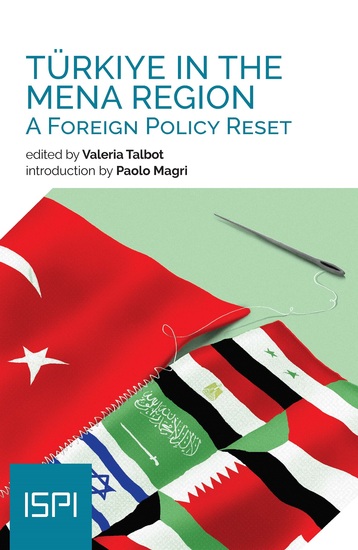
Turkiye in the MENA Region - A Foreign Policy Reset - cover

Turkiye in the MENA Region - A Foreign Policy Reset

Valeria Talbot

Publisher: Ledizioni

  • 0
  • 0
  • 0

Summary

In recent years, Türkiye's foreign policy has been driven by efforts to reset relations with regional competitors in the
Middle East and North Africa (MENA) region. Against a backdrop of disruption caused by the Covid-19 pandemic and the Russian invasion of Ukraine, as well as the redefinition of the US role in the region, Ankara's renewed diplomatic activism has been guided by the willingness to break from regional isolation, as well as the need to relieve Türkiye's deteriorating economy. How did Türkiye ditch its ideological approach in the wake of the 2011 Arab uprisings to adopt a more pragmatic stance? And how is the process of rapprochement with other key actors in the MENA region playing out – namely Gulf monarchies, Israel and Egypt?
Available since: 09/27/2023.
Print length: 139 pages.
Other books that might interest you

  • John Stuart Mill - A Very Short Introduction - cover

    John Stuart Mill - A Very Short...

    Gregory Claeys

    • 0
    • 0
    • 0
    John Stuart Mill (1806-73) is widely regarded as the leading liberal philosopher, economist, and political theorist of nineteenth century Britain. In his lifetime he was best known for his System of Logic (1843) and the Principles of Political Economy (1848). Today Mill is chiefly identified with On Liberty (1859), perhaps the definitive text of modern liberal statement of its subject, and probably the single most important work of modern political thought. Mill was also the first major male feminist thinker of the period (author of The Subjection of Women, 1869), and the first, as an MP, to introduce a bill for female enfranchisement before Parliament. 


    This Very Short Introduction offers a brief survey of the life and key ideas of this most influential Victorian British writer. Moving chronologically, Gregory Claeys outlines the philosophical background out of which Mill developed, chiefly through the ideas of Jeremy Bentham and James Mill. He demonstrates how Mill's personal life, especially his 'mental crisis' of 1827, and his relationship with Harriet Taylor, were integral to his intellectual development. Throughout Claeys considers Mill's key works set within the context of his lesser writings and correspondence, and discusses the more controversial aspects of his thought concerning religion, secularism, and birth control.
    Show book
  • Age of Deception - Cybersecurity as Secret Statecraft (Cornell Studies in Security Affairs) - cover

    Age of Deception - Cybersecurity...

    Jon R. Lindsay

    • 0
    • 0
    • 0
    At the heart of cybersecurity is a paradox: Cooperation enables conflict. In Age of Deception, Jon R. Lindsay shows how widespread trust in cyberspace enables espionage and subversion.  
    The dark arts have long been part of global politics, but digital systems expand their scope and scale. Yet success in secret statecraft depends on political context, not just sophisticated technology. Lindsay provides a general theory of intelligence performance—the analogue to military performance in battle—to explain why spies and hackers alike depend on clandestine organizations and vulnerable institutions. 
    Through cases spanning codebreaking at Bletchley Park during WWII to the weaponization of pagers by Israel in 2024, Lindsay reveals continuity and change in secret statecraft. Along the way he explains why popular assumptions about cyber warfare are profoundly misleading. Offense does not simply dominate defense, for example, because the same digital complexity that expands opportunities for deception also creates potential for self-deception and counter-deception. Provocative and persuasive, Age of Deception offers crucial insights into the future of secret statecraft in cyberspace and beyond.
    Show book
  • Think It Over - How to Use Critical Thinking to Avoid Falsity and Failure - cover

    Think It Over - How to Use...

    Oliver L. North, David L. Goetsch

    • 0
    • 0
    • 0
    In the past, one of the most cherished American values was the truth. When people dealt with dilemmas, issues, opinions, and decisions, their first question was “What is the truth in this situation?” Now people are concerned only with what they think, feel, and want.  
    We have lost touch with the importance of truth in our lives. This reality has resulted in a society in abject turmoil and confusion.  
     
    Perhaps the greatest failure of the American school system is in turning out generations without the ability to carefully think through what they see, read, and hear. This book is the path for our return to truth.
    Show book
  • The Magic and Mayhem of Donald Trump - cover

    The Magic and Mayhem of Donald...

    Gretchen Wollert

    • 0
    • 0
    • 0
    In today’s deeply divisive political environment, the constant media storm pits Democrats against Republicans and liberals against conservatives, and drives narratives that describe Donald Trump as the worst president in American history who should be incarcerated forever for high crimes against society. But another segment of America believes Trump is the savior of the nation and worthy of sainthood. 
    What is the truth? Is there an acceptable reality somewhere within these two extremes? Can we know what actually guides Trump’s larger than life political persona? What really makes him tick? Is he worthy of the support of an American people desperately seeking the best for a nation in turmoil? 
    The Magic and Mayhem of Donald Trump lays out with uncommon clarity the reality of the Trump enigma. Known for his supreme self-confidence, inexhaustible ambition, braggadocio, arrogance, vanity, and knack for thriving amid conflict, Trump, who fights opponents with a fierce intensity that is often cruel and harsh, also possesses a firm but realistic sense of right and wrong influenced by a simple faith and bears a serious connection to everyday common people that springs from his past. 
    You will confidently discover, amidst the magic and the mayhem, the real man behind the myth. And in the process, you just might acquire a renewed or even novel appreciation for this American original.
    Show book
  • The End of America? - A Guide to the New World Disorder - cover

    The End of America? - A Guide to...

    Allan Friedman

    • 0
    • 1
    • 0
    America was the shining city on a hill. It was the country at the forefront of the world democratic order, the global policeman, the might of its military matched only by the depth of its financial reserves. America was the one the world listened to, whether it wanted to or not. So, what happened?
    Well, a lot of things. In this searing account, Alan Friedman shows how, from the disastrous Vietnam War to Barack Obama's bungled response to the Arab Spring, American intervention has ceased to be the decisive action it once was. And now, with the rise of China and Russia, coupled with America's prostration of itself following the election of Donald Trump, the decline of its authority is only hastening.
    We move now, Friedman argues, into the New World Disorder. In this dangerous and unstable world, the Washington-enforced liberal order is receding, and a new set of alliances and anxieties are in ascendence. What is America's place in this? Which powers are going to emerge as the leaders? Will the European Union count at all? One thing is for sure: the effects of the New World Disorder will challenge our Western values to breaking point.
    Show book
  • Radical Antiquity - Free Love Zoroastrians Farming Pirates and Ancient Uprisings - cover

    Radical Antiquity - Free Love...

    Christopher B. Zeichmann

    • 0
    • 0
    • 0
    When you think of Ancient Greece and Rome, what do you see? The Acropolis and the Colosseum? Perhaps the philosophy of Plato and Aristotle and the rule of the Caesars? Or the birth of democracy and the vast reach of an empire? This well-trodden history of great thinkers, military leaders, and early state formation in the classical world still enthralls us, but it tells only half the story . . . 
     
    How democratic was Athenian democracy? How much power did states wield beyond their city walls? And who looked upon the systems of domination that prevailed and sought to create something different? 
    Radical Antiquity takes you on a unique journey in search of anarchy, statelessness, and social experimentation in the Graeco-Roman world. Sweeping across the Mediterranean from the time of the first Olympic Games in 776 BCE until the emergence of Islam in 610 CE, Christopher B. Zeichmann introduces the listener to communities of escaped enslaved people, pirates, and religious sects—all of whom sought a more egalitarian way of life that avoided the coercion, hierarchy, and exploitation of the state. This history from below brings the experiences of ordinary and marginal people out of obscurity and radically expands our understanding of social and political life in the classical world.
    Show book