Begleiten Sie uns auf eine literarische Weltreise!
Buch zum Bücherregal hinzufügen
Grey
Einen neuen Kommentar schreiben Default profile 50px
Grey
Jetzt das ganze Buch im Abo oder die ersten Seiten gratis lesen!
All characters reduced
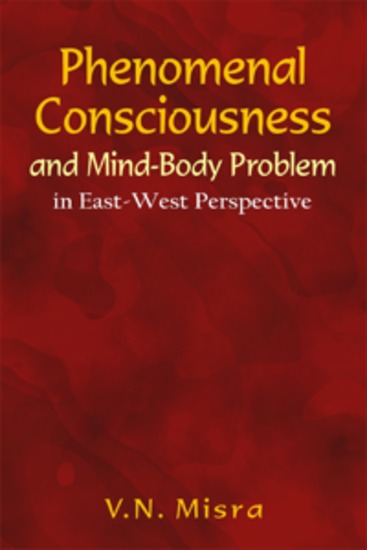
Phenomenal Consciousness and Mind–Body Problem - in East–West Perspective - cover

Phenomenal Consciousness and Mind–Body Problem - in East–West Perspective

V. N. Misra

Verlag: D.K. Printworld

  • 0
  • 0
  • 0

Beschreibung

The problem of explanatory gap in the phenomenal consciousness has risen in the Western philosophy mainly because the consciousness itself and its manifestations or reflections are treated separately. Whereas, according to the Vedānta school of India, the phenomenal consciousness is merely manifestations of self-consciousness which is embodied in the human beings. In this approach, the phenomenal consciousness and self-consciousness are one and the same thing because the former depends upon the latter. Hence, there is no explanatory gap in the phenomenal consciousness. Similar is the case with the mind–body problem which exists in the Western philosophy mainly because the mind is treated as synonymous with  consciousness.This book solves the above problems on the basis of the Indian philosophy and existential philosophy of Jean-Paul Sartre. In both the philosophies, there is no explanatory gap in the phenomenal consciousness and the mind–body problem.
Verfügbar seit: 19.03.2025.
Drucklänge: 215 Seiten.

Weitere Bücher, die Sie mögen werden

  • 3 Dirty Gay Men Paranormal Erotic Stories - Vampires Werewolves Gangbang Babysitter and Cowboy - cover

    3 Dirty Gay Men Paranormal...

    Bobby Large, Jim Right

    • 0
    • 0
    • 0
    Delve deep into 3 filthy gay men paranormal fantasies. 
    Titles included are: 
    The Babysitter’s Vampire Night: 
    Setting up a babysitter service is a way for Harvey to make some money, but a call coming in when no one is available leaves him with little choice but to take the job himself. The house he arrives at is no different from the others on a quiet street, but he enters to find out there’s no child. The occupant then reveals his real reason for making the call. A vampire with a babysitter fetish seems insane, but Harvey gives in to a torrid encounter with Mr. Doyle to find out just how sexy a vampire can be. 
    Wild Werewolf on the Prairie: 
    A successful delivery of steers end with Cody making his way back across the open prairie alone. A late start setting out necessitates overnight camping and the howls he hears turn out not to be buffalo wolves. What comes out of the darkness is a legend, but the werewolf doesn’t want to take a life. Its interest is in something much more primal and Cody finds himself having a full moon encounter with an aroused beast. 
    Back Alley Vampire Gangbang: 
    Walking home after a heavy night out is Wesley’s first mistake. Taking a shortcut is his second. He’s not complaining at first when he bumps into Conrad, but a kiss with a handsome guy in a back alley turns crazy when two more men come out of the darkness. There’s no escape when the three men reveal what they really are, but giving in completely brings on as much pleasure as pain when vampire bites turn him on in a way he never expected.
    Zum Buch
  • Thinking about Thinking - cover

    Thinking about Thinking

    Darin Jewell

    • 0
    • 0
    • 0
    "Thinking About Thinking" is a based on a series of lectures delivered at Harvard University in 1996 by Professors Alan Dershowitz (lawyer), Robert Nozick (philosopher) and Stephen Jay Gould (paleontologist) about perennial issues such as truth, free will, race, gender and religion.
    Zum Buch
  • The Life of the Romans - cover

    The Life of the Romans

    KidsChoice

    • 0
    • 0
    • 0
    KidsChoice: World knowledge for Children is an engaging audiobook series that takes young listeners on a fascinating journey to explore and understand the world around them. Aimed at curious children aged 7 to 99, this series dives into a variety of topics in science, society, and culture, making complex ideas accessible and exciting.  Each episode brings a unique theme to life—whether exploring the mysteries of space, uncovering the secrets of the human body, or discovering the diversity of cultures and traditions worldwide. With lively narration, interesting facts, and interactive elements, the series guides young listeners on an adventure full of discovery, encouraging them to ask questions and expand their understanding in a fun way.  In the scientific world of KidsChoice, children learn about the wonders of nature and the universe. Concepts like the solar system, animal behavior, the human body, and Earth's various ecosystems are explained in a way that is easy for kids to grasp and find fascinating. Exciting analogies and vivid examples help spark curiosity, turning learning into an adventure.  Societal topics also have a special place in the series. KidsChoice introduces young listeners to the basics of community, compassion, and making a positive impact. Children learn what it means to be a good citizen and how they can make small, meaningful contributions to their communities.  Additionally, KidsChoice opens a window to the vibrant world of global cultures. Through a virtual journey around the globe, children discover how people in other countries live, the customs and traditions they follow, the languages they speak, and the foods they enjoy. This fosters understanding and respect for diverse ways of life, celebrating the richness of human experience as a beautiful, valuable part of the world.  With its vivid language and captivating soundscapes, "KidsChoice: World knowledge for Children" turns learning into an exciting experience, sparking a lifelong curiosity and a deeper understanding of the world around them.
    Zum Buch
  • Sons and Others - On Loving Male Survivors - cover

    Sons and Others - On Loving Male...

    Tanaka Mhishi

    • 0
    • 0
    • 0
    In the UK, around one in six men will experience some form of sexual violence. Many of these men who experience sexual abuse are dismissed, only brought up as the butt of a joke, an exception to the rule or, perhaps at worst, are used as a rhetorical tool against female victims.
    Conversations on sexual violence have understandably focused on women's voices and experiences, with data indicating that women are still the majority of victims and not enough is being done to prevent this violence. As most perpetrators of this violence against women are men, it becomes almost easy to mistake that male survivors stories are exceptions or irrelevances. The fact is that we share a world and our experiences are closely interwoven.
    Sons and Others challenges misconceptions and misrepresentations of sexual violence against men across media and society and offers a new way of seeing and understanding these men in our lives, asking how the violence they experience affects us all.
    Zum Buch
  • Before Augustus - The Collapse of the Roman Republic - cover

    Before Augustus - The Collapse...

    Natale Barca

    • 0
    • 0
    • 0
    "...the author does an admirable job of showing just how complicated and interconnected all the great patrician families were and how their jealousies and rivalries ultimately led to their undoing and the end of the great Roman Republic." — New York Journal of BooksThe political process that culminated in the transition from Republic to Empire in ancient Rome began with the military reform of Caius Marius in the last decades of the 2nd century BC. Following the Civil War and Sulla’s dictatorship, it developed further with the First Triumvirate of Caesar, Pompey, and Crassus, and two further civil wars. These wars, which saw Caesar pitted against Pompey, and Octavian fighting Anthony, ended in 27 BC with the rise to power of Octavian, the adoptive son of Caesar.  Before Augustus outlines a summary of the last years of the Roman Republic, weaving together the military, political, and social aspects. Scholar Natale Barca sets the protagonists within the complex societal and political system that they operated, analyzing their actions, and the epic battles that ensued.
    Zum Buch
  • Ancient Egyptian Astronomy and Astrology: The History of Celestial Observations in Egypt - cover

    Ancient Egyptian Astronomy and...

    Charles River Editors

    • 0
    • 0
    • 0
    Among the most intriguing aspects of ancient Egyptian culture is the relationship between their observations of the heavens and their beliefs about life, death, and cosmic order. While modern Egyptologists debate whether the Egyptians practiced astrology in the sense familiar to people today, it is universally acknowledged that they maintained a profound “Star Religion” from very early times. The term “Star Religion” encompasses a reverence for celestial phenomena, especially the stars, and their integration into religious ritual, calendar systems, and mythology. However, whether this system extended to linking human birth and life with celestial positions remains contentious. 
    	Some independent researchers, such as John Anthony West, an American Egyptologist and writer, argue that the Egyptians did indeed incorporate astrology as part of their sacred science. West contends that astronomical observations were closely connected to the timing of human life and the divine order, implying that celestial patterns influenced both earthly events and the lives of individuals. Traditional Egyptologists, however, caution against projecting later astrological practices backward into the prehistoric or early dynastic periods of Egypt, emphasizing that surviving textual evidence primarily reflects religious and ritualistic use of celestial phenomena rather than predictive or personal astrology. 
    Regardless of how they’re analyzed, from the earliest periods of their civilization, the Egyptians observed the night sky with remarkable attention to detail. Astronomical phenomena were integrated into their ritual calendar, architecture, and mythological narratives, and the brightest star visible from Earth, Sirius (known in ancient Egypt as Spdt), is mentioned as early as 2300 BCE in the Pyramid Texts, although it was undoubtedly observed much earlier.
    Zum Buch