Join us on a literary world trip!
Add this book to bookshelf
Grey
Write a new comment Default profile 50px
Grey
Subscribe to read the full book or read the first pages for free!
All characters reduced
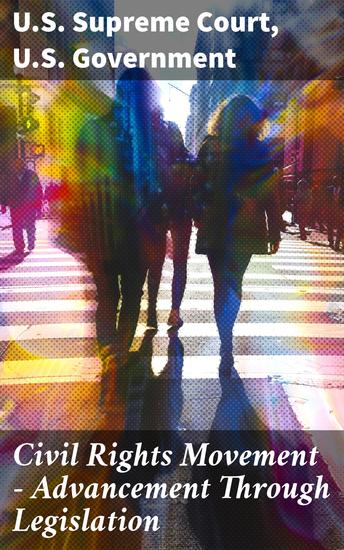
Civil Rights Movement - Advancement Through Legislation - A Comprehensive Law Collection: Civil Rights Law and Supreme Court Decisions Involving Race Cases - cover

Civil Rights Movement - Advancement Through Legislation - A Comprehensive Law Collection: Civil Rights Law and Supreme Court Decisions Involving Race Cases

U.S. Government, U.S. Supreme Court

Publisher: Good Press

  • 0
  • 0
  • 0

Summary

Civil Rights Movement - Advancement Through Legislation is an anthology that captures the pivotal role of legislative measures in shaping the landscape of civil rights in the United States. The collection presents a diverse array of legal texts and landmark decisions that illustrate the dynamic interplay between activism and lawmaking during a transformative period in American history. From groundbreaking Supreme Court rulings to influential bills passed by Congress, the anthology underscores the power of legal frameworks in advancing equality and justice. Each piece is meticulously selected to demonstrate the impact of legal progress and the cultural shifts that prompted and ensued from these advancements, allowing readers to appreciate the depth and breadth of the civil rights era. The anthology is enriched by the contributions of the U.S. Supreme Court and the U.S. Government, whose collective influence played a critical role in crafting the civil rights narrative through legislation and judicial interpretation. These institutions, driven by constitutional mandates and social changes, reflect a confluence of legal thought and practical governance aimed at dismantling systemic discrimination. The anthology aligns with the civil rights movement's historical context, showcasing how diverse legal voices contributed to a unified purpose of achieving liberty and equality for all. For readers seeking a comprehensive understanding of the civil rights movement's legislative milestones, Civil Rights Movement - Advancement Through Legislation offers an invaluable resource. This collection invites exploration of the nuanced interactions between different legal entities and their concerted efforts to enact meaningful change. Engaging with this anthology encourages a deeper awareness of how legislative narratives shape societal ethos, underscoring its educational significance and the multifaceted perspectives it celebrates within a single, authoritative volume.
Available since: 12/17/2023.
Print length: 504 pages.

Other books that might interest you

  • Mercy for None - cover

    Mercy for None

    Brian K. Hannaford

    • 0
    • 0
    • 0
    This is an amazing true-story of five children, who suffer at the hands of a demon possessed, murdering psychopathic dad for 14 agonizing years. It involves angels, demons, God and the supernatural. God makes himself known to the main character in many ways, even bringing him back to life as an infant. A life full of turmoil, yet an inspirational story of perseverance. This story has the ability to make you reflect on your own life, and be thankful.
    Show book
  • Sovok - The Memoirs of a Liar? - cover

    Sovok - The Memoirs of a Liar?

    Kevin McKinney

    • 0
    • 0
    • 0
    Witness first-hand the transition from Soviet Union to liberated Russia and its return to a regime of tyranny and injustice from the perspective of a foreigner who lived through it. McKinney describes his interactions for over twenty years with dissidents, billionaires, artists, cosmonauts, mob bosses, presidents, prosecutors, and prime ministers, while constantly breaking laws and bending rules, as mostly every character in the book also does. He introduces some of the most dangerous, loyal, and hospitable people, and often they're one in the same person. 
    Described by one literary critic as "Jack Kerouac, narrating the adventures of Thomas Pynchon's character, Tyrone Slothrop, only in Russia," Sovok takes you on a front-row view of the transition from Soviet Union to liberated Russia and then how it went back to today's tyranny. 
    If a movie plot, it would be a blend of Grand Hotel Budapest, Wolf of Wall Street, Bonfire of the Vanities, Snatch, Eastern Promises, and Everything is Illuminated. By declaring himself a liar, the author prods the reader to question everyone and everything. Through personal stories, one of Sovok's central themes is that a network of loyal and moral friends can circumvent the strictest government regulations and defeat criminal syndicates. Sovok falls into one or a dozen categories of book. The one category it is not is ordinary. 
    "Everything is so realistic that is seems invented," - Italy 
    "The impression is incredible. I feel like I'm in reading science fiction, yet I am one of the characters. Events are described not as I knew them, but completely differently. It's as if the author saw them from a different angle, and that the author's angle is truer than the distorted view I saw them from. This is the best thing I've read in many years." - Ukraine 
    "I am totally, completely, absolutely and entirely fascinated. The things you write about are so well familiar to me. I love it." - Russia
    Show book
  • Lord Byron and Lord Tennyson: The Lives and Works of 19th Century England’s Most Famous Poets - cover

    Lord Byron and Lord Tennyson:...

    Charles River Editors

    • 0
    • 0
    • 0
    Lord Byron’s very name conjures up visions of the Romantic movement and outlandishly dressed bohemians, for if Alfred, Lord Tennyson was the poetic darling of the masses, Byron was the hero of the hedonists. While the traditional English literary hero was a nobleman rescuing a damsel in distress, Byron created the anti-hero, a man plagued by self-doubt and hidden sorrow. At the same time, his hero was also capable of facing reality once he had wrestled through his own angst, and even of occasionally acting nobly in the great tradition of the author’s Puritan forebears. 
    Whereas poets like Wordsworth and Browning were easy to love, Lord Byron inspired a certain amount of fear among the upper classes, and pious mothers were reluctant to let their daughters read his work. In a manner more appropriate to the 21st century than the 19th, Lord Byron was a man true to his own beliefs, supporting the rights of the oppressed even while enjoying all the benefits offered to him as a member of the British aristocracy.  
    Born to a father plagued by bouts of drinking and depression, and surrounded by siblings with similar ailments, Alfred Tennyson grew up believing that he must be a victim of hereditary illness, to the point that he believed he must never marry or father children less he perpetuate the suffering on future generations. With these thoughts always in his head, he turned his mind towards a near worship of romantic love, while at the same time repeatedly painting a tragic ending for his most cherished characters, many of whom seemed to die of a broken heart or some illness or accident related to it. In fact, by the time Tennyson began to prosper, he was so accustomed to sorrow that he felt compelled to seek it out, focusing his attention in his middle years not on the comfortable home and growing family he had been blessed with, but instead on the tragic losses experienced by his country during the Crimean War.
    Show book
  • Lethal Doses - The Story Behind "The Godfather Of Fentanyl" - cover

    Lethal Doses - The Story Behind...

    John Madinger

    • 0
    • 0
    • 0
    On a cold afternoon in February 1991, a frightening new drug hit the streets of New York City, a synthetic narcotic marketed in packets labeled “Tango & Cash.” As police scrambled to warn heroin users of the danger, the overdose victims began piling up in hospital emergency rooms and county morgues across three states. As a Drug Enforcement Administration agent said at the time, “We don’t know yet who’s putting this stuff out there, but whoever he is, he’s an ice-cold son of a bitch.” Fentanyl had come to America. In 2024, fentanyl is killing nearly 200 Americans every day, and not just heroin users, a seemingly unstoppable narcotic curse like none ever seen before. But few know that this plague began in the brilliant mind of the high-school dropout and chemistry prodigy that the DEA called “the best and most dangerous clandestine chemist” it has ever encountered. The clandestine chemist was George Erik Marquardt. Starting at just twelve years old, Marquardt used his extraordinary talents to make every illegal drug in the book, from bootleg booze to heroin. He brewed LSD for Timothy Leary and the Grateful Dead, methamphetamine for outlaw motorcycle gangs, nerve gas for Idaho Nazis, and even life-saving AZT for AIDS patients. But when that ice-cold son of a bitch turned to fentanyl, thousands of Americans would die. In LETHAL DOSES: The Story Behind ‘The Godfather of Fentanyl,’ award-winning author and former undercover agent for the Oklahoma Bureau of Narcotics John Madinger, tells the remarkable story of DEA’s three-year pursuit, the genesis of our fentanyl problem today, and the uniquely dangerous evil genius he spent hundreds of hours interviewing. Now you can read the incredible book on which the hit docuseries, THE GODFATHER OF FENTANYL, is based!
    Show book
  • Ivan Turgenev - A Short Story Collection - The hugely popular author that helped connect Russian literature to the West - cover

    Ivan Turgenev - A Short Story...

    Ivan Turgenev

    • 0
    • 0
    • 0
    Ivan Sergeyevich Turgenev was born on 9th November 1818 in Oryol, Russia to parents from the nobility.  He and his two brothers were raised by their mother on the family estate.  Surrounded by foreign governesses he became fluent in French, German, and English.  Their father spent little time with them and this undoubtedly had an effect on him and his brothers.  When he was nine the family moved to Moscow to give their children a proper education. 
     
    Turgenev studied for a year at the University of Moscow and then at the University of St Petersburg to study Classics, Russian literature, and philology.  During that time his father died from kidney stone disease.  In 1838 Turgenev studied philosophy and history at the University of Berlin for 3 years before returning to St Petersburg for his master's. 
     
    He started his career with the Russian Civil Service and it was only in 1852 that he made his name with his short story collection, ‘A Sportsman's Sketches’, based on his observations of peasant life and nature. 
     
    That same year he wrote an obituary for Nikolai Gogol: "Gogol is dead!... What Russian heart is not shaken by those three words?... He is gone, that man whom we now have the right (the bitter right, given to us by death) to call great."  The St Petersburg censor banned publication but the Moscow censor allowed it.  He was dismissed but Turgenev was held responsible and imprisoned for a month, and then exiled to his country estate. 
     
    Along with many other Russian intellectuals Turgenev left and settled in Paris in 1854.  During this period he wrote his finest stories and four novels. 
     
    Alexander II ascended the Russian throne in 1855, and the political climate became more relaxed, Turgenev returned home. 
     
    ‘Fathers and Sons’, Turgenev's most famous and enduring novel, appeared in 1862. Its leading character is considered the first ‘Bolshevik’ in Russian literature. But the hostile reaction prompted Turgenev's decision to again leave Russia. 
     
    His health declined during his later years. In January 1883, an aggressive malignant tumor was removed but by then it had metastasized in his upper spinal cord, causing him intense pain in his final few months of life. 
     
    Ivan Turgenev died on 3rd September 1883 of a spinal abscess, a complication of the metastatic liposarcoma, in his house near Paris.  He was buried in St Petersburg. 
     
    1 - Ivan Turgenev - A Short Story Collection - An Introduction 
    2 - A Strange Story by Ivan Turgenev 
    3 - Mumu by Ivan Turgenev 
    4 - The District Doctor by Ivan Turgenev 
    5 - The Jew by Ivan Turgenev 
    6 - The Rendezvous by Ivan Turgenev 
     -  
     -  
     -  
    1 - Leonid Andreyev - A Short Story Collection - An Introduction 
    2 - Silence by Leonid Nikolaevich Andreyev 
    3 - Lazarus by Leonid Andreyev 
    4 - The City by Leonid Andreyev 
    5 - The Friend by Leonoid Andreyev 
    6 - The Lie by Leonid Andreyev 
    7 - The Marseillaise by Leonid Andreyev
    Show book
  • W L George - A Short Story Collection - Turn of the century writer that supported feminism pacifisim and labour reform - cover

    W L George - A Short Story...

    W L George

    • 0
    • 0
    • 0
    Walter Lionel George was born to British parents on the 20th March 1882 in Paris, France. 
     
    It was not until he was a young man of 20 that he learned English.  In 1905 he moved to London to work in an office but soon found himself working as a journalist, and as a foreign correspondent, for various London newspapers. 
     
    By 1911, with the publication of his first novel ‘A Bed of Roses’, which portrayed the fall of a penniless young woman into prostitution, his efforts were rewarded, and he turned to literature as a full-time career. 
     
    His writings now sold well.  He added short stories to his offerings as well as literary essays and several tracts that discussed left-wing themes.  Some critics thought his subject matter to be difficult and poorly chosen. His political views gained him little credit amongst his peers although such luminaries as George Orwell praised both subject matter and style. 
     
    His personal life was also turbulent.  His three marriages left him widowed twice.  In 1908 he married Helen Porter who died in 1914.  Helen Agnes Moorhead followed in 1916 but died only 4 years later.  His last marriage was to Kathleen Geipel in 1921. 
     
    W. L George died on 30th January 1926.  He was 43.
    Show book