Join us on a literary world trip!
Add this book to bookshelf
Grey
Write a new comment Default profile 50px
Grey
Subscribe to read the full book or read the first pages for free!
All characters reduced
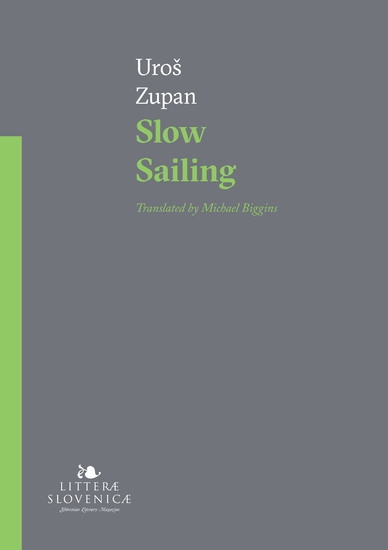
Slow Sailing - cover

Slow Sailing

Uroš Zupan

Translator Michael Biggins

Publisher: Slovene Writers' Association

  • 0
  • 0
  • 0

Summary

Uroš Zupan (1963) is one of Slovenia's most prominent contemporary poets and he has made his mark on Slovenian poetry of the past 30 years. Slow Sailing presents the author's own selection of the best of his best. This collection, which covers a period of more than two dozen years, is both personal and stern, since the author deals with his own poetry. From his delving into the golden age of his individual past to a sensuous hymn to soft summer light and the miracle of life that does not exist without the arts, Slow Sailing invites us to discover and re-discover one of post-independence Slovenia's most distinctive poetic voices, while also offering a unique insight into Slovenian poetry at the turn of the millennium.

The greatest Slovenian poet of the middle generation, his work has not been translated much (and not at all into English); the book is already part of the Slovenian canon and contains Zupan's own selection of his finest poems. He is already included in school literature curricula.
Available since: 06/05/2022.
Print length: 232 pages.

Other books that might interest you

  • Tam O'Shanter - Burns had a way with words that few could equal In this masterful tale he shows us exactly why that is - cover

    Tam O'Shanter - Burns had a way...

    Robert Burns

    • 0
    • 0
    • 0
    Many nations have produced outstanding poets who they would gladly have represent their Culture.  But can any Nation say they have an equivalent of Robbie Burns?  Rabbie. The Ploughman Poet.  The Bard (Of Scotland).  This one poet is indelibly linked and intertwined with the culture and people of Scotland.  His life, loves, politics, verse and songs speak as them and for them.  
    From humble roots, the eldest son of seven born in 1759 to parents, both from tenant farming stock, the family endured both hardship and poverty.   Burns endured the test and began to write first at 15 and to publish his first volume some two years later.    
    He wrote in both true Scottish, dialect and English as well as turning his hand to song.  Politically he was an inspiration to both liberalism and socialism as well as a Scottish parliament.  His unique ability enabled him to appeal to all and quite rightly to be viewed as the National poet.    
    As well as creating his own great works he was also an avid collector of Scottish Folk Songs preserving for posterity the works of others.  
    However his own life was short dying at the young age of only 37.   What further greatness would have lain before him is impossible to say.  But, poetically, on the day of his death his son, Maxwell was born.    
    His fame today is worldwide and celebrated in January each year with the Traditional Burns night.  Each New Years Eve friends and families the world over link arms to ‘Auld Lang Syne’, giving immortality to his words and aims.  
    As former Secretary General of the United Nations, Kofi Annan says:  Burn’s poems dignify and illuminate the struggle faced by the vast majority of the world’s population today.
    Show book
  • The Generosity - Poems - cover

    The Generosity - Poems

    Luci Shaw

    • 0
    • 0
    • 0
    "Rejoice, readers, as you receive the generosity of Luci Shaw's 76 new grace-infused parable poems. Autobiography once more merges with theology as these poems illuminate in splendored natural detail how the seasons of creation parallel and explain the seasons of her life as a poet. Again and again, these poems shower us with glorious epiphanies from the natural world as it reflects God's generosity at work such as "spring's impossible news of green." These poems confirm that in poetry as in faith "ripeness is all." Like Wordsworth, Luci is celebrated for being a highly gifted landscape poet whose works are rich in imagery from the physical world— meadows filled with seeds, flowers, and also poems which are like "shoots" in Luci's writing life. Animals, too, great and small (beetles, cricket, and voles to bears and whales) play a major role in Luci's poetics of creation; God is likened to a great bear who leaves paw tracks for us to follow. In their deep faith and vibrant colors and designs, the poems in Generosity might be considered Luci's Book of Kells. We need to be like Luci's father who carried her poems in his briefcase to show his friends." — Philip C. Kolin, Author, Reaching Forever: Poems; Distinguished Professor of English (Emeritus), University of Southern Mississippi
    Show book
  • The Lake Poets - Three of the titans of English poetry muse in one of Englands finest landscapes - cover

    The Lake Poets - Three of the...

    William Wordsworth

    • 0
    • 0
    • 0
    Strictly speaking The Lake Poets were not a movement or school of poetry they were only so named as such by The Edinburgh Review so that they could be disparaged. 
    It was a spectacular backfire! 
    The three main figures would be rightly seen as among the most monumental figures in English poetry - William Wordsworth, Samuel Taylor Coleridge and the under rated but immense Robert Southey, himself a thirty year poet laureate. 
    The profound majesty of the Lake District, an area of almost unequalled beauty, of mythical landscapes and beguiling charm influenced and acted as muse to their burgeoning talents. 
    Their creations have ennobled this poetry as an art form that is intense, lyrical, moving and above all deliciously satisfying. 
    This volume comes to you from Portable Poetry, a specialized imprint from Deadtree Publishing.  Our range is large and growing and covers single poets, themes, and many compilations.
    Show book
  • Bunny Girls - cover

    Bunny Girls

    Angela Readman

    • 0
    • 0
    • 0
    Out of the doll's house and into the woods, Bunny Girls steps out of the shadows of girlhood and looks at the world with wide eyes. Surreal, spiky, wise and darkly funny, this new collection by Costa-winning author and poet Angela Readman expertly mixes shades of film noir, northern wit, and magic realism. Through the lens of childhood, these poems address autism, anxiety, and darker concerns buried by cultural ideals of femininity.
    Here in Readman's skilful words are odes to severed heads, angels and Disney villains, Marilyn Monroe's body double, squashed slugs, sexual awakenings, Wendy-houses and snow globes, nosebleeds and blackbirds. Women are both invisible and actively writing themselves into the visible. Where there is isolation and dislocation, its counterbalance is finding breathless, reckless joy in the acts of creation and imagination. At its heart, this enlivening, magnificent book is about darkness and light, the lovely and the frightening, the beautiful and the worrying.
    Show book
  • The Tragedy of Timon of Athens - cover

    The Tragedy of Timon of Athens

    William Shakespeare

    • 0
    • 0
    • 0
    The Tragedy of Timon of Athens (The Life of Tymon of Athens) is a play by William Shakespeare, probably written in collaboration with Thomas Middleton in about 1605–1606, which was published in the First Folio in 1623. It is about the fortunes of an Athenian named Timon. The central character is a beloved citizen of Athens who through tremendous generosity spends his entire fortune on corrupt hangers-on only interested in getting the next payout.
    The earliest-known production of the play was in 1674, when Thomas Shadwell wrote an adaptation under the title The History of Timon of Athens, The Man-hater. Multiple other adaptations followed over the next century, by writers such as Thomas Hull, James Love and Richard Cumberland. The straight Shakespearean text was performed at Smock Alley in Dublin in 1761, but adaptations continued to dominate the stage until well into the 20th century.
    ... Flavius arrives. He wants the money as well, but he also wants Timon to come back into society. Timon acknowledges that he has had one true friend in Flavius, a shining example of an otherwise diseased and impure race, but laments that this man is a mere servant. He invites the last envoys from Athens, who hoped Timon might placate Alcibiades, to go hang themselves, and then dies in the wilderness. Alcibiades, marching on Athens, then throws down his glove, and ends the play reading the bitter epitaph Timon wrote for himself, part of which was composed by Callimachus:
    "Here lies a wretched corpse of wretched soul bereft:
    Seek not my name: a plague consume you wicked caitiffs left!"
    Here lie I, Timon, who alive, all living men did hate,
    Pass by, and curse thy fill, but pass and stay not here thy gait...
    Among the most significant works William Shakespeare: Hamlet, Othello, King Lear, Macbeth, Orpheus, Romeo and Juliet, Julius Caesar, Troilus and Cressida, The Tempest, Venus and Adonis, Antony and Cleopatra, Measure for Measure, The Winter's Tale and many more.
    Show book
  • Worldly Things - cover

    Worldly Things

    Michael Kleber-Diggs

    • 0
    • 0
    • 0
    “Sometimes,” writes Michael Kleber-Diggs writes in this winner of the Max Ritvo Poetry Prize, “everything reduces to circles and lines.”In these poems, Kleber-Diggs names delight in the same breath as loss. Moments suffused with love—teaching his daughter how to drive; watching his grandmother bake a cake; waking beside his beloved to ponder trumpet mechanics—couple with moments of wrenching grief—a father’s life ended by a gun; mourning children draped around their mother’s waist; Freddie Gray’s death in police custody. Even in the refuge-space of dreams, a man calls the police on his Black neighbor.But Worldly Things refuses to “offer allegiance” to this centuries-old status quo. With uncompromising candor, Kleber-Diggs documents the many ways America systemically fails those who call it home while also calling upon our collective potential for something better. “Let’s create folklore side-by-side,” he urges, asking us to aspire to a form of nurturing defined by tenderness, to a kind of community devoted to mutual prosperity. “All of us want,” after all, “our share of light, and just enough rainfall.”Sonorous and measured, the poems of Worldly Things offer needed guidance on ways forward—toward radical kindness and a socially responsible poetics.
    Show book