Join us on a literary world trip!
Add this book to bookshelf
Grey
Write a new comment Default profile 50px
Grey
Subscribe to read the full book or read the first pages for free!
All characters reduced
The Collected Works - cover

The Collected Works

Upton Sinclair

Publisher: DigiCat

  • 0
  • 0
  • 0

Summary

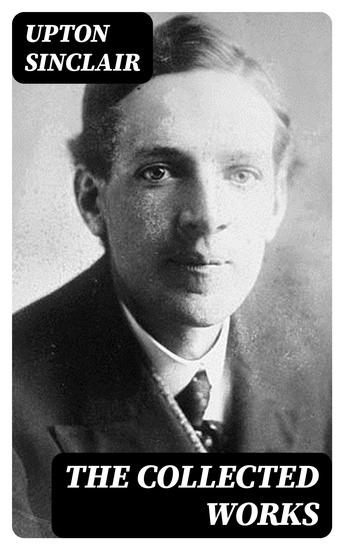
Upton Sinclair's 'The Collected Works' comprises a multifaceted examination of American society through a radical literary lens. From the gritty realism of industrial exploitation in 'The Jungle' to incisive social critiques in his other novels and essays, Sinclair's prose is both poignant and unflinching. This collection showcases his unique ability to blend journalism with fiction, revealing the social injustices of his time while advocating for progressive reforms. Sinclair's work is marked by an undercurrent of muckraking journalism, aiming to enlighten readers about the harsh realities faced by the working class during the early 20th century. Sinclair was a fervent social activist and a prominent figure in the Socialist Party. His firsthand experiences with the struggles of laborers and immigrants deeply influenced his writing. An advocate for social change, Sinclair's commitment to revealing the truth about corporate malfeasance and political corruption is evident throughout this comprehensive anthology, which not only represents his literary genius but also his relentless pursuit of social justice. The reader is encouraged to delve into 'The Collected Works' to explore the transformative power of literature as a catalyst for change. This collection serves as an essential lens through which one can understand the socio-economic issues of the early 20th century, while still offering a timeless call to action that remains relevant today.
Available since: 10/11/2022.
Print length: 2628 pages.

Other books that might interest you

  • The Uncommercial Traveller - cover

    The Uncommercial Traveller

    Charles Dickens

    • 0
    • 0
    • 0
    The Uncommercial Traveller is a collection of literary sketches and reminiscences written by Charles Dickens. In 1859 Dickens founded a new journal called All the Year Round and the Uncommercial Traveller articles would be among his main contributions. He seems to have chosen the title and persona of the Uncommercial Traveller as a result of a speech he gave on the 22 December 1859 to the Commercial Travellers' School London in his role as honorary chairman and treasurer. The persona sits well with a writer who liked to travel, not only as a tourist, but also to research and report what he found; visiting Europe, America and giving book readings throughout Britain. He does not seem content to rest late in his career when he had attained wealth and comfort and continued travelling locally, walking the streets of London in the mould of the flâneur, a 'gentleman stroller of city streets'. He often suffered from insomnia and his night-time wanderings gave him an insight into some of the hidden aspects of Victorian London, details of which he also incorporated into his novels. (Summary by Wikipedia)
    Show book
  • The Wife Who Didn't Eat - cover

    The Wife Who Didn't Eat

    Thersa Matsuura

    • 0
    • 0
    • 0
    A farmer in old Japan prays to the gods for a wife, someone who is kind, beautiful, and hardworking. What would be even better is if she didn’t eat at all, saving him both money and food. Imagine his surprise when just such a woman shows up at his house one night. But all is not perfect. The gods have quite the sense of humor, and the farmer soon learns what kind of monster he is living with. But is it too late?“The Wife Who Didn’t Eat” is author Thersa Matsuura’s retelling of a classic horror-tinged Japanese folktale, “Kwazu Nyobo”. Here she reads her version of the story followed by a short commentary with some of her research notes and thoughts on the tale. Both the short story and commentary come in at just under one hour. Thersa Matsuura is a published author of two short story collections, one nominated for a Bram Stoker Award. You can also find her on her podcast, Uncanny Japan, where she talks more about the more obscure parts of Japanese culture. Reviews: “Very soothing, educational and entertaining. Love this deep dive into Japanese culture. Not to mention just the right amount of Spooky.”            By Spooks76“High production value and haunting storytelling helps shed light onto Japanese folklore. Teresa is clear, concise and highlights stories that might otherwise never be heard by Western ears. Highly recommend!”         By Jameswhojamesyu
    Show book
  • Alcibiades I - A Young Politician’s Search for Self-Knowledge – Plato’s Dialogue on Ambition and the Soul - cover

    Alcibiades I - A Young...

    Plato, Tim Zengerink

    • 0
    • 0
    • 0
    What if true leadership begins with the courage to look inward? 
    In Alcibiades I, Plato stages a riveting dialogue between Socrates and the young, glory-seeking Alcibiades. As the young man prepares to enter politics and shape the fate of Athens, Socrates urges him to reflect on a deeper question: How can you lead others if you have not come to know yourself? 
    This modernized audiobook version brings clarity and intensity to one of Plato’s most inspiring philosophical encounters—where ambition meets wisdom and the path to greatness is revealed to lie within. 
    What you’ll discover inside: 
    •	A powerful dialogue on self-awareness as the foundation of leadership and justice 
    •	Alcibiades’ internal struggle between ego and ethics, fame and virtue 
    •	Socratic reasoning at its sharpest, uncovering truth through self-examination 
    •	A clear, accessible translation ideal for personal development and political thought 
    Whether you’re on a journey of growth or exploring the foundations of wise rule, Alcibiades I offers timeless insight for mastering the self before mastering the world.
    Show book
  • Seeking Social Democracy - Seven Decades in the Fight for Equality - cover

    Seeking Social Democracy - Seven...

    Edward Broadbent, Frances Abele,...

    • 0
    • 0
    • 0
    The first full-length treatment of Ed Broadbent’s ideas and remarkable seven-decade engagement in public life
    		 
    Part memoir, part history, part political manifesto, Seeking Social Democracy offers the first full-length treatment of Ed Broadbent’s ideas and remarkable seven-decade engagement in public life. In dialogue with three collaborators from different generations, Broadbent leads readers through a life spent fighting for equality in Parliament and beyond: exploring the formation of his social democratic ideals, his engagement on the international stage, and his relationships with historical figures from Pierre Trudeau and Fidel Castro to Tommy Douglas, René Lévesque, and Willy Brandt. From the formative minority Parliament of 1972–1974 to the contentious national debate over Canada’s constitution to the free trade election of 1988, the book chronicles the life and thought of one of Canada’s most respected political leaders and public intellectuals from his childhood in 1930s Oshawa to the present day. Broadbent’s analysis also points toward the future, offering lessons to a new generation on how principles can inform action and social democracy can look beyond neoliberalism. The result is an engaging, timely, and sweeping analysis of Canadian politics, philosophy, and the nature of democratic leadership.
    Show book
  • I AM NELSON What Happened Next - The story of the little dog continues Still dead Still as alive as ever - cover

    I AM NELSON What Happened Next -...

    Martina Mars

    • 0
    • 0
    • 0
    Hilariously funny and very moving - a book for dog (and cat) lovers and anyone who’s ever loved and lost an animal. 
    Meet Nelson, the feisty and lovable little dog whose only wish is to be reunited with his beloved human family once more. Follow along as he tries to find a way back from the Afterlife, where he uncovers what happened next (and before) in the lives of his human friends and family after he had to leave them behind. 
    Through heartwarming true rescue stories and countless hilarious anecdotes about a whole menagerie of rescue pets, Nelson’s continued journey will have you laughing, crying and everything in between. 
    Don’t miss out and experience life and death through the eyes of this special little dog!
    Show book
  • A Profitable Weakness - From their pens to your ears genius in every story - cover

    A Profitable Weakness - From...

    George Gissing

    • 0
    • 0
    • 0
    George Robert Gissing was born on November 22nd, 1857 in Wakefield, Yorkshire.  
    He was educated at Back Lane School in Wakefield. Gissing loved school. He was enthusiastic with a thirst for learning and always diligent.  By the age of ten he was reading Dickens, a lifelong hero. 
    In 1872 Gissing won a scholarship to Owens College. Whilst there Gissing worked hard but remained solitary. Unfortunately, he had run short of funds and stole from his fellow students. He was arrested, prosecuted, found guilty, expelled and sentenced to a month's hard labour in 1876. 
    On release he decided to start over.  In September 1876 he travelled to the United States. Here he wrote short stories for the Chicago Tribune and other newspapers. On his return home he was ready for novels. 
    Gissing self-published his first novel but it failed to sell.  His second was acquired but never published. His writing career was static.  Something had to change.  And it did. 
    By 1884 The Unclassed was published.  Now everything he wrote was published. Both Isabel Clarendon and Demos appeared in 1886. He mined the lives of the working class as diligently as any capitalist. 
    In 1889 Gissing used the proceeds from the sale of The Nether World to go to Italy. This trip formed the basis for his 1890 work The Emancipated. 
    Gissing's works began to command higher payments. New Grub Street (1891) brought a fee of £250.  
    Short stories followed and in 1895, three novellas were published; Eve's Ransom, The Paying Guest and Sleeping Fires. Gissing was careful to keep up with the changing attitudes of his audience.  
    Unfortunately, he was also diagnosed as suffering from emphysema. The last years of his life were spent as a semi-invalid in France but he continued to write. 1899; The Crown of Life. Our Friend the Charlatan appeared in 1901, followed two years later by The Private Papers of Henry Ryecroft. 
    George Robert Gissing died aged 46 on December 28th, 1903 after catching a chill on a winter walk.
    Show book