Join us on a literary world trip!
Add this book to bookshelf
Grey
Write a new comment Default profile 50px
Grey
Subscribe to read the full book or read the first pages for free!
All characters reduced
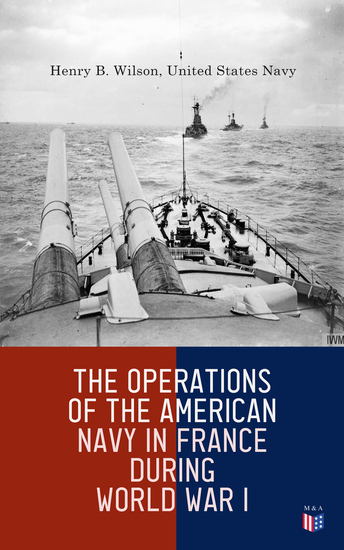
The Operations of the American Navy in France During World War I - cover

The Operations of the American Navy in France During World War I

United States Navy, Henry B. Wilson

Publisher: Madison & Adams Press

  • 0
  • 0
  • 0

Summary

"The Operations of the American Navy in France During World War I" by Henry B. Wilson provides a comprehensive account of the American Navy's role on the Atlantic Coast of France during the First World War. The book details the operational methods, which relied heavily on cooperation between the Allied forces, particularly with the French naval service. It outlines the initial phases where American forces, under Rear Admiral W. B. Fletcher and later Admiral Henry B. Wilson, operated primarily with auxiliary craft like yachts and mine-sweepers, before being augmented by destroyers.
Available since: 11/27/2023.
Print length: 180 pages.


Other books that might interest you

  • Empire of the United States The: Forged by the Spirit of God in Man - cover

    Empire of the United States The:...

    Martin K. Ettington

    • 0
    • 0
    • 0
    In the United States of America today we live in a time of problems, confusion, and with lots of fighting between the main political parties. 
    Yet, people from all over the world still want to come here. 
    Why do so many persons still want to become Americans? I think it is because the United States has become the guiding star for the growth of humanity, now and in the future. People see their best futures to be here. 
    There is nowhere else that the rights our citizens possess allow many to go from being penniless to a multimillionaire in their lifetimes. And the provisions of freedom of religion and freedom of speech are important to our full expression as human beings. 
    But most American citizens despair about their lives, and the future of our country. Due to our poor educational system many don’t know the true history of this country and how it was formed to spread the Spirit of God in our country and around the world. 
    And what about new industries created here in the USA? In fact can anyone name a new industry which was not created here? 
    The purpose of this book is to show how the Spirit of God in man during the history of United States of America has made a huge positive difference in our world. 
    We should be extremely proud of the country we live in. 
    The United States was the light of the world in the past, is still in the present, and will continue to be so in the future.
    Show book
  • Navigating The World of Social Media - cover

    Navigating The World of Social...

    Waseem Khan

    • 0
    • 0
    • 0
    TAKE CONTROL OF YOUR TIME, YOUR MIND, AND YOUR FAITH  
       UNCOVER THE SECRETS TO MASTERING YOUR SCREEN TIME WHILE DEEPENING YOUR CONNECTION TO YOUR FAITH  
    In an age where social media dominates our daily lives, Muslims face the pressing challenge of balancing their online presence with their spiritual obligations. The constant lure of notifications, the endless scroll, and the fear of missing out can easily spiral into addiction, affecting both mental well-being and one's connection to faith.  
    Navigating the World of Social Media by Waseem Khan addresses this modern dilemma, offering a comprehensive guide for Muslims seeking to overcome the pitfalls of social media addiction. Drawing on extensive neuroscience research, this book uncovers the psychological traps set by social media platforms and how they exploit the brain’s reward system to keep users hooked.  
    What distinguishes this book is its unique integration of scientific analysis with Islamic principles. Waseem Khan explores the teachings of Islam, emphasising the critical importance of time in the faith and providing actionable strategies to reclaim it. Through practical advice, reflective exercises, and spiritual guidance, Navigating the World of Social Media empowers readers to break free from the distractions of the digital world and lead lives aligned with Islamic values.  
    Whether you are grappling with smartphone addiction yourself or seeking to support others in your community, this book provides the tools, insights, and knowledge needed to navigate the complexities of the digital age with confidence and faith.
    Show book
  • Puzzles and Conundrums - The Ultimate Historical Riddles Explained (4 in 1) - cover

    Puzzles and Conundrums - The...

    John Harpoon

    • 0
    • 0
    • 0
    This book is a bundle of several titles which are: 
    - Dawn's Dilemma: Waking up in the morning is supposed to be a fresh start—a chance to begin anew, to seize the day. But for many, it is instead a moment of resistance, a time when the comfort of the bed feels more appealing than the promise of a productive day ahead. This paradox, where the desire to be productive and successful clashes with the reluctance to rise from sleep, is at the heart of what I call the "Awakening Paradox." 
    - The Ultimate Enigma: The story of this enigma begins with a seemingly ordinary event that spiraled into an extraordinary mystery, captivating the minds of people across the globe. What started as an unexplained disappearance soon transformed into one of the most perplexing and widely discussed mysteries in recorded history. The vanishing of this individual—or object, depending on the version of the story one hears—left behind only traces of confusion, a scattering of evidence, and no clear answers. 
    - The Emperor's Edge: Napoleon Bonaparte's journey from a modest Corsican background to one of history's greatest military leaders is nothing short of remarkable. Born on August 15, 1769, in Ajaccio, Corsica, a French territory that had only recently been acquired from the Genoese, Napoleon’s early years were shaped by the turbulent political climate of his homeland.  
    - The Shadow Agents: Covert operations are a cornerstone of modern intelligence and national security strategies. They are defined by their secrecy and the fact that they are often conducted in a manner that prevents any overt acknowledgment of their existence. In essence, covert operations are activities undertaken by government agencies, intelligence services, or other organizations to influence events or gather information while keeping their involvement hidden from the public eye.
    Show book
  • The Unindexed Mind - cover

    The Unindexed Mind

    Tory Handcock

    • 0
    • 0
    • 0
    This isn't a self-help book. It's a mental junk drawer — full of quotes, chaos, forklift wisdom, and a guy just trying to make sense of the noise. 
    No chapters. No index. No roadmap. You'll find meaning, then lose it again. And maybe that's the point. 
    It's part philosophy, part humor, part existential napkin scribble. 
    If you've ever argued with God in a break room or felt like socks next to the couch might symbolize existential dread... you're in the right place.
    Show book
  • Spanish and Portuguese in the New World The: The History and Legacy of the First European Rivalry in the Americas - cover

    Spanish and Portuguese in the...

    Editors Charles River

    • 0
    • 0
    • 0
    In 1451, Prince Henry the Navigator helped fund and develop a new type of ship, the caravel, that featured triangular lateen sails and would be able to travel in the open ocean and sail against the wind. In 1488, Bartholomew Diaz rounded the southern tip of Africa, named the Cape of Good Hope by King John of Portugal, and entered the Indian Ocean from the Atlantic. 
    One explorer, Christopher Columbus, sought funding from the Portuguese to search for a passage to Asia by sailing westwards, but he was rejected. At this time in the late 15th century, Portugal’s domination of the western African sea routes prompted the neighboring Crown of Castile and the Catholic monarchs in modern Spain to search for an alternative route to south and east Asia (termed Indies), so they provided Columbus with the funding he required. By the time Christopher Columbus started setting back east from the New World after landing there in October 1492, he had explored San Salvador in the Bahamas (which he thought was Japan), Cuba (which he thought was China), and Hispaniola, the source of gold. As the common story goes, Columbus, en route back to Spain from his first journey, called in at Lisbon as a courtesy to brief the Portuguese King John II of his discovery of the New World. King John subsequently protested that according to the 1479 Treaty of Alcáçovas, which divided the Atlantic Ocean between Spanish and Portuguese spheres of influence, the newly discovered lands rightly belonged to Portugal. To make clear the point, a Portuguese fleet was authorized and dispatched west from the Tagus to lay claim to the “Indies,” which prompted a flurry of diplomatic activity in the court of Ferdinand and Isabella.
    Show book
  • Making Every PE Lesson Count - Six principles to support great physical education teaching - cover

    Making Every PE Lesson Count -...

    James Crane

    • 0
    • 0
    • 0
    Written by James Crane, Making Every PE Lesson Count: Six principles to support great physical education teaching provides realistic and practical strategies that will help teachers make abstract ideas more concrete and meaningful in both practical and theory PE.
    PE provides a unique opportunity for some students to flourish and become professional athletes or achieve excellent academic outcomes. However, if you ask any PE teacher, their main aim is that all students leave school with a love of physical activity and lifelong participation in sport. The benefits on physical, mental and social health are undeniable. The place PE holds in the curriculum is therefore fundamental to society in that it acts as a vehicle to promote resilience, determination and perseverance.
    Writing in the engaging style of the award-winning Making Every Lesson Count series, James Crane articulates the fundamentals of great PE teaching and shares simple and practical strategies designed to challenge students across all aspects of the subject. In an age of educational quick fixes and ever-moving goalposts, this precise and timely book returns to the fundamental questions that all PE teachers must consider: 'What can I do to help my students thrive in the wide world of physical education?'
    Making Every PE LessonCount is underpinned by six pedagogical principles - challenge, explanation, modelling, practice, feedback and questioning. Good PE teaching is littered with all these principles, not as a checklist or plan as such, but to ensure that teaching is well structured and thought out.
    This book aims to bring the evidence around effective teaching linked to the six pedagogical principles to life through the lens of a physical education teacher. It focuses on all aspects of PE in secondary schools with reference to real-life examples from a huge range of sports and physical activities and classroom theory. James links his findings back to the subject throughout and offers reflective questions for teachers to sharpen their practice.
    Making Every PE LessonCount aims to synthesise the latest research on teaching and learning and link it specifically to PE. There is a huge amount of evidence available for teachers, and this book acts as an practical guide that will successfully bridge the gap between the world of academic research and PE teaching.
    Show book