Join us on a literary world trip!
Add this book to bookshelf
Grey
Write a new comment Default profile 50px
Grey
Subscribe to read the full book or read the first pages for free!
All characters reduced
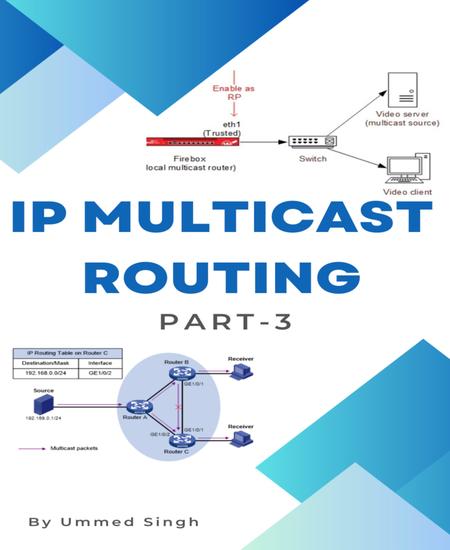
IP MULTICAST ROUTING Part -3 - Use of multicast routing - cover

IP MULTICAST ROUTING Part -3 - Use of multicast routing

Ummed Singh

Publisher: BookRix

  • 0
  • 0
  • 0

Summary

 IP multicast routing is a technique used in computer networks to efficiently deliver data packets from a single sender to multiple recipients. It is specifically designed for applications where data needs to be distributed simultaneously to a group of interested receivers. In traditional unicast communication, a sender sends packets to individual receivers using their unique IP addresses. This creates a point-to-point connection between the sender and each receiver, resulting in duplicate transmissions if multiple receivers are interested in the same data. Unicast is inefficient for one-to-many or many-to-many communication scenarios. Multicast routing, on the other hand, allows a sender to transmit a single copy of a packet, and network routers replicate and forward it to all interested receivers. This saves network bandwidth and processing resources, as the data is distributed only once. Multicast routing uses special IP multicast addresses, typically in the range of 224.0.0.0 to 239.255.255.255, to identify multicast groups. To enable IP multicast routing, routers in the network need to support multicast routing protocols such as Protocol Independent Multicast (PIM). These protocols enable routers to exchange information about multicast groups and determine the optimal path for forwarding multicast traffic. Routers maintain multicast routing tables that specify the outgoing interfaces and next-hop routers for forwarding multicast packets. When a sender wants to send data to a multicast group, it encapsulates the data in a multicast packet and sets the appropriate multicast IP destination address. The routers along the path use the multicast routing tables to determine how to forward the packet to all interested receivers. Receivers interested in receiving multicast data join the multicast group by sending a membership request to the nearest router. The router adds the receiver to the multicast distribution tree, and subsequent multicast packets are forwarded. 
Available since: 07/23/2023.
Print length: 35 pages.
Other books that might interest you

  • Ways of Attending - How our Divided Brain Constructs the World - cover

    Ways of Attending - How our...

    Iain McGilchrist

    • 0
    • 0
    • 0
    Attention is not just receptive, but actively creative of the world we inhabit. How we attend makes all the difference to the world we experience. And nowadays in the West we generally attend in a rather unusual way: governed by the narrowly focussed, target-driven left hemisphere of the brain.  
    Forget everything you thought you knew about the difference between the hemispheres, because it will be largely wrong. It is not what each hemisphere does – they are both involved in everything – but how it does it, that matters. And the prime difference between the brain hemispheres is the manner in which they attend. For reasons of survival we need one hemisphere (in humans and many animals, the left) to pay narrow attention to detail, to grab hold of things we need, while the other, the right, keeps an eye out for everything else. The result is that one hemisphere is good at utilising the world, the other better at understanding it.  
    Absent, present, detached, engaged, alienated, empathic, broad or narrow, sustained or piecemeal, attention has the power to alter whatever it meets. The play of attention can both create and destroy, but it never leaves its object unchanged. How you attend to something – or don’t attend to it – matters a very great deal. This book helps you to see what it is you may have been trained by our very unusual culture not to see.  
    Ways of Attending is expertly read by Mike Fraser. The cover design has been adapted from a Cajal original drawing, and used with permission of Legado Cajal (Madrid).  
    This audiobook was produced and published by Echo Point Books & Media, an independent bookseller in Brattleboro, Vermont. © 2018 Iain McGilchrist (P)
    Show book
  • Introduction to Solid State Physics - The Basics of Solid State Physics - cover

    Introduction to Solid State...

    Mark Hedges

    • 0
    • 0
    • 0
    Crystal structure and bonding are fundamental to understanding the physical properties of solid materials. A crystal is a solid material whose atoms, ions, or molecules are arranged in a highly ordered, repeating pattern extending in all three spatial dimensions. The smallest repeating unit of this structure is called the unit cell. The unit cell defines the crystal’s lattice parameters, including the edge lengths a,b,ca, b, c and the angles between them α,β,γ\alpha, \beta, \gamma. The crystal lattice is generated by translating the unit cell along its edges, forming the complete crystalline structure. 
    Crystals are classified according to their symmetry into seven crystal systems: cubic, tetragonal, orthorhombic, monoclinic, triclinic, hexagonal, and rhombohedral. Each system is characterized by specific symmetry elements such as mirror planes, rotation axes, and inversion centers. The Bravais lattices describe the 14 distinct lattice types that can fill three-dimensional space using translational symmetry. The atomic positions within a unit cell are described by fractional coordinates relative to the lattice vectors. In a face-centered cubic (FCC) lattice, atoms are located at the corners and the centers of the faces of the cube, while in a body-centered cubic (BCC) lattice, an additional atom is placed at the center of the cube.
    Show book
  • Agile Transformation with an Agile Coaching Mindset - Adoption of agile methodology in software development - cover

    Agile Transformation with an...

    Jimmy Mathew

    • 0
    • 0
    • 0
    Agile Transformation with an Agile Coaching Mindset: Moving to agile software development. 
    Coaching, Agile Coaching, Transformation, Agile Transformation, Agile Coach, Transformation Coach…. Lots of combinations we hear in everyday life. We are discussing agile transformation here. The approach we follow in this training is “Agile Transformation with an Agile Coaching Mindset”. 
    The dictionary meaning for agile is "able to move quickly and easily". Also, a much talked about attribute of agile is flexibility, ability to respond to changes. 
    How agile can an “agile transformation be"? In our approach, we believe the transformation itself must be agile. It must be an empirical process with an adaptive plan, which is flexible enough to accommodate new learnings accrued during the transformation journey. We keep improving every moment, and the agility evolves as we progress through this journey. 
    We believe in “Agile Transformation with an Agile Coaching Mindset”. 
    Let’s try to list down various phases a typical transformation journey goes through. These steps are negotiable. Based on the organization, team, and environment, these steps may change, be replaced, or be removed. The team may go through phases like… 
    Understand the Organisation, Culture, and Practices; Understand the drivers and set goals; Define Road map; Make Agile visible; Establish Agile training; Align Organisation structure and high-level processes; Start with Agile Practices; Team level transformation; Inspect and Adapt. 
    There is not any specific order for executing many of these steps in our journey. These may even go in parallel or in a different order based on the situation. This book discusses each phase in detail.
    Show book
  • Before We Go Live - Navigating the Abusive World of Online Entertainment - cover

    Before We Go Live - Navigating...

    Stephen Flavall

    • 0
    • 0
    • 0
    ‘Starting out, I made three dollars an hour; then I made four, then eight. After a year and a half of streaming full-time I was finally making minimum wage. A couple of years after that I was signed to a professional team and advertising products to my audience for $1,000 an hour.’ 
    Streaming video games is now a billion-dollar industry. In 2022, Twitch alone has over 140 million active monthly users, with top players earning millions each year. But success breeds envy, and when big money’s being made, everyone wants a piece. 
    In Before We Go Live, professional streamer Stephen Flavall, aka ‘jorbs’, invites the reader behind the scenes of this new frontier. 
    From the boardrooms of LA to doctors' offices in the Midwest, dealing with trolls and stalkers to mingling with crypto scammers and ruthless opportunists, Before We Go Live is both a true story about the dark realities of streaming and the tale of a deep and enduring friendship. 
    It’s about what happens when real life intersects with entertainment, and learning to act with kindness and humour in an online world full of prejudice and abuse. 
    This audiobook edition is narrated by Ray Chase, voice of Noctis Lucis Caelum, L, and Bruno Buccellatti.
    Show book
  • Pitch Sketch Launch - What Sketch Comedy Can Teach Us About Product Development - cover

    Pitch Sketch Launch - What...

    John Krewson

    • 0
    • 0
    • 0
    Software development is no laughing matter. But it should be. 
    Backward management practices have hobbled what was once the world’s most innovative industry. The result? Wasted time and resources. Sinking morale. Dissatisfied customers. 
    Regaining software development’s groundbreaking spirit requires the type of bold, madcap thinking that originally defined it—and in Pitch, Sketch, Launch John Krewson presents a remarkable, proven template for revival. 
    Pitch, Sketch, Launch extracts the techniques used to create today’s most beloved comedy shows and applies them to revitalizing software development. It shines a spotlight on the sketch comedy world’s ethos of feedback-driven product deliveries and its playful search for original solutions. Insightful interviews, best practices, and case studies demonstrate how creating comedy applies to designing top-tier software. 
    Rethink what makes your creative team effective. Transform meetings into electrifying idea incubators. Rediscover the exhilaration of software innovation. Let Pitch, Sketch, Launch help you set the stage for producing your most adventurous work yet.
    Show book
  • Beyond Agile: What Is the Next Big Development Paradigm? - cover

    Beyond Agile: What Is the Next...

    Tom Henricksen

    • 0
    • 0
    • 0
    Where is the next big development paradigm? Many companies are moving beyond Agile methods to release faster and delivery value. In this book we review some of the cutting edge methods. In this educational book you will learn how companies use Agile practices to respond quickly to changing demands. Check out Beyond Agile and take your team to the next level!
    Show book