Join us on a literary world trip!
Add this book to bookshelf
Grey
Write a new comment Default profile 50px
Grey
Subscribe to read the full book or read the first pages for free!
All characters reduced
No Way Out - cover

No Way Out

U.G. Krishnamurti

Publisher: Musaicum Books

  • 0
  • 0
  • 0

Summary

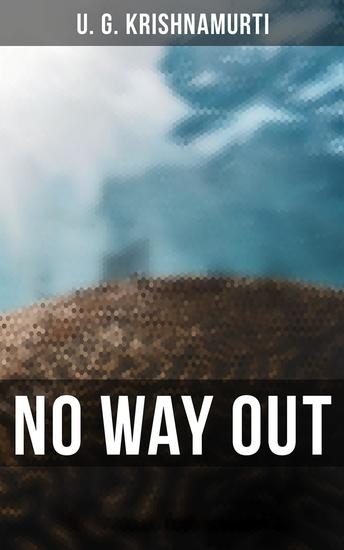
In the groundbreaking work 'No Way Out' by U. G. Krishnamurti, the author delves into the complex interplay between the mind and the self, challenging traditional notions of enlightenment and spiritual growth. Krishnamurti's writing style is sharp and direct, eschewing flowery language in favor of stark truths and unconventional wisdom. Drawing on his own experiences and encounters, the book pushes readers to question their beliefs and assumptions about existence and the nature of reality. Set in the backdrop of the 20th century, 'No Way Out' stands as a bold critique of traditional spiritual teachings, offering a fresh perspective on the search for meaning and enlightenment. U. G. Krishnamurti, a spiritual teacher and philosopher, was known for his unorthodox views and rejection of traditional spiritual practices. His personal journey and disillusionment with the spiritual teachings of his time led him to write 'No Way Out', a thought-provoking critique of the spiritual industry and human quest for enlightenment. For readers seeking a challenging and thought-provoking read, 'No Way Out' by U. G. Krishnamurti offers a unique perspective on the nature of enlightenment and self-realization. This book is recommended for those interested in exploring unconventional spiritual teachings and questioning the foundations of their beliefs.
Available since: 01/04/2022.
Print length: 166 pages.

Other books that might interest you

  • Fancies versus Fads - cover

    Fancies versus Fads

    G K Chesterton

    • 0
    • 0
    • 0
    The last volume of Chesterton's collected essays, Gathered from the London Mercury, the New Witness, and the Illustrated London News, it is the only volume from after WWI, and is most serious, philosophical, and socially direct collection. 
    "The problem is not so much Prohibition with a large P as prohibition with a small one. I mean, I am interested not so much in liquor as in liberty. I want to know on what principle the prohibitionists are proceeding in this case, and how they think it applies to any other case. And I cannot for the life of me make out. They…do not attack liquor; they do quite simply attack liberty. I mean that they are satisfied with saying about this liberty what can obviously be said about any liberty – that it can be, and is, abominably abused. If that had been a final objection to any form of freedom, there never would have been any form of freedom." 
    "So long as we combine ceaseless and often reckless scientific speculation with rapid and often random social reform, the result must inevitably be not anarchy but ever-increasing tyranny. There must be a ceaseless and almost mechanical multiplication of things forbidden. The resolution to cure all the ills that flesh is heir to, combined with the guesswork about all possible ills that flesh and nerve and brain-cell may be heir to – these two things conducted simultaneously must inevitably spread a sort of panic of prohibition. Scientific imagination and social reform between them will quite logically and almost legitimately have made us slaves."
    Show book
  • How God Thinks - Revealing God's Heart through the Language of Symbolism - cover

    How God Thinks - Revealing God's...

    David Vancelette

    • 0
    • 0
    • 0
    God created us in his image. This places a great burden on each person to not break that image of God within us. God thinks in symbols and so do we. There is always punishment for broken symbolism. Questions considered are, what does God think about: Gender, marriage, sex, the Cross as broken, not fulfilled symbolism? Why did God punish Moses so harshly when he struck the Rock in the wilderness the second time? Why is God allowing seemingly innocent victims to die by random shooters? Why does God see the climate change movement as idolatry? Why did Satan devise homosexuality? Why did God assign the death penalty for male but not female homosexuality? Why is having multiple wives acceptable in the Old Testament, but not having multiple husbands? All these topics, and many others, have to do with symbolism and are explained by How God Thinks.
    Show book
  • 5 Steps to Winning Your Auditions! - cover

    5 Steps to Winning Your Auditions!

    Anthony Stream

    • 0
    • 0
    • 0
    In the highly competitive world of acting, auditions are the gateway to a successful career. The ability to make a lasting impression in those fleeting, yet critical moments can mean the difference between landing the role of a lifetime or being left in the waiting room, hoping for the phone to ring.? Mastering the art of auditioning, be they in-person, via self-tapes, or live on Zoom is a vital skill every acto?r must acquire. This guide is designed to help with practical advice, insightful s?trategies, and actionable steps to empower actors to turn each audition into a stepping stone towards success.?
    Show book
  • The Big Ride At The Musical Fair - Come Join Our Musical Journey - cover

    The Big Ride At The Musical Fair...

    Julie Kirchhubel

    • 0
    • 0
    • 0
    The Big Ride At The Musical FairIt’s Fair time for the animals today, and they are all ready in their seats and really looking forward to the Big Ride starting. But the Ride can’t begin just yet. What – or who – are they waiting for?
    Show book
  • Secrets Lies and Consequences - A Great Scholar's Hidden Past and his Protégé's Unsolved Murder - cover

    Secrets Lies and Consequences -...

    Bruce Lincoln

    • 0
    • 0
    • 0
    In 1991, Ioan Culianu was on the precipice of a brilliant academic career. Culianu had fled his native Romania and established himself as a widely admired scholar at just forty-one years old. He was teaching at the University of Chicago Divinity School where he was seen as the heir apparent to his mentor, Mircea Eliade, a fellow Romanian expatriate and the founding father of the field of religious studies, who had died a few years earlier. When Culianu began to receive threatening messages, he asked a colleague to hold onto some papers for safekeeping. A week later someone fired a bullet into the back of his head, killing him instantly. The case was never solved, though the prevailing theory is that Culianu was targeted by the Romanian secret police as a result of critical articles he wrote after the fall of Nicolae Ceausescu. 


    What was in those papers and what connection might they have to Culianu's death? The papers eventually passed into the hands of Bruce Lincoln, and their story is at the heart of this book. The documents were English translations of articles that Eliade wrote in the 1930s, some of which voiced Eliade's support for the Iron Guard. Bruce Lincoln explores what the articles reveal about Eliade's past, his subsequent efforts to conceal that past, his complex relations with Culianu, and the possible motives for Culianu's shocking murder.
    Show book
  • Ancient Roman Holidays - cover

    Ancient Roman Holidays

    Mab Borden

    • 0
    • 1
    • 0
    Ancient Roman Holidays is a remarkable book that explores the ancient seasons and religious observance practices of the ancient Romans. Mab Borden’s meticulous research paints a vivid picture of the interconnectedness between mankind and the Gods. This book is invaluable for those interested in the religious traditions of ancient Rome.Ancient Roman Holidays invite readers to embark on a captivating journey into the enchanting realm of sacred days, months, and seasons, unearthing the profound significance of these ancient observances. Immersed in meticulously detailed accounts, as each sacred day unfurls, this book reveals the venerated deities and the intricacies of the accompanying social and ceremonial practices. Within the pages of Ancient Roman Holidays, the reader will discover comprehensive explanations of the ancient Roman calendar, forging a deep understanding of the interplay between celestial rhythms and religious rituals. The appendices provide a treasure trove of knowledge, mapping deity holidays to their corresponding months. This added layer of insight offers a panoramic view of the intricate spiritual tapestry that was interwoven throughout ancient Roman society. The reader will embark on a mesmerizing expedition through festivals dedicated to revered Gods and Goddesses such as Jupiter, Minerva, and Bacchus, delving into the wisdom encapsulated within the rites, ceremonies, and beliefs that molded ancient Roman spirituality. The reader will be transported to a world where every day bores a sacred connection to the divine. Witness the solemnity of religious processions and partake in the jubilant revelries of harvest festivals, as the ancient Roman holidays spring to life in vivid detail. These ancient traditions allow the reader to introspect upon their own spiritual practices, finding resonance in the timeless wisdom of the past. Inviting the reader to rediscover the exquisite beauty of these spiritual observances, Ancient Roman Holidays unveil the secrets and traditions that shaped the Roman calendar. The immersive journey through the vibrant tapestry of ancient Roman spirituality will invite the reader to renew their appreciation for the sacred rhythms that once resonated throughout the lives of these remarkable people.
    Show book