Join us on a literary world trip!
Add this book to bookshelf
Grey
Write a new comment Default profile 50px
Grey
Subscribe to read the full book or read the first pages for free!
All characters reduced
No Way Out - Enriched edition - cover

No Way Out - Enriched edition

U. G. Krishnamurti

Publisher: Musaicum Books

  • 0
  • 0
  • 0

Summary

In the groundbreaking work 'No Way Out' by U. G. Krishnamurti, the author delves into the complex interplay between the mind and the self, challenging traditional notions of enlightenment and spiritual growth. Krishnamurti's writing style is sharp and direct, eschewing flowery language in favor of stark truths and unconventional wisdom. Drawing on his own experiences and encounters, the book pushes readers to question their beliefs and assumptions about existence and the nature of reality. Set in the backdrop of the 20th century, 'No Way Out' stands as a bold critique of traditional spiritual teachings, offering a fresh perspective on the search for meaning and enlightenment. U. G. Krishnamurti, a spiritual teacher and philosopher, was known for his unorthodox views and rejection of traditional spiritual practices. His personal journey and disillusionment with the spiritual teachings of his time led him to write 'No Way Out', a thought-provoking critique of the spiritual industry and human quest for enlightenment. For readers seeking a challenging and thought-provoking read, 'No Way Out' by U. G. Krishnamurti offers a unique perspective on the nature of enlightenment and self-realization. This book is recommended for those interested in exploring unconventional spiritual teachings and questioning the foundations of their beliefs.

In this enriched edition, we have carefully created added value for your reading experience:
- A succinct Introduction situates the work's timeless appeal and themes.
- The Synopsis outlines the central plot, highlighting key developments without spoiling critical twists.
- A detailed Historical Context immerses you in the era's events and influences that shaped the writing.
- A thorough Analysis dissects symbols, motifs, and character arcs to unearth underlying meanings.
- Reflection questions prompt you to engage personally with the work's messages, connecting them to modern life.
- Hand‐picked Memorable Quotes shine a spotlight on moments of literary brilliance.
- Interactive footnotes clarify unusual references, historical allusions, and archaic phrases for an effortless, more informed read.
Available since: 01/04/2022.
Print length: 166 pages.


Other books that might interest you

  • Beneath Dark Waters - The Legacy of the Empress of Ireland Shipwreck - cover

    Beneath Dark Waters - The Legacy...

    Eve Lazarus

    • 0
    • 0
    • 0
    On May 28, 1914, the RMS Empress of Ireland began her 192nd trip across the Atlantic from Quebec City, Canada, en route to Liverpool, England, carrying 1,056 passengers and a crew of 423. In the early hours of May 29, fog descended on the St. Lawrence River, and the ocean liner was rammed by the Storstad, a Norwegian coal ship. In the fourteen minutes it took for the Empress of Ireland to sink, there was time to launch only four of the forty lifeboats, and rather than women and children first, it was everyone for themselves. Over a thousand people died that night, claiming the lives of more passengers than either the Titanic or the Lusitania, and the tragedy stands as the worst maritime disaster during peacetime in Canadian history. 


    Investigative journalist and author Eve Lazarus draws on a trove of historical documents to tell the story of the wreck and its aftermath. Lazarus recounts the story from both a Canadian and a Norwegian perspective and investigates why many accounts regurgitated in newspapers and books are wrong. The result is an utterly stirring narrative that uncovers tales of heroism and sacrifice, human endurance, and modern-day shipwreck hunters. 


    Beneath Dark Waters is an epic chronicle that restores the Empress of Ireland as well as its survivors and victims to their rightful place in maritime history.
    Show book
  • Make Peace With Anxiety - Manage the Good Bad and Out of Control - cover

    Make Peace With Anxiety - Manage...

    Alivette Sadiqi

    • 0
    • 0
    • 0
    Are you struggling with anxiety and depression and looking to improve your mental health? 
    It is time to make peace with anxiety! 
    Emotions are an essential part of being human—anxiety included. Anxiety appears when the mind determines it is necessary to handle certain moments, situations, or at the perceived appropriate time. However, if anxiety manifests as excessive worrying leading to unreasonable fear, unhealthy behaviors, or physical pain, there is a problem. The good news is anxiety won’t stop you from living a beautiful life; all you must do is manage it well. In this book, author Alivette Vigo will show you how… 
    Be ready to discover:How to decipher if your anxiety is healthy or notA word on mental health stigmaHow spirituality and self-growth aid anxiety managementWhat to consider when selecting emotional and medical supportAnd more… 
    “If you find that anxiety is hard to control, if you don’t know where to find help, and want to overcome the stigma associated with mental health, this is the book for you.”
    Show book
  • Conduct of Life volume 2 - cover

    Conduct of Life volume 2

    Moses Almosnino, Walter Hilliger

    • 0
    • 0
    • 0
    The major work of Rabbi Moses Almosnino (1515-1580), “Conduct of Life,” remains to this day an essential reference in classical Judeo-Spanish literature, now finally available in English in its first translation. First published in Ladino in 1564 as, Sefer Hanhagat ha-hayim and in 1729 as “Regimiento de la vida”, this three-volume edition is part of the prestigious collection Veritas è terra orietur. The work aims to disseminate the timeless teachings of ethics, in the words of the author: “In all that has been said, my intention is only to make you understand how the one who follows the path of virtue and customs of practising good and pure knowledge since childhood, lives a happy and fulfilled life (Volume 1, chapter 2)” This second volume addresses the confusion of indeterminism with free will (Volume 2, chapter 1) and how virtues arise from free will to surpass the force of destiny chapter 2), their conditions (chapter 3); the three types of strength or courage, which is the first virtue (chapter 4), its five properties and eleven conditions (chapter 5); as well as the ten ethical virtues, temperance (chapter 6), the sixteen properties of liberality chapters 7-8), magnificence (chapter 9), magnanimity and its fifty properties (chapter 10-12), modesty (chapter 13), meekness (chapters 14-16), affability (chapter 17), honesty or truth (chapters 18-19), and courtesy (chapter 20); following the order and numbering of Aristotle's Nicomachean Ethics.“Conduct of Life” draws heavily from the Nicomachean Ethics but transcends this source by situating itself at the universal intersection of several traditions: Greco-Arabic philosophy, Judeo-Christian scholasticism, classical Sephardic Judaism, and medieval Jewish thought. Thus, this work contributes to peace and intercultural understanding among peoples.
    Show book
  • Gabriel Tarde On Communication and Social Influence - Selected Papers - cover

    Gabriel Tarde On Communication...

    Gabriel Tarde

    • 0
    • 0
    • 0
    Gabriel Tarde ranks as one of the most outstanding sociologists of nineteenth-century France, though not as well known by English readers as his peers Comte and Durkheim. This book makes available Tarde’s most important work and demonstrates his continuing relevance to a new generation of students and thinkers. 
    Tarde’s landmark research and empirical analysis drew upon collective behavior, mass communications, and civic opinion as elements to be explained within the context of broader social patterns. Unlike the mass society theorists that followed in his wake, Tarde integrated his discussions of societal change at the macrosocietal and individual levels, anticipating later twentieth-century thinkers who fused the studies of mass communications and public opinion research. 
     
    Terry N. Clark’s introduction, considered the premier guide to Tarde’s opus, accompanies this important work, reprinted here for the first time in forty years.
    Show book
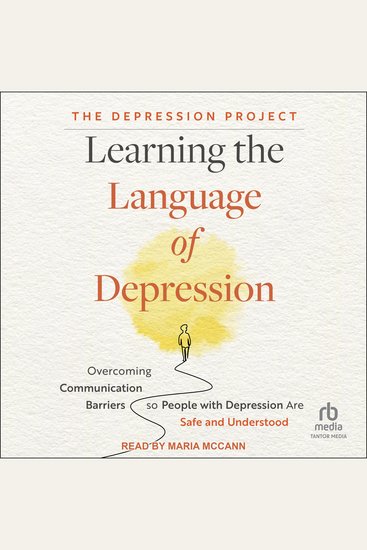
  • Learning the Language of Depression - Overcoming Communication Barriers so People with Depression Are Safe and Understood - cover

    Learning the Language of...

    The Depression Project

    • 0
    • 0
    • 0
    As The Depression Project hears every single day from members of their social media community, a "language barrier" often exists between people with depression and those around them—many words, everyday expressions, and non-verbal forms of communication can take on a different meaning than they otherwise would when they are coming from someone who has depression. 


    Consequently, in order to overcome this "language barrier" and therefore help people with depression feel safe, understood, supported and much better as a result. This book will: 


    ● Explain what people with depression say other commonly spoken phrases that are often misunderstood by people who have never experienced depression themselves before. 


    ● Share a wide variety of suggestions to help make it easier for people with depression to put what they are going through into words. 


    ● Highlight the language people with depression often use that can indicate they are feeling suicidal. 


    Learning The Language Of Depression is an ideal book for people with depression who would like some help communicating, as well as friends and family of someone with depression who would like to better understand their loved one.
    Show book
  • The Hidden Holocaust - The Holodomor and Its Legacy - cover

    The Hidden Holocaust - The...

    Sarah Willards

    • 0
    • 0
    • 0
    The Holodomor, a man-made famine that devastated Ukraine between 1932 and 1933, has its roots in the policies of the Soviet Union under Joseph Stalin. While the famine itself was a tragedy of immense proportions, its causes can be traced to the larger political and economic strategies of the Soviet regime. 
    The Soviet Union, in its quest for rapid industrialization, implemented harsh agricultural policies, which included forced collectivization. The idea was to consolidate small farms into larger collective farms, thereby increasing agricultural output and facilitating the redistribution of food to feed the growing industrial centers. However, this policy had disastrous effects on Ukraine, where agriculture was the backbone of the economy. 
    Collectivization forced Ukrainian peasants, who were traditionally independent farmers, into state-run collective farms. This not only disrupted agricultural production but also led to widespread resistance, as many Ukrainians viewed this as a direct attack on their way of life. The Soviets, determined to break this resistance, responded with brutal force. Those who opposed collectivization were often punished or executed, and the fertile lands of Ukraine were systematically confiscated. 
    Stalin’s government implemented the policy of grain requisitioning, where large amounts of grain were forcibly taken from Ukraine to support other areas of the Soviet Union. Ukraine, known as the “breadbasket” of the Soviet Union, became the primary target of these requisitions. The grain was not only taken for export but also used to fuel the industrial ambitions of the Soviet state. This left the Ukrainian population without sufficient food for survival, pushing them into a state of extreme deprivation.
    Show book