Join us on a literary world trip!
Add this book to bookshelf
Grey
Write a new comment Default profile 50px
Grey
Subscribe to read the full book or read the first pages for free!
All characters reduced
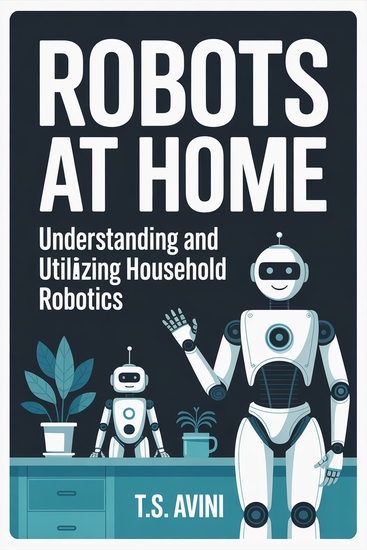
Robots at Home - Understanding and Utilizing Household Robotics - cover

Robots at Home - Understanding and Utilizing Household Robotics

T.S Avini

Publisher: T.S. AVINI

  • 0
  • 0
  • 0

Summary

"Robots at Home: Understanding and Utilizing Household Robotics" is your ultimate guide to the exciting and rapidly evolving world of domestic robotics. Offering a comprehensive overview of robotic technologies that are becoming integral to modern living, this book is essential for anyone looking to enhance their home with cutting-edge solutions. - Explore the evolution of home robotics, from simple automated devices to sophisticated AI-powered systems that improve efficiency and convenience in daily tasks.- Dive into detailed chapters covering a variety of robots, from cleaning and maintenance bots to entertainment and educational devices for children, providing you with the knowledge to make informed decisions.Whether you're curious about integrating a smart vacuum, investing in a kitchen assistant, or enhancing home security with surveillance robots, this book provides valuable insights and practical guidance. Don't miss out on the opportunity to revolutionize your living space—embrace the future of household robotics today!
Available since: 08/07/2025.
Print length: 213 pages.


Other books that might interest you

  • Psychedelics and mental health - Therapeutic applications and neuroscience of psilocybin LSD DMT and MDMA - cover

    Psychedelics and mental health -...

    Irene de Caso

    • 0
    • 0
    • 0
     
    Irene de Caso explains in an understandable and entertaining way the current neuroscientific advances related to psychedelic drugs, as well as their clinical and experiential applications.
    José Carlos Bouso, PhD, Scientific Director, ICEERS.
    
    Learn about the therapeutic uses of classical psychedelics and empathogens as revolutionary tools for neuroplasticity and mental health. Discover how they promote profoundly revealing mental states capable of restructuring our internal models of the world, reconsolidate traumatic memories and improve our social relationships. How do they affect the brain? What characteristics make these substances powerful catalysts for the psychotherapeutic process?
    Learn how they can help to improve severe symptoms: addictions, treatment-resistant depression, anxiety or post-traumatic stress.
    This illustrated guide describes the most important clinical studies and will be of great interest to all medical and mental health professionals seeking to understand the cutting edge clinical applications of these molecules, as well as to individuals interested in learning about the potential of psychedelic-assisted therapies.
    Show book
  • Why Not Better and Cheaper? - Healthcare and Innovation - cover

    Why Not Better and Cheaper? -...

    James B. Rebitzer, Robert S....

    • 0
    • 0
    • 0
    An engaging account of innovation in healthcare and why the results fall short for patients and society. 


    The evolution of the cell phones we carry in our pockets demonstrates that quality can increase while prices fall. Why doesn't healthcare also get better and cheaper? 


    In Why Not Better and Cheaper?, James B. Rebitzer and Robert S. Rebitzer offer an answer to this question. Bringing together research on incentives, social norms, and market competition, they argue that the healthcare system generates the wrong kinds of innovation. It is too easy to profit from low-value innovations and too hard to profit from innovations that reduce the costs of care. The result is a healthcare system that is profusely innovative yet remarkably ineffective in discovering ways to deliver increased value at lower cost. 


    Why Not Better and Cheaper? sheds new light on the trajectory of innovation in healthcare, and how to point innovation in a better direction.
    Show book
  • Embracing Mental Health Awareness: Understanding Support and Well-being - A Guide to Navigating Challenges and Cultivating Resilience - cover

    Embracing Mental Health...

    Emma Green

    • 0
    • 0
    • 0
    Embracing Mental Health Awareness: Understanding, Support, and Well-being - A Guide to Navigating Challenges and Cultivating Resilience is a complete guidebook that gives people the tools they need to put their mental health and well-being first in today's busy world. This book goes into great detail about mental health and gives useful advice to help readers understand how important it is, spot signs of trouble, and get the help they need. 
    The book talks about important issues like reducing stigma, building strong support networks, and making people more emotionally resilient. It does this by using clear language and methods that have been shown to work. It talks about how self-care, mindfulness, and therapy can help you deal with stress, worry, and other mental health problems. The book gives readers useful tips on how to live a peaceful life, improve their emotional intelligence, and keep their relationships healthy. 
    This book is a great resource for anyone who wants to improve their own mental health, help a loved one, or raise understanding in their community. It helps people understand mental health better and understand how others feel, giving readers the tools they need to face problems with confidence and kindness. Embracing Mental Health Awareness is more than just a guide; it's a call to action to build resilience and a culture of health.
    Show book
  • OCN Study Guide 2024-2025 - Review Book With 330+ Practice Questions and Answer Explanations for the ONCC Oncology Certified Nurse Test - cover

    OCN Study Guide 2024-2025 -...

    Shawn Blake

    • 0
    • 0
    • 0
    The critical mistake that sabotages OCN exam scores (and how you can avoid it). 
    Passing the OCN exam isn’t a matter of memorizing information or knowing everything there is to know. 
      
    It’s about knowing what specifically is covered on the exam itself and having a personalized plan for filling in any knowledge gaps. 
      
    That’s what makes this OCN Exam guide different. Rather than leaving you to figure out how to schedule your study sessions, this book provides a 14-week preparation roadmap along with key concepts to know for each section of the exam. It specifies particular topics you’ll most likely be tested on and even shows you the percentage breakdown of all the questions by each section. 
      
    Inside, you’ll discover: 
     2 full-length exams (330 questions) to practice with, along with detailed answer explanations for each to help you spot any areas of knowledge to focus onA special study “hack” that makes it easier to stay focused and prevent information overloadThe vital pre-practice step that helps you get the most out of any OCN practice test you take (don’t attempt a single practice question until you’ve done this)Detailed profiles of the 18 cancer care symptoms to know about (including etiology, frequency, and treatment options)Which oncological emergencies are you tested on, and important facts to remember for each one 
      
    And much more! 
      
    So whether you’re an experienced oncology nurse or still fairly new to nursing, this guide can not only help you focus on the right topics but also keep you on the path toward earning your certification. 
      
    Dominate the OCN exam and take your career to the next level.
    Show book
  • Carbon Technocracy - Energy Regimes in Modern East Asia - cover

    Carbon Technocracy - Energy...

    Victor Seow

    • 0
    • 0
    • 0
    A forceful reckoning with the relationship between energy and power through the history of what was once East Asia’s largest coal mine. 
     
    The coal-mining town of Fushun in China’s Northeast is home to a monstrous open pit. First excavated in the early twentieth century, this pit grew like a widening maw over the ensuing decades, as various Chinese and Japanese states endeavored to unearth Fushun’s purportedly “inexhaustible” carbon resources. Today, the depleted mine that remains is a wondrous and terrifying monument to fantasies of a fossil-fueled future and the technologies mobilized in attempts to turn those developmentalist dreams into reality. 
     
    In Carbon Technocracy, Victor Seow uses the remarkable story of the Fushun colliery to chart how the fossil fuel economy emerged in tandem with the rise of the modern technocratic state. Taking coal as an essential feedstock of national wealth and power, Chinese and Japanese bureaucrats, engineers, and industrialists deployed new technologies like open-pit mining and hydraulic stowage in pursuit of intensive energy extraction. But as much as these mine operators idealized the might of fossil fuel–driven machines, their extractive efforts nevertheless relied heavily on the human labor that those devices were expected to displace. Under the carbon energy regime, countless workers here and elsewhere would be subjected to invasive techniques of labor control, ever-escalating output targets, and the dangers of an increasingly exploited earth. 
     
    Although Fushun is no longer the coal capital it once was, the pattern of aggressive fossil-fueled development that led to its ascent endures. As we confront a planetary crisis precipitated by our extravagant consumption of carbon, it holds urgent lessons. This is a groundbreaking exploration of how the mutual production of energy and power came to define industrial modernity and the wider world that carbon made.
    Show book
  • Sum Stories - Equations and Their Origins - cover

    Sum Stories - Equations and...

    Robin Wilson

    • 0
    • 0
    • 0
    Can one prove that 1 + 1 = 2? How long is the coastline of Britain? Which US president proved Pythagoras's theorem on right-angled triangles? Who originated the quadratic equation we learned at school? In how many ways can you tile your bathroom? Is there a formula for prime numbers? How often are two winning lottery numbers consecutive? Who was the witch of Agnesi? What is "the most important theorem in mathematics"? Who scratched mathematical equations on a Dublin bridge? What is a "space-filling curve"? Must all infinities be the same size?These and many other questions are answered in this book which presents eighteen "Stories" featuring famous mathematical equations and their historical development. The equations arise from geometry, arithmetic, algebra, calculus, combinatorics, number theory, and mathematical logic, and range over 4,000 years from early counting and circle measurement via Renaissance algebra to fractal geometry, and from the geometry of the ancient Greeks via the development of calculus to Boolean algebra and computing. Presented in a straightforward, intelligible, and entertaining manner, Sum Stories is written for general audiences of all ages with an interest in mathematics and its historical development.
    Show book