Join us on a literary world trip!
Add this book to bookshelf
Grey
Write a new comment Default profile 50px
Grey
Subscribe to read the full book or read the first pages for free!
All characters reduced
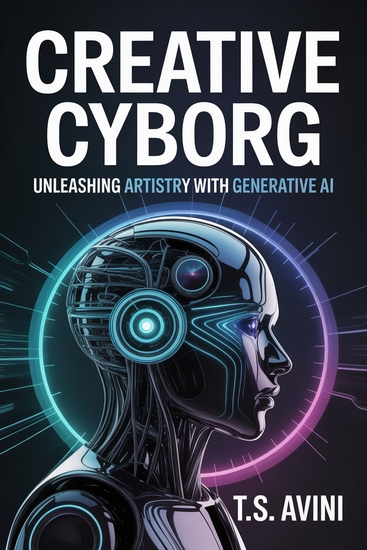
Creative Cyborg - Unleashing Artistry with Generative AI - cover

Creative Cyborg - Unleashing Artistry with Generative AI

T.S Avini

Publisher: T.S. AVINI

  • 0
  • 0
  • 0

Summary

Discover the transformative world of "Creative Cyborg," where technology meets creativity in a dazzling new synergy. This book unveils how generative AI is revolutionizing art, music, and literature, offering a frontier ripe for exploration by artists and technologists alike.- Dive into the evolution of AI in art, tracing its journey from niche technology to a fundamental tool reshaping creative processes.- Unveil the ethical implications and challenges of AI artistry, exploring how ownership and authorship are redefined in the era of intelligent machines. Whether you're an artist seeking inspiration or a technologist eager to harness new tools, "Creative Cyborg" reveals the potential of collaborating with AI. Embark on this exciting journey and redefine the boundaries of your creative universe today!
Available since: 08/07/2025.
Print length: 198 pages.
Other books that might interest you

  • Celebrity Image and the New Politics of Pop - How Ariana Grande Redefines Feminism Fame and Influence in the Digital Age - cover

    Celebrity Image and the New...

    Alice Jackson

    • 0
    • 0
    • 0
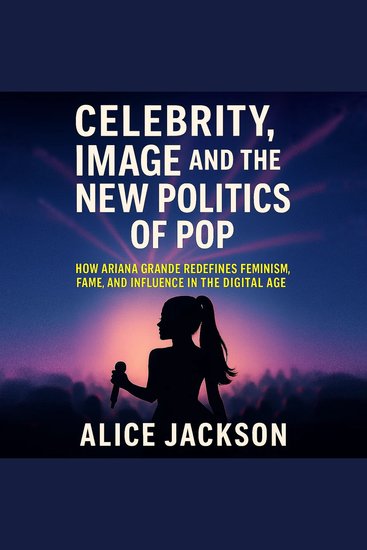
    In an era where pop stars are more than performers, they are also brands, icons, and political actors. Celebrity, Image, and the New Politics of Pop offers a groundbreaking look into the cultural power of one of the most influential figures of our time: Ariana Grande. 
    Drawing on cultural criticism, media theory, and feminist analysis, this book examines how Grande has strategically crafted her image to navigate and challenge the evolving landscapes of celebrity, gender politics, and digital culture. From her early Nickelodeon days to her transformation into a global feminist symbol, Grande's rise is more than a success story; it's a case study in how pop stardom operates in the 21st century. 
    Whether she's using social media to bypass traditional media gatekeepers or reclaiming agency over her body and voice, Grande embodies a new kind of celebrity, one that blurs the lines between personal branding and political influence, performance and authenticity. 
    For readers fascinated by pop culture, media studies, feminism, or the artistry and ambition behind one of today's biggest stars, this book is an essential and eye-opening read.
    Show book
  • Kendrick Lamar's To Pimp a Butterfly - cover

    Kendrick Lamar's To Pimp a...

    Sequoia Maner

    • 0
    • 0
    • 0
    Breaking the global record for streams in a single day, nearly 10 million people around the world tuned in to hear Kendrick Lamar’s sophomore album in the hours after its release. To Pimp a Butterfly was widely hailed as an instant classic, garnering laudatory album reviews, many awards, and even a canonized place in Harvard’s W. E. B. Du Bois archive. Why did this strangely compelling record stimulate the emotions and imaginations of listeners?This book takes a deep dive into the sounds, images, and lyrics of To Pimp a Butterfly to suggest that Kendrick appeals to the psyche of a nation in crisis and embraces the development of a radical political conscience. Kendrick breathes fresh life into the Black musical protest tradition and cultivates a platform for loving resistance. Combining funk, jazz, and spoken word, To Pimp a Butterfly’s expansive sonic and lyrical geography brings a high level of innovation to rap music. More importantly, Kendrick’s introspective and philosophical songs compel us to believe in a future where, perhaps, we gon’ be alright.
    Show book
  • Tokugawa Shogunate - Peace Isolation and the Preservation of Samurai Culture - cover

    Tokugawa Shogunate - Peace...

    Rolf Hedger

    • 0
    • 0
    • 0
    The Tokugawa Shogunate, also known as the Edo period (1603–1868), was a time of unprecedented peace and stability in Japan, following centuries of war and political fragmentation. This era began with the victory of Tokugawa Ieyasu at the Battle of Sekigahara in 1600, a decisive conflict that allowed him to consolidate power over the warring daimyo. Three years later, in 1603, he was granted the title of shogun by the emperor, officially marking the beginning of Tokugawa rule. 
    Ieyasu’s triumph at Sekigahara was not merely a military success but also a demonstration of his strategic brilliance and political foresight. By carefully forging alliances and exploiting rivalries among the daimyo, he ensured that his Tokugawa clan would emerge as the dominant force in Japan. Once in power, Ieyasu took immediate steps to secure his family’s hold over the nation. He redistributed land among the daimyo, rewarding loyal vassals and weakening potential threats. This reorganization of landholdings laid the foundation for the centralized feudal system that would define the Tokugawa era. 
    Although Ieyasu formally retired in 1605, passing the title of shogun to his son Tokugawa Hidetada, he continued to wield significant influence from behind the scenes. His retirement was a strategic move designed to solidify the legitimacy of hereditary succession, ensuring that the Tokugawa family would maintain control for generations. This transition of power set a precedent for stability, preventing the kind of succession disputes that had plagued previous shogunates.
    Show book
  • Dark Knight Rises The - The Ultimate Trivia Collection - From The Movie Directed By Christopher Nolan - cover

    Dark Knight Rises The - The...

    Film Trivia Metaverse

    • 0
    • 0
    • 0
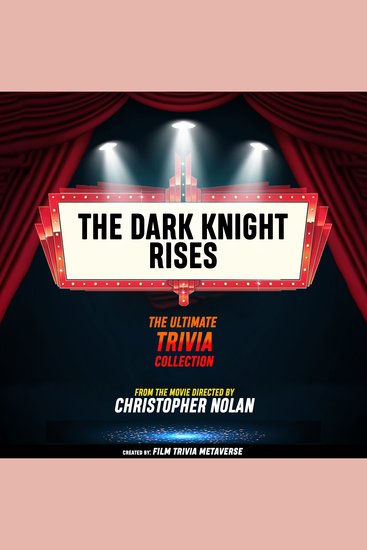
    THE DARK KNIGHT RISES 
    THE ULTIMATE TRIVIA COLLECTION 
      
    FROM THE MOVIE DIRECTED BY CHRISTOPHER NOLAN 
      
    CREATED BY FILM TRIVIA METAVERSE 
      
    ABOUT THE FILM 
    The Dark Knight Rises is a 2012 superhero film directed by Christopher Nolan, marking the conclusion of his Batman trilogy. Set eight years after The Dark Knight, Bruce Wayne (Christian Bale) has retired as Batman, living in isolation. However, Gotham faces a new threat in the form of Bane (Tom Hardy), a masked revolutionary who seeks to destroy the city. As Bane's plan unfolds, Bruce is forced to confront his past, physical limitations, and the legacy of Gotham’s protector. The film explores themes of redemption, resilience, and sacrifice, blending action with emotional depth and complex character arcs. 
      
    TRIVIA SAMPLES: 
      
    “Nolan described the central theme of "The Dark Knight Rises" as "pain," in contrast to "fear" in "Batman Begins" and "chaos" in "The Dark Knight." 
      
    “To avoid leaks, Christopher Nolan chose to verbally share the film's ending with the cast rather than providing written scripts.” 
      
    “To make Bane appear taller than his co-stars, Tom Hardy, who stands at 5'9", wore lifts that added three inches to his height.” 
      
    “The line "That's a lovely, lovely voice" was improvised by Tom Hardy during a scene at approximately 1 hour 28 minutes in the film.” 
      
    “Tom Hardy revealed that the most challenging aspect of filming was the fight scenes. Despite being a huge Batman fan, he said it felt strange to be "beating up [his] childhood hero."”
    Show book
  • Birdman - The Ultimate Trivia Collection - From The Movie Directed By Alejandro G Iñarritu - cover

    Birdman - The Ultimate Trivia...

    Film Trivia Metaverse

    • 0
    • 0
    • 0
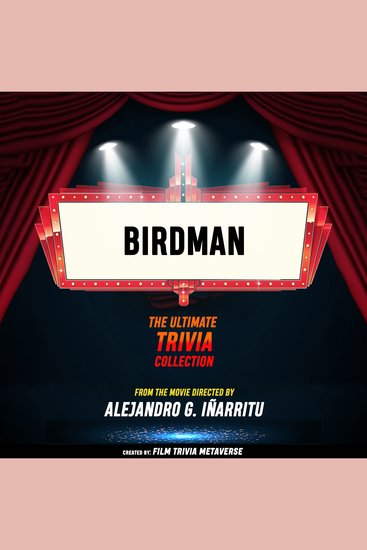
    BIRDMAN 
    THE ULTIMATE TRIVIA COLLECTION 
      
    FROM THE MOVIE DIRECTED BY ALEJANDRO G. IÑÁRRITU 
      
    CREATED BY FILM TRIVIA METAVERSE 
      
    ABOUT THE FILM 
    Birdman (2014), directed by Alejandro G. Iñárritu, follows Riggan Thomson, a faded Hollywood actor known for his role as the superhero "Birdman." Struggling with his past fame, Riggan attempts to reinvent himself by writing, directing, and starring in a Broadway play. The film explores themes of identity, self-worth, and the pressures of fame, blurring the lines between reality and fantasy. Shot in long takes to create the illusion of a single continuous scene, Birdman delves into the complexities of artistic expression, personal redemption, and the challenges of escaping the shadows of past successes. 
      
    TRIVIA SAMPLES: 
      
    "The movie was rehearsed and shot in sequence, so the editing process only took two weeks." 
      
    "Only sixteen visible cuts can be found in the entire film." 
      
    "During filming, Edward Norton and Michael Keaton kept track of the actors' flubs, with Emma Stone making the most errors and Zach Galifianakis the fewest." 
      
    "Much of the film was shot inside Broadway's St. James Theatre, where the actors had to deliver up to fifteen pages of dialogue in one take while hitting precisely choreographed marks." 
      
    "Edward Norton's character parodies his own reputation for being difficult to work with, similar to the way Michael Keaton's Birdman mirrors his earlier role as Batman."
    Show book
  • God Gave Rock and Roll to You - A History of Contemporary Christian Music - cover

    God Gave Rock and Roll to You -...

    Leah Payne

    • 0
    • 0
    • 0
    Few things frightened conservative white Protestant parents of the 1950s and the 1960s more than thought of their children falling prey to the "menace to Christendom" known as rock and roll. The raucous sounds of Elvis Presley and Little Richard seemed tailor-made to destroy the faith of their young and, in the process, undermine the moral foundations of the United States. Parents and pastors launched a crusade against rock music, but they were fighting an uphill battle. 


    Salvation came in a most unlikely form. When a revival swept through counterculture hippie communities of the West Coast in the 1960s and 1970s a new alternative emerged. Known as the Jesus Movement—and its members, more colloquially, as "Jesus freaks"—the revival was short-lived. But by combining the rock and folk music of the counterculture with religious ideas and aims of conservative white evangelicals, Jesus freaks and evangelical media moguls gave birth to an entire genre known as Contemporary Christian Music (CCM). 


    In this book, Leah Payne traces the history and trajectory of CCM in America and, in the process, demonstrates how the industry, its artists, and its fans shaped—and continue to shape—conservative, (mostly) white, evangelical Protestantism.
    Show book