

Join us on a literary world trip!
Add this book to bookshelf
Grey
Write a new comment Default profile 50px
Grey
Subscribe to read the full book or read the first pages for free!
All characters reduced
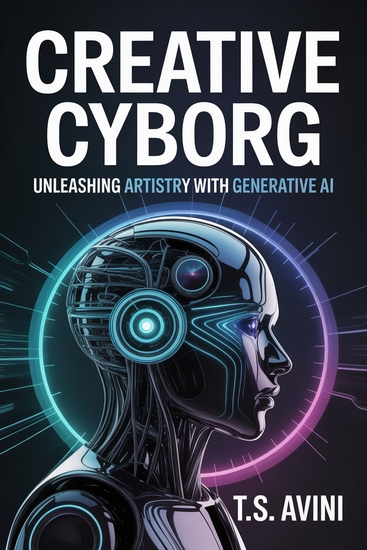
Creative Cyborg - Unleashing Artistry with Generative AI - cover

Creative Cyborg - Unleashing Artistry with Generative AI

T.S Avini

Publisher: T.S. AVINI

  • 0
  • 0
  • 0

Summary

Discover the transformative world of "Creative Cyborg," where technology meets creativity in a dazzling new synergy. This book unveils how generative AI is revolutionizing art, music, and literature, offering a frontier ripe for exploration by artists and technologists alike.- Dive into the evolution of AI in art, tracing its journey from niche technology to a fundamental tool reshaping creative processes.- Unveil the ethical implications and challenges of AI artistry, exploring how ownership and authorship are redefined in the era of intelligent machines. Whether you're an artist seeking inspiration or a technologist eager to harness new tools, "Creative Cyborg" reveals the potential of collaborating with AI. Embark on this exciting journey and redefine the boundaries of your creative universe today!
Available since: 08/07/2025.
Print length: 198 pages.

Other books that might interest you

  • Bruce Springsteen's Born in the USA - cover

    Bruce Springsteen's Born in the USA

    Geoffrey Himes

    • 0
    • 0
    • 0
    When Bruce Springsteen went back on the road in 1984, he opened every show by shouting out, ""one, two, one, two, three, four,"" followed by the droning synth chords of ""Born in the U.S.A."" Max Weinberg hit his drums with a two-fisted physicality that cut through the swelling chords. With a rolled-up red kerchief around his head and heavy black boots under his faded jeans, Springsteen looked like the character of the song, and from the very first line (""Born down in a dead man's town"") he sang with the throat-scraping desperation of a man with his back against the wall. When he reached the crucial lines, though, the guitars and bass dropped out and Weinberg switched to just the hi-hat. Springsteen's voice grew a bit more private and reluctant as he sang, ""Nowhere to run. Nowhere to go."" It was as if he weren't sure if this were an admission of defeat or the drawing of a line in the sand. But when the band came crashing back at full strength—building a crescendo that fell apart in the cacophony of Springsteen's and Weinberg's wild soloing, paused and then came together again in the determined, marching riff—it was clear that the singer was ready to make a stand.
    Show book
  • Muromachi Period - Ashikaga Shoguns and the Rise of Feudal Japan - cover

    Muromachi Period - Ashikaga...

    Rolf Hedger

    • 0
    • 0
    • 0
    The Muromachi Period, spanning from 1336 to 1573, marked a significant turning point in Japanese history, characterized by the rise of the Ashikaga Shogunate and the gradual shift toward decentralized feudal rule. This period emerged following the fall of the Kamakura Shogunate, as Ashikaga Takauji established his military government in Kyoto. The political, social, and cultural transformations that unfolded during this time laid the foundation for the later Sengoku era, a period of constant warfare among regional warlords. 
    The decline of the Kamakura Shogunate stemmed from mounting dissatisfaction among the samurai class, who had grown discontent with the Hojo regents’ rule. The Mongol invasions of Japan in 1274 and 1281 had placed immense strain on the government, as victory brought no financial rewards for the warriors who had fought to defend the nation. With no lands to distribute as compensation, loyalty to the shogunate weakened, creating an opportunity for ambitious leaders to challenge its authority. Amid this unrest, Emperor Go-Daigo launched the Kenmu Restoration (1333–1336), an effort to reestablish imperial rule. However, his failure to recognize the interests of the samurai led to his downfall. 
    Ashikaga Takauji, originally a supporter of the emperor, turned against him and seized power, defeating both imperial and Kamakura loyalists. In 1336, Takauji established his own military government, known as the Muromachi Bakufu, in Kyoto. Unlike the Kamakura Shogunate, which ruled from a distant military capital, the Muromachi Shogunate was strategically located in the heart of Japan’s cultural and political sphere. Takauji’s rule was solidified in 1338 when he was officially
    Show book
  • Beryl - cover

    Beryl

    Joanna Quinn

    • 0
    • 0
    • 0
    This book documents the behind-the-scenes work that went into the animation of the award-winning short film Affairs of the Art by Beryl Productions. It includes a range of sketches, storyboards, final artwork and commentary from director Joanna Quinn and writer Les Mills.
    Show book
  • Father and Son Issues - The Secret History of Spider-Man - cover

    Father and Son Issues - The...

    Jeff Ryan

    • 0
    • 0
    • 0
    FATHER AND SON ISSUES: The Secret History of Spider-Man is the true story of someone with a great power, and a great responsibility. That man, artist John Romita, was the best comics artist no one had ever heard of. After Spider-Man's creators had a falling out, Jazzy John (as Stan Lee called him) had to become the new tale-spinner for the web-spinner.John's take on Spider-Man made Spidey the biggest star at Marvel, and Marvel the biggest name in comics. Comics was a tough business, so the last thing he wanted was for John Romita Jr. to follow in his footsteps.But like father, like son.
    Show book
  • A Rare Recording of Film Icon Burt Lancaster - cover

    A Rare Recording of Film Icon...

    Burt Lancaster

    • 0
    • 0
    • 0
    Burton Stephen Lancaster (November 2, 1913 to October 20, 1994), born in New York City, was an American actor and World War II veteran. Over a 45-year career in films and television series, Lancaster was nominated four times for the Academy Award for Best Actor (winning the Oscar for his role in Elmer Gantry, 1960), won two BAFTA Awards, and one Golden Globe Award. The following audio clips include a 1963 interview discussing Lancaster's participation in the March On Washington, a tv interview from 1963 about his experience working with various directors, and a tv interview from 1974 during which Lancaster promotes his forthcoming Moses The Lawgiving tv mini-series.
    Show book
  • Godfather The - The Ultimate Trivia Collection - From The Movie Directed By Francis Ford Coppola - cover

    Godfather The - The Ultimate...

    Film Trivia Metaverse

    • 0
    • 0
    • 0
    THE GODFATHER 
    THE ULTIMATE TRIVIA COLLECTION 
      
    FROM THE MOVIE DIRECTED BY FRANCIS FORD COPPOLA 
      
    CREATED BY FILM TRIVIA METAVERSE 
      
    ABOUT THE FILM 
    The Godfather is a 1972 American crime drama directed by Francis Ford Coppola, based on Mario Puzo’s bestselling novel. The film follows the powerful Corleone family, led by patriarch Vito Corleone, a Mafia don in post-World War II New York. As Vito’s youngest son, Michael, reluctantly becomes involved in the family's criminal empire, the story explores themes of power, loyalty, revenge, and the complexities of family dynamics. The film delves into the moral struggles faced by its characters as they navigate the dangerous world of organized crime, blending crime thriller with deep emotional and ethical conflicts. 
      
    TRIVIA SAMPLES: 
      
    “Marlon Brando used a mouthpiece made by a dentist to create the distinct look of Don Vito Corleone. He had originally stuffed his cheeks with cotton for his audition to achieve the "bulldog" look.” 
      
    “The cat held by Marlon Brando in the opening scene was a stray that Coppola found on the Paramount lot. It wasn't in the script, and the cat’s purring muffled Brando’s dialogue, so most of his lines had to be re-recorded.” 
      
    “There was significant tension between Francis Ford Coppola and Paramount Pictures, with the studio often trying to replace Coppola due to delays, overspending, and casting issues. However, Coppola finished the film ahead of schedule and under budget.” 
      
    “Marlon Brando improvised the smack that Don Vito gives Johnny Fontane in the movie, and Al Martino's confused reaction was genuine. James Caan later said that Martino didn't know whether to laugh or cry.”
    Show book
