Join us on a literary world trip!
Add this book to bookshelf
Grey
Write a new comment Default profile 50px
Grey
Subscribe to read the full book or read the first pages for free!
All characters reduced
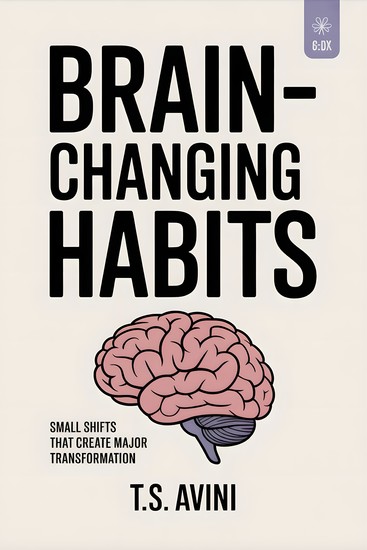
Brain-Changing Habits - Small Shifts That Create Major Transformation - cover

Brain-Changing Habits - Small Shifts That Create Major Transformation

T.S Avini

Publisher: T.S. AVINI

  • 0
  • 0
  • 0

Summary

Discover how small shifts can lead to major life transformations with "Brain-Changing Habits." This insightfulguide delves into the art of habit formation, breaking down the science behind our daily rituals and offeringpracticalstrategies for lasting change. Explore the cycle of habits and learn how to:
 
-Identify and replace negative patterns with positive, rewarding behaviors.
 
-Leverage the power of your environment and social circles to reinforce beneficial habits.
 
With actionable techniques for setting SMART goals and tracking progress, this book reveals the undeniable impactof incremental progress. Whether you're looking to enhance your personal or professional life, these brain-changing habits provide a solid foundationfor achieving your dreams. Embrace this journey toward continuousgrowth and unlock your true potential today!
Available since: 08/04/2025.
Print length: 245 pages.

Other books that might interest you

  • Healthy Feelings Thriving Faith - Growing Emotionally and Spiritually Through the Enneagram - cover

    Healthy Feelings Thriving Faith...

    Kristi Gaultiere, Bill Gaultiere

    • 0
    • 0
    • 0
    If you've ever taken a personality test, you may have found yourself in enthusiastic agreement about the positive aspects of your personality, while the less desirable traits listed may have made you a bit defensive. Maybe you read up on a different personality type and wished you had more of those qualities. But the truth is, every type can get stuck in unhealthy emotional and spiritual patterns. And no matter what your personality, you have the potential to grow into the healthiest and most loving version of yourself. 


    In Healthy Feelings, Thriving Faith, Drs. Bill and Kristi Gaultiere use the Enneagram to lead you through a journey of discovery, showing you how God can transform unhealthy patterns of anger, shame, anxiety, and sadness into freedom, joy, peace, and love. Through eye-opening insights, engaging stories, and simple soul care practices and spiritual disciplines, this book offers an avenue to renewed hope and personal growth you may not have thought possible. 


    If you want to go from knowing your personality type to growing in wholeness, empathy, and faith, let the Gaultieres be your guide.
    Show book
  • On the Nature of Things - cover

    On the Nature of Things

    Lucretius

    • 0
    • 0
    • 0
    "On the Nature of Things" by Lucretius is a profound exploration of Epicurean philosophy, blending poetry and science to explain the universe. Lucretius argues that everything is composed of atoms, governed by natural laws rather than divine intervention. He explores themes of existence, free will, and the pursuit of happiness, advocating for a life free from fear of death and superstition. Through vivid imagery and logical reasoning, he dismantles myths, emphasizing the importance of reason and sensory experience. This seminal work critiques materialism and highlights the beauty of the natural world. A cornerstone of classical thought, it invites readers to embrace a rational, tranquil existence rooted in understanding the cosmos and humanity's place within it.
    Show book
  • Beyond the Horizon - How Intelligence Limits Led to The Pearl Harbor Failure - cover

    Beyond the Horizon - How...

    Davis Truman

    • 0
    • 0
    • 0
    Beyond the Horizon: How Intelligence Limits Led to the Pearl Harbor Failure offers a compelling analysis of one of history's most infamous intelligence failures — the surprise attack on Pearl Harbor. Drawing on historical evidence and cognitive science, this thesis explores the systemic issues in U.S. intelligence operations leading up to the attack, including shortcomings in collection, analysis, and management. 
    These failures were not solely the result of institutional flaws but were deeply rooted in human decision-making's inherent cognitive and behavioral limitations. The book highlights how intelligence professionals can learn from the past to anticipate and mitigate future threats by uncovering these constraints. 
    Packed with insightful lessons and actionable recommendations, Beyond the Horizon is a vital resource for intelligence officers, policymakers, and historians. It emphasizes the importance of adapting to human limitations to protect against potential surprises.
    Show book
  • Whatever You Say You Aren't with Robert Anton Wilson - cover

    Whatever You Say You Aren't with...

    Robert Anton Wilson

    • 0
    • 0
    • 0
    In this lecture Robert Anton Wilson speaks of how we think we all know who we are. You are living in your own reality that you are creating. Everybody has a vision of themselves that they have created. Where in relationships the other person has an entirely different vision of you are as a person. Strangers see you completely different from how you view yourself. Which is the real you? Certainly not the you that you know. Our knowledge of ourselves is usually tremendously delusional and most people don't actually know the real them.
    Show book
  • Spinning Out - Climate Change Mental Health and Fighting for a Better Future - cover

    Spinning Out - Climate Change...

    Charlie Hertzog Young

    • 0
    • 0
    • 0
    'Utterly brilliant - engaging, thrilling, disturbing, revelatory, explosive' GEORGE MONBIOT'This extraordinary book, written with startling honesty and vulnerability, traces Charlie's remarkable journey from deep despair to resistance, reconnection and remedy. If you are ready to channel grief within into action in the world, read on.' KATE RAWORTH, author of Doughnut Economics: Seven Ways to Think Like a 21st-Century Economist'Spinning Out is a salve, weaving together the intricacies of madness underscored by the backdrop of a changing climate. It's an essential and insightful resource in the fight for climate justice.' TORI TSUI, author of It's Not Just You'Heart-rendingly, heart-stoppingly glorious' MANDA SCOTT, author of bestselling Boudica seriesHumanity is driving the earth mad. Now, the earth is driving us mad in return. Charlie Hertzog Young became a climate activist in his early teens. His journey led him onto airport runways and into the halls of power, but also to a serious mental health breakdown. He had to rebuild himself physically and psychologically, before focusing his efforts on collective mental recovery in response to a planet in crisis.Spinning Out explores how climate chaos and the failure of those in power to tackle it are causing an inevitable mental health crisis across the globe. The relationship between the climate and our emotional wellbeing goes far deeper than eco-anxiety. It goes to he roots of our civilisation - its principles, its practices and its false solutions.With testimony from dozens of activists, organisers and researchers across every habitable continent, Spinning Out is a celebration (of other ways to be) and a manual for anyone who wants to fight for a better world, while avoiding burnout and despair.Wedding the needs of the earth with the needs of the human mind, Spinning Out offers a powerful, collective vision for change.
    Show book
  • Shiloh: The History of the First Major Battle in the Western Theater during the Civil War - cover

    Shiloh: The History of the First...

    Jonathan Gianos-Steinberg

    • 0
    • 0
    • 0
    After Union General Ulysses S. Grant captured Fort Henry and Fort Donelson in early 1862, Confederate General Albert Sidney Johnston, widely considered the Confederacy’s best general, concentrated his forces in northern Georgia and prepared for a major offensive that culminated with the biggest battle of the war to that point, the Battle of Shiloh. On the morning of April 6, Johnston directed an all out attack on Grant’s army around Shiloh Church, and though Grant’s men had been encamped there, they had failed to create defensive fortifications or earthworks. They were also badly caught by surprise. With nearly 45,000 Confederates attacking, Johnston’s army began to steadily push Grant’s men back toward the river. 
    The Battle of Shiloh lasted two days, but the battle over the battle had just begun. Grant’s army had just won the biggest battle in the history of North America, with nearly 24,000 combined casualties among the Union and Confederate forces. Usually the winner of a major battle is hailed as a hero, but Grant was hardly a winner at Shiloh. The Battle of Shiloh took place before costlier battles at places like Antietam and Gettysburg, so the extent of the casualties at Shiloh shocked the nation. Moreover, at Shiloh the casualties were viewed as needless; Grant was pilloried for allowing the Confederates to take his forces by surprise, as well as the failure to build defensive earthworks and fortifications, which nearly resulted in a rout of his army. Speculation again arose that Grant had a drinking problem, and some even assumed he was drunk during the battle. Though the Union won, it was largely viewed that their success owed to the heroics of General Sherman in rallying the men and Don Carlos Buell arriving with his army, and General Buell was happy to receive the credit at Grant’s expense.
    Show book