Join us on a literary world trip!
Add this book to bookshelf
Grey
Write a new comment Default profile 50px
Grey
Subscribe to read the full book or read the first pages for free!
All characters reduced
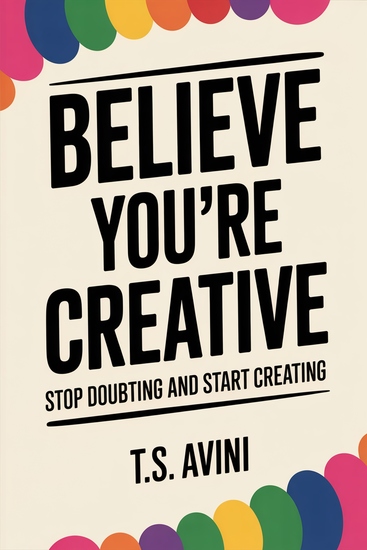
Believe You're Creative - Stop Doubting and Start Creating - cover

Believe You're Creative - Stop Doubting and Start Creating

T.S Avini

Publisher: T.S. AVINI

  • 0
  • 0
  • 0

Summary

"Believe You're Creative: Stop Doubting and Start Creating" is your comprehensive guide to tapping into the creative potential that resides within us all. This enlightening book dismantles the myth of the "non-creative" person and provides you with the tools to unleash your untapped creativity. With captivating insights into the science of creativity, it explores how anyone can overcome self-doubt and cultivate a growth mindset to fuel their creative journey. - Discover the importance of nurturing curiosity and learn about the power of routine and discipline in fostering long-lasting creativity.- Explore how your environment, collaborations, and even your failures can be transformative in your path to unlocking creativity.This book not only inspires but equips you to believe in your ability to create, offering a blend of wisdom and actionable strategies. Are you ready to embark on a transformative journey and embrace your creative self? Begin your adventure today.
Available since: 08/05/2025.
Print length: 200 pages.


Other books that might interest you

  • Heart of the Anarchist - cover

    Heart of the Anarchist

    Jaron Dagan

    • 0
    • 0
    • 0
    A series of essays, laid out to detail the ethos of postmodern anarchism. 
    Jaron Dagan assembles a unique and unusual array of historical stories, philosophical ideas, and geopolitical catalogues, with the aim of explaining the utility of anarchism in the modern world.
    Show book
  • Emperor Charlemagne: A short biography - 5 Minutes: Short on time - long on info! - cover

    Emperor Charlemagne: A short...

    5 Minutes, 5 Minute Biographies,...

    • 0
    • 0
    • 0
    Emperor Charlemagne, German and European: Life and works in a short biography! Everything you need to know, brief and concise. Infotainment, education and entertainment at its best!
    Show book
  • Cryptocurrency for beginners: how to get started - cover

    Cryptocurrency for beginners:...

    AHMED MUSA

    • 0
    • 0
    • 0
    Cryptocurrency for Beginners: How to Get Started is your ultimate guide to understanding the exciting world of digital currencies and blockchain technology. Whether you're curious about Bitcoin, Ethereum, or NFTs, this book demystifies the jargon and equips you with the knowledge to navigate the cryptocurrency landscape with confidence. 
    Starting with the basics, you'll learn what cryptocurrencies are, how they work, and why they matter. From creating a digital wallet to securing your investments, this book covers essential steps to help you buy, trade, and store crypto safely. Explore real-world applications, including decentralized finance (DeFi), non-fungible tokens (NFTs), and blockchain’s impact on industries like healthcare, gaming, and supply chain management. 
    Designed for beginners, this practical and accessible guide provides clear explanations, actionable tips, and insights into minimizing risks and maximizing opportunities. Whether you're investing, exploring blockchain projects, or simply curious about this revolutionary technology, Cryptocurrency for Beginners empowers you to take the first step toward understanding and leveraging the future of money.
    Show book
  • Dome of the Rock The: The History of the Oldest Islamic Shrine in Jerusalem - cover

    Dome of the Rock The: The...

    Charles River Editors

    • 0
    • 0
    • 0
    Among the world’s most recognizable man-made structures, the Dome of the Rock – known in Arabic as the Qubbat as-Sakara – is also one of its most mysterious. Although much of the Dome’s construction, reconstruction, and later additions are well-known from historical texts and archeological work, what it represents, why it was built where it was, and even its use remain the subject of scholarly controversy. Known for its immense size and beauty, and also for being located in the middle of Jerusalem, one of the world’s holiest cities, the Dome of the Rock has been the focus of political leaders who wished to legitimize their rule, religious warriors who believed that it empowered their weapons, and pilgrims who thought it was a site of salvation and enlightenment. As it drew these often diverse and sometimes disparate people to it, it has served the purposes of devout Jews, Muslims, and Christians, who -- although often not peacefully sharing the site -- seem to recognize its spiritual importance. 
    The Dome of the Rock has been many things to many people over the centuries, and historians, art historians, and archaeologists have studied the Dome of the Rock and its background extensively. Academics have created an accurate chronology of its life, as well as details about how the monument was built, including the construction and artistic techniques that were used. The dome was built on the site of what is believed to have been the Solomonic Temple that the Israelites built to worship their god, Yahweh, setting the stage for the entire area to be a holy site for the Abrahamic religions over the following centuries. Historians believe that the Umayyad Muslims saw this background as a prime location to build one of the greatest religious complexes in the Islamic world.
    Show book
  • This Southern Metropolis - Life in Antebellum Mobile - cover

    This Southern Metropolis - Life...

    Mike Bunn

    • 0
    • 0
    • 0
    This book is based on visitor descriptions of antebellum Mobile, Alabama's physical and social environment. Mobile's foundational era is a period in which the city transformed from a struggling colonial outpost into one of the nation's most significant economic powerhouses, largely owing to the cotton trade and the labor of enslaved people. On the eve of the Civil War, the Mobile ranked as the fourth most populous community in what would soon become the Confederacy, and within the Gulf Coast region, it stood second only to New Orleans in population, wealth, and influence. 


    The city's remarkable architecture, beautiful natural setting, and abundance of entertainment options made it one of the South's most distinctive communities. Its cultural diversity added to its uniqueness. In addition to being home to the largest white population of any community in Alabama, the city also claimed the state's largest free Black, foreign-born, and Creole communities. Mobile was the slave-trading center of the state until the 1850s and remained intertwined with the institution of slavery throughout the antebellum period. By 1860 Mobile's population stood at nearly thirty thousand people, making it the twenty-seventh-largest city in the US. Although numerous histories of Mobile have been published, none have focused on firsthand accounts published by antebellum-era visitors.
    Show book
  • Iron Catastrophes - A Global History of Train Disasters - cover

    Iron Catastrophes - A Global...

    P Agrawal

    • 0
    • 0
    • 0
    This audiobook is narrated by an AI Voice.   
    From the dawn of the railway age to the sleek high‑speed trains of the twenty‑first century, the story of the railroad has always carried a double edge—an instrument of triumph and transformation, and at the same time an arena of grief and devastation. Iron Catastrophes: A Global History of Train Disasters is a sweeping chronicle of how progress raced forward on steel tracks while continually stumbling into tragedy. 
    This book journeys across continents and centuries to chart the history of railway disasters in all their complex dimensions. Beginning with the earliest accidents of the nineteenth century, when untested locomotives burst their boilers or derailed on fragile tracks, it shows how railway travel was stamped by peril from its very birth. The death of British politician William Huskisson in 1830, struck down on the Liverpool and Manchester line’s opening day, symbolized how quickly innovation could turn lethal. Soon after came infernos, collisions in the fog, bridge collapses, and explosions that shocked a society intoxicated by speed yet horrified by risk. 
    The narrative then widens to explore disasters across Europe, America, Asia, Africa, and the colonial world. Chapters recount Europe’s notorious horrors—from Britain’s Harrow collision to France’s Versailles fire and Spain’s Torre del Bierzo tragedy—where crashes shattered faith in modernity. In America, endless expansion created reckless improvisations: wooden bridges that collapsed, locomotives that burned, collisions that littered small towns with wreckage. In Asia, the disasters grew on an almost unimaginable scale. India’s catastrophic wrecks, Japan’s cultural trauma at Amagasaki, Sri Lanka’s tsunami train engulfed by waves, and China’s modern tragedy at Wenzhou illustrate that even regions most reliant on the rails suffered losses measured in the thousands.
    Show book