Join us on a literary world trip!
Add this book to bookshelf
Grey
Write a new comment Default profile 50px
Grey
Subscribe to read the full book or read the first pages for free!
All characters reduced
48 Hours Unplugged - How to Reset Focus and Reduce Anxiety - cover

48 Hours Unplugged - How to Reset Focus and Reduce Anxiety

T.S Avini

Publisher: T.S. AVINI

  • 0
  • 0
  • 0

Summary

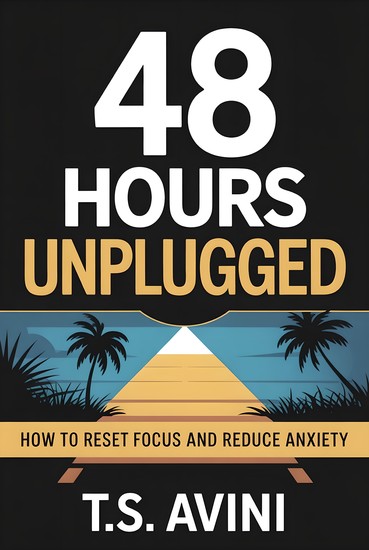
In "48 Hours Unplugged: How to Reset Focus and Reduce Anxiety," discover the transformative power ofdisconnecting from the digital world and reconnecting with your authentic self. As our lives are increasinglydominated by screens and notifications, this book provides a practical roadmap to break free and regain control. Explore the science behind anxiety and focus and learn why a tech hiatus is essential for your mental health.
 
-Understand the profound impact technology has on your mental well-being and how to create a healthierrelationship with it.
 
-Follow step-by-step guidance to prepare for your unplugged experience, manage withdrawal symptoms, andembrace mindfulness.
 
Through personal stories and expert insights, you’ll explore creative activities, face-to-face interactions, and thejoys of solitude. This book is your guide to achieving long-term digital balance and nurturing your inner child. Takethe first step toward a more focused, anxiety-free life—commit to 48 hours unplugged!
Available since: 08/02/2025.
Print length: 245 pages.

Other books that might interest you

  • Theodor Adorno - A Very Short Introduction - cover

    Theodor Adorno - A Very Short...

    Andrew Bowie

    • 0
    • 0
    • 0
    T. W. Adorno (1903-1969) was a German philosopher and social and cultural theorist. His work has come to be seen as increasingly relevant to understanding the pathologies of contemporary society evident in today's climate emergency, the financial crash, the reappearance of fascism in many countries, and the growing instability of the world order. 


    This Very Short Introduction covers Adorno's work and life, explaining his key philosophical concepts and the philosophical background and historical context of Adorno's thinking. Andrew Bowie shows how Adorno's exploration of why human reason can have irrational consequences led him to rethink basic concepts like 'nature', 'history', and 'freedom', offering alternatives to many ways of thinking about these concepts in contemporary philosophy. The book also examines Adorno's social theory, as well as his highly critical assessments of jazz and modern culture, which he considered threatened by the effects of modern capitalism.
    Show book
  • Dangerous Liaisons - cover

    Dangerous Liaisons

    Pierre Choderlos de Laclos

    • 0
    • 0
    • 0
    Set in pre-revolutionary France, "Dangerous Liaisons" is an epistolary novel that revolves around the cynical Marquise de Merteuil and the Vicomte de Valmont, two former lovers who engage in a web of seduction, manipulation, and betrayal. Through their letters, the novel exposes the moral corruption and decadence of the French aristocracy. With themes of sexual intrigue, power dynamics, and the consequences of unbridled passions, Laclos crafts a gripping and psychologically intricate narrative that continues to captivate readers today. "Dangerous Liaisons" remains a timeless exploration of human desires and the destructive nature of games played with hearts. 
     
    Pierre Choderlos de Laclos, a French army general and writer, is most famous for his epistolary novel "Les Liaisons Dangereuses" ("Dangerous Liaisons"), published in 1782. The novel, exploring themes of seduction, manipulation, and revenge among the French aristocracy, became a literary classic and a seminal work of French literature.
    Show book
  • Sundaland: The History of the Asian Landmass that Started Sinking After the Ice Age - cover

    Sundaland: The History of the...

    Editors Charles River

    • 0
    • 0
    • 0
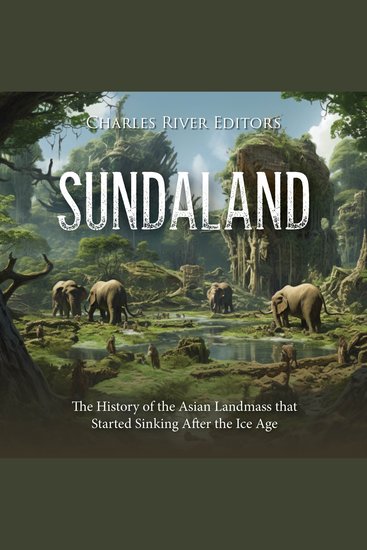
    By the time the Pleistocene Epoch ended around 12,000 years ago, Homo sapiens had become one of the most significant species on the planet. 	It was also near the end of that period of time that modern humans began to gradually populate what would become Europe, Asia, and the Americas, eventually becoming the inheritors of the Paleolithic era and the only human species to make it into the Neolithic era. The process was long and difficult, and the survival of the species only happened through a combination of human tenacity and a fair amount of luck. As much as humans evolved during the Pleistocene, the topography, geography, and environment changed even more. 
    The cold Pleistocene temperatures lowered water levels across the planet, exposing land that was not there before or after the period. At the same time, significant regions of the planet were very different during the Pleistocene, including Southeast Asia, particularly the modern islands of Bali, Borneo, Sumatra, and the Malay Peninsula, roughly equivalent to parts of Indonesia, Malaysia, Myanmar, and Thailand. This region, which modern scholars refer to as Sunda or Sundaland, was unique because all of it was connected by land, meaning today’s islands were once part of a contiguous subcontinent, and in terms of the people, flora, and fauna, it was very different than it is today. If a modern traveler could somehow transport back to the Pleistocene, Sundaland would look nothing like modern Southeast Asia and would resemble as much of a lost world as something out of a science fiction novel.  
    Although much is still unknown about Sundaland, researchers have uncovered plenty of evidence bringing this lost world to life. As anthropologists and archaeologists developed new models and discovered ancient material culture, they learned that Sundaland played a significant role in the development of Neolithic Southeast Asia in many ways. 
    Show book
  • Romanovs The: An Enthralling Overview of the House of Romanov - cover

    Romanovs The: An Enthralling...

    Billy Wellman

    • 0
    • 0
    • 0
    With some of the most memorable names in history, the Romanov dynasty is one of those royal families whose legacy can only be rivaled by a few. 
    Ruling Russia for a little over three hundred years, from the 17th to the early 20th centuries, the Romanov tsars and, in rare but unforgettable cases, empresses dominated the political landscapes of their times and forged one of the most legendary dynasties of all time. 
    In fact, Russia, the big and powerful nation-state we know today, was largely created because of the efforts of Romanov rulers like Peter the Great or Catherine the Great. The Romanov family has forever been guaranteed a place in Russian, European, and even world history books. 
    Diving into the history of such a well-known dynasty is a treat for anyone who is passionate about learning more about Russia. 
    Here’s a glimpse of what you will find in this audiobook:An in-depth history of the emergence of the Romanov dynasty, which happened during perhaps the most turbulent period in Russia’s existenceThe social and political developments throughout the Romanov dynasty, from Mikhail Romanov to Nicholas IIA deep dive into the external and domestic conflicts that shaped Russia under the RomanovsAn exciting journey of Russia’s cultural transformation from a backward country to a world superpower that strived to achieve a clear European identityThe role of the Romanovs in several world-shattering events, such as World War I and the Russian Revolution of 1917The legacy of the Romanov dynastyAnd much, much more! 
    Scroll up and click the “add to cart” button to begin your journey into the past today!
    Show book
  • Oceans of Grain - How American Wheat Remade the World - cover

    Oceans of Grain - How American...

    Scott Reynolds Nelson

    • 0
    • 0
    • 0
    An "incredibly timely" global history journeys from the Ukrainian steppe to the American prairie to show how grain built and toppled the world's largest empires (Financial Times). To understand the rise and fall of empires, we must follow the paths traveled by grain—along rivers, between ports, and across seas. In Oceans of Grain, historian Scott Reynolds Nelson reveals how the struggle to dominate these routes transformed the balance of world power. Early in the nineteenth century, imperial Russia fed much of Europe through the booming port of Odessa, on the Black Sea in Ukraine. But following the US Civil War, tons of American wheat began to flood across the Atlantic, and food prices plummeted. This cheap foreign grain spurred the rise of Germany and Italy, the decline of the Habsburgs and the Ottomans, and the European scramble for empire. It was a crucial factor in the outbreak of the First World War and the Russian Revolution. A powerful new interpretation, Oceans of Grain shows that amid the great powers’ rivalries, there was no greater power than control of grain.“American cotton changed the world in the first half of the nineteenth century, American wheat in its second half. Scott Reynolds Nelson’s globe-spanning exploration of the powers of a humble grain to topple empires, enable industrialization, build cities, and redirect trade flows is the kind of commodity history one wishes for: attentive to politics, connected as well as comparative in perspective, and with a knack for telling details. After reading this fast-paced book, the wars, revolutions, and empires of the nineteenth century will never seem the same.”―Sven Beckert, author of Empire of Cotton
    Show book
  • Borderline Personality Disorder - A Life-Changing Guide to Successfully Manage BPD Protect Your Mental Health and Cultivate Healthy Relationships - cover

    Borderline Personality Disorder...

    Lois Frost

    • 0
    • 0
    • 0
    Are you constantly grappling with intense emotional turmoil? 
    Does the fear of abandonment often consume your thoughts, causing you to push away those you love the most? 
    Do you struggle to understand why your mood can shift so rapidly from euphoria to deep despair? 
    Does the storm of rage inside you often lead to impulsive and self-damaging actions? 
    I understand the whirlwind of emotions and the constant struggle. I've been there. 
    It's hard, it's confusing, it's often lonely, but remember, you are not alone. Your battle with BPD is not in vain. This book is your beacon of hope. 
    Imagine for a second, what if you could ... 
    - Gain control over your emotions, rather than letting them control you. 
    - Learn to navigate relationships healthily, fostering deep, meaningful connections. 
    - Overcome the fear of abandonment and build resilience within yourself. 
    - Develop a strong and stable sense of self, firmly rooted in self-acceptance and self-love. 
    - Find healthier outlets for your impulsivity, channeling it into productive endeavors. 
    - Learn to manage stress and paranoia, fostering a more peaceful and serene mindset. 
    Here's a little sneak preview of what you’ll get: 
    - Practical strategies to manage emotional instability and cultivate emotional intelligence. 
    - Insights into the origins and symptoms of BPD, helping you better understand your condition. 
    - Effective coping mechanisms to handle stress and paranoia, fostering a sense of peace and tranquility. 
    - Techniques to help you develop a healthier and more positive self-image. 
    - Methods to regulate anger and express your emotions effectively.Make the first move towards a better tomorrow. Your healthier, happier self awaits.
    Show book