Join us on a literary world trip!
Add this book to bookshelf
Grey
Write a new comment Default profile 50px
Grey
Subscribe to read the full book or read the first pages for free!
All characters reduced
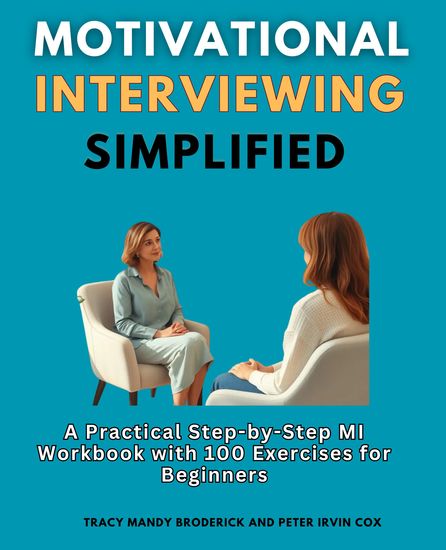
Motivational Interviewing Simplified - A Practical Step-by-Step MI Workbook with 100 Exercises for Beginners - cover

Motivational Interviewing Simplified - A Practical Step-by-Step MI Workbook with 100 Exercises for Beginners

Tracy Mandy Broderick, Peter Irvin Cox

Publisher: TherapyBooks Publishing

  • 0
  • 0
  • 0

Summary

Motivational Interviewing Simplified: A Practical Step-by-Step MI Workbook with 100 Exercises for Beginners
 
Fed up with traditional counseling approaches that fall flat? "Motivational Interviewing Simplified" cuts through the noise, delivering exactly what beginners need to master this game-changing method. Authors Tracy Mandy Broderick and Peter Irvin Cox have crafted the ultimate hands-on resource that transforms theory into immediate practice.
 
This isn't another dry textbook gathering dust on your shelf. It's a working toolkit packed with 100 ready-to-use worksheets that breathe life into the art of helping others discover their own reasons for change. The genius lies in its accessibility – complex concepts are broken down into bite-sized, actionable techniques anyone can implement right away.
 
Inside these pages, you'll find:
 
No-nonsense explanations that demystify MI's core principles without drowning you in jargon Concrete methods for spotting "change talk" and gently navigating resistance Field-tested worksheets tailored for healthcare providers facing medication adherence challenges, educators motivating reluctant students, counselors supporting addiction recovery, and managers inspiring workplace performance Practical roadmaps for handling cultural differences with sensitivity and respect Real-world examples showing exactly how these techniques play out in actual conversations
 
What sets this workbook apart is its ruthless focus on application. Each worksheet comes with clear directions, proven rationales, and problem-solving tips for when things don't go as planned. You'll learn to dance with ambivalence, reflect with precision, and guide conversations toward meaningful outcomes.
 
Perfect for front-line practitioners who need solutions now, this resource lets you photocopy worksheets for immediate use with clients or students. From the crucial first steps of building rapport to the advanced skills of maintaining hard-won progress, this workbook walks beside you through every phase of the MI journey.
 
Ditch the ineffective lecture-style approaches. With "Motivational Interviewing Simplified," you'll develop the confidence to help others tap into their intrinsic motivation for lasting change – perhaps the most valuable skill any helping professional can master.
 
Retry
Available since: 02/26/2025.
Print length: 212 pages.

Other books that might interest you

  • Finis Britanniae - A Military History of Late Roman Britain and the Saxon Conquest - cover

    Finis Britanniae - A Military...

    Murray Dahm

    • 0
    • 0
    • 0
    The end of Roman Britain and the arrival of the invading Saxons forms part of the most disruptive period in Britain’s history. Centuries of relative stability as a Roman province gave way to an age of conquest and destruction. It is a period which is difficult to comprehend, coming at the end of the Roman era and in the pre-dawn of the Medieval. It is a Dark Age, both in terms of our apparent lack of source material and in our understanding of events. As a result, several legendary figures appear – it is the age of Arthur, Merlin and others; figures steeped in mystery, mysticism and magic, allowed to thrive in the paucity of the source material. 
     
    In this new analysis, Murray Dahm explores the military history of Roman Britain’s slow decline, going back to the roots of the province’s final rupture from Rome in the fifth century and the subsequent invasions. Using a wide array of sources, the author illuminates this dark world and examines what we know (or what we think we know) of the Angle, Jute, Saxon and other invasions that took advantage of Rome’s absence and which, in their own way, shaped the Britain of today.
    Show book
  • Thanatology - The Study of Death - cover

    Thanatology - The Study of Death

    Mike Crawford

    • 0
    • 0
    • 0
    Thanatology, the study of death and the processes surrounding it, has deep historical roots. While the formal discipline emerged in the 20th century, human fascination with death dates back to ancient times. Early civilizations developed complex rituals, beliefs, and philosophies surrounding death, shaping the way societies understood and coped with mortality. Over time, thanatology evolved from religious and philosophical inquiries to a multidisciplinary field incorporating medical, psychological, and sociological perspectives. 
    In ancient societies, death was often viewed through a spiritual or mythological lens. Egyptian, Greek, and Hindu traditions conceptualized the afterlife in elaborate ways, influencing burial practices and rituals. The Egyptians, for instance, believed in the preservation of the body for the soul’s journey in the afterlife, leading to the practice of mummification. Similarly, Greek philosophy—particularly the works of Plato—explored the soul’s immortality and the nature of existence beyond death. These early interpretations laid the groundwork for later philosophical and religious discussions on mortality. 
    The Middle Ages saw the dominance of religious perspectives on death, with Christianity, Islam, and Buddhism offering moral and theological frameworks for understanding mortality. Death was often seen as a transition rather than an end, shaping attitudes toward dying and burial practices. The Black Death in the 14th century significantly influenced perceptions of death, leading to a greater emphasis on the fragility of life and the afterlife. Art, literature, and religious texts from this period reflect a deep engagement with the themes of death and salvation.
    Show book
  • Trustworthiness - The Mark of Reliability - Being a Person Others Can Depend on - cover

    Trustworthiness - The Mark of...

    Esther Jameson

    • 0
    • 0
    • 0
    Understanding trustworthiness is a multifaceted journey that begins with self-reflection and extends outward into every aspect of personal and professional relationships. At its core, trustworthiness embodies a steadfast commitment to honesty, ethical behavior, and consistency, which collectively create a solid foundation for dependable character. Recognizing the importance of trust, individuals who are trustworthy not only honor their promises but also cultivate an environment of reliability in their interactions with others. This journey requires introspection, awareness of personal values, and an unyielding dedication to doing what is right, even in challenging circumstances. 
    When we examine the nature of trustworthiness, it becomes evident that it is more than simply avoiding deceit. It is about aligning one’s actions with deeply held principles, ensuring that words and deeds resonate with a sense of sincerity and transparency. A trustworthy person understands that their reputation is built on small, everyday acts of integrity, whether it is keeping a promise to a friend, fulfilling obligations at work, or providing honest feedback when it is most needed. In doing so, they establish a track record that not only builds self-confidence but also inspires confidence in those who depend on them. 
    Moreover, trustworthiness is an active pursuit that requires continuous effort and self-improvement. It demands that individuals remain vigilant against the temptations of shortcuts and the allure of expediency, always choosing the ethical path even when it may seem inconvenient. Such a mindset reinforces the idea that being dependable is a lifelong commitment, one that is enriched by learning from mistakes and growing through experience. This commitment forms the cornerstone of all meaningful relationships, whether in the context of personal life, the workplace, or broader community interactions.
    Show book
  • I'll Just Be Five More Minutes - And Other Tales from My ADHD Brain - cover

    I'll Just Be Five More Minutes -...

    Emily Farris

    • 0
    • 0
    • 0
    A hilariously-honest, heartwarming essay collection about life, love, and discovering you have ADHD at age 35   Despite being a published writer with a family, a gaggle of internet fans, and (most shockingly) a mortgage, Emily Farris could never get her sh*t together. As she saw it, disorganization was one of her countless character flaws—that is until she was diagnosed with ADHD at age 35. Like many girls who go undiagnosed, Emily grew up internalizing criticisms about her impulsivity and lack of follow-through. She held onto that shame as she tried (and often failed) to fit into a world designed for neurotypical brains.  I'll Just Be Five More Minutes is a personal essay collection of laugh-out-loud-funny, tear-jerking, and at times cringey true stories of Emily's experiences as a neurodivergent woman. With the newfound knowledge of her ADHD, Emily candidly reexamines her complicated relationships (including one with a celebrity stalker), her money problems, the years she spent unknowingly self-medicating, and her hyperfixations (two words: decorative baskets).    A memoir-in-essays both entertaining and enlightening, I'll Just Be Five More Minutes is for people with ADHD, as well as those who know and love them. This is a powerful collection of deeply relatable, wide-ranging stories about a woman's right to control her own body, about overwhelm and oversharing, about drinking too much and sleeping too little, and about being misunderstood by the people closest to you. At its heart, I’ll Just Be Five More Minutes is about not quite fitting in and not really understanding why—something we’ve all felt whether we're neurodivergent or not.
    Show book
  • The Awakened Empath Bundle 2 in 1 Bundle: - cover

    The Awakened Empath Bundle 2 in...

    Ari Camran, Cate Orrell

    • 0
    • 0
    • 0
    The Awakened Empath Bundle, 2 in 1 Bundle: Empath's Survival Guide and Empath AbilitiesPeople have common misconceptions about being empathetic and being an empath. To state the obvious, these are two different concepts.  Being empathetic is when our hearts feel for another individual who is going through a period of crisis. Empathy gives us the power to think about, understand, and care about each other. Empath people, however, detect their energy, emotions, and physiological symptoms in them. They are usually more accurate in recognizing emotions just by looking through their body language. They are also more likely to acknowledge emotions prior to others and rate those emotions as being more intense.In this bundle, you will learn how to build and enhance your empathy. It will teach you sensible and time-tested tips you can use to rise above personal biases and become kinder, more forgiving, more accepting, and more loving toward other people. It will also be a guide for empaths.This 2 in 1 bundle includes the following audiobooks:1. Empath's Survival Guide: An Empath's Guide on How to Become Emotionally and Spiritually Healthy to Be the Best Version of Yourself2. Empath Abilities: Learn About the Power of Empathy and How it Can Significantly Enrich Your Life Plus Tips on How to Enhance Your EmpathyIf you want to learn more, download your copy of The Awakened Empath Bundle today!
    Show book
  • Julian - Rome's Last Pagan Emperor - cover

    Julian - Rome's Last Pagan Emperor

    Phillip Freeman

    • 0
    • 0
    • 0
    "When we think of ancient Rome, it's impossible not to think of Christianity, one of its most notable exports—but what if it hadn't been? This is the question provoked by classicist Philip Freeman in Julian, an appealing new entry in Yale's Ancient Lives series, which tells the story of the old faith's last imperial torchbearer."—Anna Heyward, New York Times Book Review 


    Flavius Claudius Julianus, or Julian the Apostate, ruled Rome as sole emperor for just a year and a half, from 361 to 363, but during that time he turned the world upside down. Although a nephew of Constantine the Great, the first Christian emperor of Rome, Julian fought to return Rome to the old gods who had led his ancestors to build their vast empire. 


    As emperor, Julian set about reforming the administration, conquering new territories, and reviving ancient religions. He was scorned in his time for repudiating Christianity and demonized as an apostate for willfully rejecting Christ. Through the centuries, Julian has been viewed by many as a tragic figure who sought to save Rome from its enemies and the corrupting influence of Christianity. Christian writers and historians have seen Julian much differently: as a traitor to God and violent oppressor of Christians. Had Julian not been killed by a random Persian spear, he might well have changed all of history.
    Show book