Join us on a literary world trip!
Add this book to bookshelf
Grey
Write a new comment Default profile 50px
Grey
Subscribe to read the full book or read the first pages for free!
All characters reduced
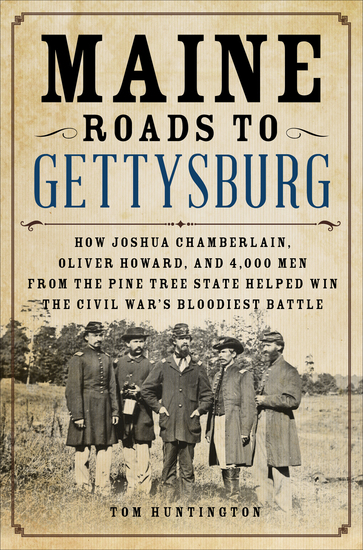
Maine Roads to Gettysburg - How Joshua Chamberlain Oliver Howard and 4000 Men from the Pine Tree State Helped Win the Civil War's Bloodiest Battle - cover

Maine Roads to Gettysburg - How Joshua Chamberlain Oliver Howard and 4000 Men from the Pine Tree State Helped Win the Civil War's Bloodiest Battle

Tom Huntington

Publisher: Stackpole Books

  • 0
  • 0
  • 0

Summary

From the author of Searching for George Gordon Meade, a study of how troops from Maine aided the Union Army’s victory at the Battle of Gettysburg. Joshua Lawrence Chamberlain and his 20th Maine regiment made a legendary stand on Little Round Top during the Battle of Gettysburg in July 1863. But Maine’s role in the battle includes much more than that. Soldiers from the Pine Tree State contributed mightily during the three days of fighting. Pious general Oliver Otis Howard secured the high ground of Cemetery Ridge for the Union on the first day. Adelbert Ames—the stern taskmaster who had transformed the 20th Maine into a fighting regiment—commanded a brigade and then a division at Gettysburg. The 17th Maine fought ably in the confused and bloody action in the Wheatfield; a sea captain turned artilleryman named Freeman McGilvery cobbled together a defensive line that proved decisive on July 2; and the 19th Maine helped stop Pickett’s Charge during the battle’s climax.  Maine soldiers had fought and died for two bloody years even before they reached Gettysburg. They had fallen on battlefields in Virginia and Maryland. They had died in front of Richmond, in the Shenandoah Valley, on the bloody fields of Antietam, in the Slaughter Pen at Fredericksburg, and in the tangled Wilderness around Chancellorsville. And the survivors kept fighting, even as they followed Robert E. Lee’s Army of Northern Virginia into Pennsylvania.  In Maine Roads to Gettysburg, author Tom Huntington tells their stories. Praise for Searching for George Gordon Meade “An engrossing narrative that the reader can scarcely put down.” —Pulitzer Prize-winning historian James M. McPherson “Unique and irresistible.” —Lincoln Prize-winning historian Harold Holzer
Available since: 06/14/2023.
Print length: 432 pages.

Other books that might interest you

  • Matrixial Logic - Forms of Inequality - cover

    Matrixial Logic - Forms of...

    Paul Chaplin

    • 0
    • 1
    • 0
    There is a hidden architecture to how we think, and how we can think. Understanding it grants us power over our thinking. This ground-breaking book challenges 2,500 years of our thinking about thought.
    Logic is the science of reality: the ultimate science. Logic dictates how we conduct physics, chemistry, biology, mathematics and computing. To understand reality requires first, that we understand how our understanding works.
    As a former barrister and solicitor, and legal innovator, Paul has a successful 25 year career in using the logic of the law. Turning to psychology, Paul became a Certified CBT Practitioner. In 2019, he was awarded by publication a PhD in Philosophy, for applied Psychology, for his innovative book I Want To Love But: Realising The Power Of You.
    The revolutionary new solutions to problems in logic, philosophy and science presented in this book can change your world.
    Show book
  • The Viking Saint - Olaf II of Norway - cover

    The Viking Saint - Olaf II of...

    John Carr

    • 0
    • 0
    • 0
    The Vikings and sainthood are not concepts normally found side by side. But Norway’s King Olaf II Haraldsson (c. 995-1030) embodied both to an extraordinary degree. As a battle-eager teenager he almost single-handedly pulled down London Bridge (as in the nursery rhyme) and took part in many other Viking raids. Olaf lacked none of the traditional Viking qualities of toughness and audacity, yet his routine baptism grew into a burning missionary faith that was all the more remarkable for being combined with his typically Viking determination and energy – and sometimes ruthlessness as well. His overriding mission was to Christianize Norway and extirpate heathenism. His unstinting efforts, often at great peril to his life, earned him the Norwegian throne in 1015, when he had barely reached his twenties. For the next fifteen years he labored against immense odds to subdue the rebellious heathen nobles of Norway while fending off Swedish hostility. Both finally combined against Olaf in 1030, when he fell bravely in battle not far from Trondheim, still only in his mid-thirties. After his body was found to possess healing powers, and reports of them spread from Scandinavia to Spain and Byzantium, Olaf II was canonized a saint 134 years later. He remains Norway’s patron saint as well as a legendary warrior. Yet more remarkably, he remains a saint not only of the Protestant church but also of the Roman Catholic and Greek Orthodox Churches – perhaps the only European fighting saint to achieve such acceptance.
    Show book
  • Diadochi The: The History of Alexander the Great’s Successors and the Wars that Divided His Empire - cover

    Diadochi The: The History of...

    Editors Charles River

    • 0
    • 0
    • 0
    On his deathbed, some ancient historians claimed that when he was pressed to name a successor, Alexander the Great muttered that his empire should go “to the strongest”. Other sources claim that he passed his signet ring to his general Perdiccas, thereby naming him successor, but whatever his choices were or may have been, they were ignored. Alexander’s generals, all of them with the loyalty of their own corps at their backs, would tear each other apart in a vicious internal struggle that lasted almost half a century before four factions emerged victorious: Macedonia, the Seleucid Empire in the east, the Kingdom of Pergamon in Asia Minor, and the Ptolemaic dynasty in Egypt. During the course of these wars, Alexander’s only heir, the posthumously born Alexander IV, was murdered, extinguishing his bloodline for ever. 
    Although it was an incredibly important period in world history, it is sometimes as confusing as it is frustrating for historians because the allegiances of the generals changed constantly and historical sources are often biased in some regards and utterly lacking in others. Although none of these men were able to replicate Alexander the Great’s territorial success, a few carved out sizable empires and were able to establish long-lasting political dynasties. Ptolemy I brought Egypt back to a central position of power in the region, and Seleucus I built a strong empire on the ruins of ancient Babylonia, but other generals, such as Perdiccas, were killed early on in the fighting and slipped into relative obscurity. Some of the Macedonian generals had a significant impact on the region during their lifetimes, but they left no heirs to carry on their political memories. 
    This audiobook chronicles how Alexander’s legendary conquests shaped the next several centuries, and how the successor generals carved out various empires.
    Show book
  • The Cloud-Men of Yamato - Being an Outline of Mysticism in Japanese Literature - cover

    The Cloud-Men of Yamato - Being...

    E. V. Gatenby

    • 0
    • 0
    • 0
    "The Cloud-Men of Yamato" by E.V. Gatenby explores mysticism in Japanese literature, focusing on themes of nature, spirituality, and cultural philosophy. ​ The book delves into the influence of Zen Buddhism, Shinto beliefs, and poetic traditions like tanka and hokku, highlighting the profound connection between Japanese writers and the natural world. ​ It examines the works of notable figures such as Saigyo, Basho, and Kenko, showcasing their reflections on beauty, solitude, and enlightenment. ​ Through analysis of poetry, No-plays, and philosophical texts, the book reveals how Japanese culture intertwines art, religion, and nature to express deep emotional and spiritual truths. ​ Ultimately, it serves as a bridge between Eastern and Western perspectives on mysticism and literary expression. 
    Show book
  • The Legends of King Arthur - Chivalry Magic and Myth in Medieval Britain - cover

    The Legends of King Arthur -...

    Odessa Nightshade

    • 0
    • 0
    • 0
    The legend of King Arthur is one of the most enduring and captivating myths in Western history. For centuries, stories of the noble king, his valiant knights, and the magical forces surrounding them have fascinated people across generations. Arthurian legends have been retold through medieval manuscripts, romantic poetry, and modern films, each version reshaping the myth to fit its time. But who was King Arthur? Was he a real historical figure, or merely a creation of folklore? The answer remains elusive, yet the legend continues to hold a profound place in literature and culture.  
      
    The origins of the Arthurian legend are shrouded in mystery. Early references to Arthur can be traced back to medieval Welsh poetry and the historical writings of figures like Geoffrey of Monmouth, who played a crucial role in shaping Arthur’s story. Some believe Arthur was inspired by a real warrior who fought against invading Saxons in the early Middle Ages. Others argue that Arthur was never a historical figure at all but rather a symbol of ideal kingship, created to embody the virtues of courage, wisdom, and justice. Regardless of his origins, the myth of Arthur evolved over time, blending history with fantasy.  
      
    One of the defining elements of the Arthurian legend is the concept of chivalry. The stories of Arthur and his Knights of the Round Table emphasize honor, loyalty, and the pursuit of noble causes. These ideals were deeply rooted in the medieval code of conduct, influencing literature and knightly behavior for centuries. The knights’ quests, whether for justice or for the Holy Grail, reflect themes of personal growth, sacrifice, and moral integrity. The concept of Camelot, a utopian kingdom where justice prevails and the weak are protected, continues to inspire stories of heroism and idealism. 
    Show book
  • Forgotten - Searching for Palestine's Hidden Places and Lost Memorials - cover

    Forgotten - Searching for...

    Penny Johnson, Raja Shehadeh

    • 0
    • 0
    • 0
    A profound meditation on memory and the preservation of Palestinian heritage, from the award-winning author of We Could Have Been Friends, My Father and I. 


    Forgotten uncovers the hidden or neglected memorials and places in historic Palestine—now Israel and the Occupied Palestinian Territories—and what they might tell us about the land and the people who live on the small slip of earth between the Mediterranean Sea and the Jordan River. 


    From ancient city ruins to the Nabi 'Ukkasha mosque and tomb, acclaimed writers and researchers Raja Shehadeh and Penny Johnson ask: what has been memorialized, and what lies unseen, abandoned, or erased—and why? Whether standing on a high cliff overlooking Lebanon or at the lowest land-based elevation on earth at the Dead Sea, they explore lost connections in a fragmented land. 


    In elegiac, elegant prose, Shehadeh and Johnson grapple not only with questions of Israeli resistance to acknowledging the Nakba—the 1948 catastrophe for Palestinians—but also with the complicated history of Palestinian commemoration today.
    Show book