Join us on a literary world trip!
Add this book to bookshelf
Grey
Write a new comment Default profile 50px
Grey
Subscribe to read the full book or read the first pages for free!
All characters reduced
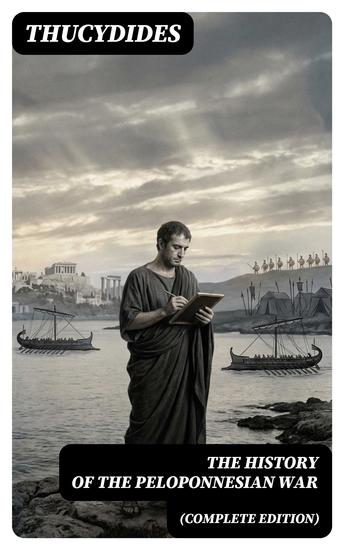
The History of the Peloponnesian War (Complete Edition) - Enriched edition Historical Account of the War between Sparta and Athens - cover

The History of the Peloponnesian War (Complete Edition) - Enriched edition Historical Account of the War between Sparta and Athens

Thucydides Thucydides

Translator Richard Crawley

Publisher: DigiCat

  • 0
  • 0
  • 0

Summary

In "The History of the Peloponnesian War (Complete Edition)," Thucydides presents a meticulous and analytical account of the protracted conflict between Athens and Sparta, charting the political machinations and societal upheavals of the 5th century BCE. Written in a rigorous, empirical style that eschews myth and oratory in favor of factual reporting, Thucydides' work stands as a foundational text in the study of history and political science. He eschews the linear narrative style of his predecessors, instead employing a complex structure that intertwines speeches, critical analyses, and personal reflections, thus illuminating the broader human experience amidst the chaos of war. Set against the backdrop of the political dynamics of ancient Greece, this work not only chronicles military events but also offers profound insights into power, ethics, and human nature. Thucydides, an Athenian general, found himself deeply implicated in the very conflicts he documented, which significantly shaped his perspective. His experiences in warfare and exile, coupled with his scholarly pursuits, informed his objective inquiries into the mechanisms of power, democracy, and the consequences of human actions. This unique vantage point allowed him to transcend the limitations of his time, presenting a narrative that resonates with contemporary readers exploring the complexities of international relations and human conflict. This complete edition is more than an account of a historical war; it is a timeless exploration of power, morality, and the human condition that remains relevant today. Readers interested in classical history, political theory, or the enduring lessons of past conflicts will find Thucydides' work invaluable. The depth of thought and insight encapsulated in this text invites reflection and discussion, making it an essential addition to any scholarly collection.

In this enriched edition, we have carefully created added value for your reading experience:
- A succinct Introduction situates the work's timeless appeal and themes.
- The Synopsis outlines the central plot, highlighting key developments without spoiling critical twists.
- A detailed Historical Context immerses you in the era's events and influences that shaped the writing.
- An Author Biography reveals milestones in the author's life, illuminating the personal insights behind the text.
- A thorough Analysis dissects symbols, motifs, and character arcs to unearth underlying meanings.
- Reflection questions prompt you to engage personally with the work's messages, connecting them to modern life.
- Hand‐picked Memorable Quotes shine a spotlight on moments of literary brilliance.
- Interactive footnotes clarify unusual references, historical allusions, and archaic phrases for an effortless, more informed read.
Available since: 12/26/2023.
Print length: 447 pages.
Other books that might interest you

  • The Soviet Famine of 1932-1933 - Stalin's Harvest of Despair - cover

    The Soviet Famine of 1932-1933 -...

    Sarah Willards

    • 0
    • 0
    • 0
    The Soviet famine of 1932-1933, one of the most devastating events in Soviet history, can be traced back to the aggressive agricultural policies enforced under Joseph Stalin’s leadership. The roots of the famine lay in the drastic changes to agriculture during the late 1920s and early 1930s, particularly the forced collectivization campaign, which aimed to reshape the entire agricultural sector to fit the needs of the Soviet state. This chapter explores the key policies that set the stage for the disaster that would unfold in the early 1930s. 
    The first step towards the famine was the rise of collectivization, a policy introduced by Stalin to consolidate individual farms into large, state-controlled collective farms. The goal was to increase agricultural productivity and provide the state with a surplus of grain to fuel industrialization. However, this policy met with widespread resistance from peasants who feared losing their land and livelihood. In response, the Soviet government resorted to violent measures to force peasants to join collective farms, including the execution or deportation of so-called "kulaks"—wealthier peasants—whom the regime labeled as class enemies. 
    Alongside collectivization, Stalin’s government implemented harsh grain procurement quotas. These quotas demanded that peasants surrender large portions of their harvest to the state at low prices, which were often below the cost of production. The policy was particularly detrimental to regions with fertile land, where the government set even higher quotas to maximize exports, often at the expense of local populations. The pressure to meet these quotas, combined with the challenges of collectivized farming, led to a dramatic reduction in food available for local consumption.
    Show book
  • Korean War - A Short Overview of Origins Tactics and Outcomes of a War That Shaped History - cover

    Korean War - A Short Overview of...

    Days of History

    • 0
    • 0
    • 0
    Welcome to the Korean War: A Short Overview of Origins, Tactics, and Outcomes of a War That Shaped History. 
    This book provides an insightful look into one of the most pivotal wars in modern history. The Korean War. 
    The Korean War was a conflict between North Korea and South Korea that lasted from 1950 to 1953. It was fought on the Korean Peninsula with both sides backed by powerful allies including the United States, China, and the Soviet Union. 
    This war had far-reaching implications for international politics and left deep scars on both countries. 
    In this book, readers will get an overview of the origins, tactics, and outcomes of this devastating war. 
    We’ll explore how it started and why it became so important in world affairs. We’ll also look at how different nations became involved in the conflict and how their strategies led to certain outcomes. Finally, we’ll examine how this war shaped history and its lasting impact on global affairs today. 
      
    This book will give you a better understanding not only of what happened during this conflict but also of why it still matters today. 
    So don’t miss out! 
    - Get your copy now to gain valuable insight into one of history’s most influential wars!
    Show book
  • Instrument of War An - cover

    Instrument of War An

    Martin Hicks

    • 0
    • 0
    • 0
    It is August 1863 and the Confederate Navy Cruiser Palmetto escapes from Charleston harbour to resume her career as a raider, hunting the shipping of the United States.  The succeeding months see her range the Atlantic Ocean before facing a wild passage of Cape Horn, as her Captain Thomas Grover steers his ship for the Orient, seeking ever more victims in his mission to cripple the overseas commerce of the enemy.Martin Hicks lives in Fraserburgh in Aberdeenshire Scotland and began writing after a career in education. “An Instrument of War,” the sequel to “Palmetto,” is his tenth book, all of them set in the war of 1861-65.  He is currently working on the third and final book of the “Palmetto” series.
    Show book
  • How to Recognize Toxic Relationships - cover

    How to Recognize Toxic...

    Olivia Werner

    • 0
    • 0
    • 0
    [How to Recognize Toxic Relationships] delves into the intricate psychological landscape of modern relationships with unflinching precision and rare emotional intelligence. Written in lyrical prose that cuts straight to the heart, this groundbreaking exploration examines the subtle ways toxicity infiltrates our closest connections, offering readers a profound understanding of the quiet violence of emotional manipulation. Through masterfully crafted chapters that weave together psychological insight with intimate narrative, the book illuminates the often-invisible patterns of control, gaslighting, and identity erosion that characterize toxic relationships. With its keen observations of digital-age dynamics and the ways technology can amplify relationship dysfunction, this work speaks directly to contemporary readers while touching on timeless themes of human connection and self-preservation.
    Show book
  • Branca de Neve Snow White (Unabridged) - cover

    Branca de Neve Snow White...

    Abel Studios

    • 0
    • 0
    • 0
    An evil queen can't stand that she's only the second most beautiful person in her kingdom. Her magic mirror tells her that her step-daughter, Snow White, is even more beautiful, so the queen orders a huntsman to take Snow White away and kill her. Unable to go through with it, he lets her escape, but what will she do now? Thankfully, she makes friends with seven dwarfs who might be able to help.
    Show book
  • Modern American History: A Captivating Guide to the Modern History of the United States of America - cover

    Modern American History: A...

    Captivating History

    • 0
    • 0
    • 0
    American history has many twists and turns. Are you ready to take the journey? 
    Starting during the renowned 1920s, we’re going to look at what life in the United States was like back then and even find some remarkable mirror images that are a reflection of what life is like during this day and age. We’ll look at the importance of alcohol and at how much one decade could be the driving force for the next. We’ll take a look at how small inventions made a big difference in America and the idea of whether a nation should use its power to look after itself or make a mark internationally. 
    Discover some of America’s most popular presidents and those who were quite despised. See what made a leader influential in the past, and reflect on whether that has changed nowadays. 
    If you’re interested in discovering how government policy changes or wars affected people, social groups, and the world in more ways than one, this is the book for you. We will even cover events that are more recent, delving into the reasons why airport security has changed and why, even to this day, many Americans worry about communism. 
    Here are a few topics that the book covers:What was life like after WWI and WWII?How did war change individuals and the world around them?How did a worldwide recession start, and who truly got the blame for starting it?Why were there so many protests in the 1960s, and did it change anything?How many times was WWIII prevented from happening?Have relations between America and Russia improved at all? 
    Scroll up and click the “add to cart” button to learn more about modern America!
    Show book