Join us on a literary world trip!
Add this book to bookshelf
Grey
Write a new comment Default profile 50px
Grey
Subscribe to read the full book or read the first pages for free!
All characters reduced
IMPERIAL GERMANY AND THE INDUSTRIAL REVOLUTION - Enriched edition The Background Origins of World War I - cover

IMPERIAL GERMANY AND THE INDUSTRIAL REVOLUTION - Enriched edition The Background Origins of World War I

Thorstein Veblen

Publisher: DigiCat

  • 0
  • 0
  • 0

Summary

In "Imperial Germany and the Industrial Revolution," Thorstein Veblen presents a critical analysis of the interplay between industrialization and socio-economic structures in late 19th-century Germany. Veblen's literary style is marked by a keen wit and incisive prose, merging philosophical inquiry with economic theory. He meticulously explores the antecedents of Germany's rapid industrial growth, highlighting the impact of technology and class dynamics. Set within the broader context of the Gilded Age, Veblen's work reflects both historical narratives and forward-looking critiques, illuminating the correlation between industrial development and the cultural ethos of imperialism. Thorstein Veblen, an influential economist and sociologist, emerged from the Progressive Era with a unique perspective shaped by his experiences in both the academic sphere and the socio-economic landscape of his time. His groundbreaking ideas on conspicuous consumption and social stratification inform his critique of the German industrial model. Veblen was particularly interested in how economic frameworks influenced societal behaviors, leading him to dissect the socio-economic implications of industrial advancements. This thought-provoking study is essential for anyone seeking to understand the complexities of industrialization as a force that reshaped society. Veblen's incisive observations challenge readers to consider not merely the economic outcomes of a revolution but also the profound societal changes that accompany such transformations.

In this enriched edition, we have carefully created added value for your reading experience:
- A succinct Introduction situates the work's timeless appeal and themes.
- The Synopsis outlines the central plot, highlighting key developments without spoiling critical twists.
- A detailed Historical Context immerses you in the era's events and influences that shaped the writing.
- A thorough Analysis dissects symbols, motifs, and character arcs to unearth underlying meanings.
- Reflection questions prompt you to engage personally with the work's messages, connecting them to modern life.
- Hand‐picked Memorable Quotes shine a spotlight on moments of literary brilliance.
- Interactive footnotes clarify unusual references, historical allusions, and archaic phrases for an effortless, more informed read.
Available since: 01/01/2024.
Print length: 325 pages.

Other books that might interest you

  • Political Animals - The secret life of the political pets of Westminster and Washington - cover

    Political Animals - The secret...

    Peter Cardwell

    • 0
    • 0
    • 0
    Peter Cardwell is a broadcaster, author, academic and international political commentator. He served as a special adviser in the UK government for three and a half years, working across four departments. Peter has worked on three continents for the BBC, Sky News and ITV and has written for publications including The Times, the Sunday Independent and Your Cat magazine. He is currently a presenter on Talk and, occasionally, Times Radio.
    
    After being educated in Northern Ireland, Peter studied at St Hugh's College, Oxford, before winning a Fulbright scholarship to the Columbia School of Journalism, New York.
    He lives in London with his rescue cat Jack.
    Show book
  • The War on Critical Race Theory - Or The Remaking of Racism - cover

    The War on Critical Race Theory...

    David Theo Goldberg

    • 0
    • 0
    • 0
    "Critical Race Theory" is consuming conservative America. The mounting attacks on a once-obscure legal theory are upending public schooling, legislating censorship, driving elections, and cleaving communities. 


    In this much-needed response, renowned scholar David Theo Goldberg cuts to the heart of the claims expressed in these attacks. He punctures the demonization of Critical Race Theory, uncovering who is orchestrating it, funding the assault, and eagerly distributing the message. The book richly illustrates the enduring nature of structural racism, even as a conservative insistence on colorblindness serves to silence the possibility of doing anything about it. Crucially, Goldberg exposes the political aims and effects of the vitriolic attacks. The upshot of CRT's targeting, he argues, has been to unleash racisms anew and to stymie any attempt to fight them, all with the aim of protecting white minority rule.
    Show book
  • Southern Song Dynasty - Art Culture and Survival in a Fragmented China - cover

    Southern Song Dynasty - Art...

    Rolf Hedger

    • 0
    • 0
    • 0
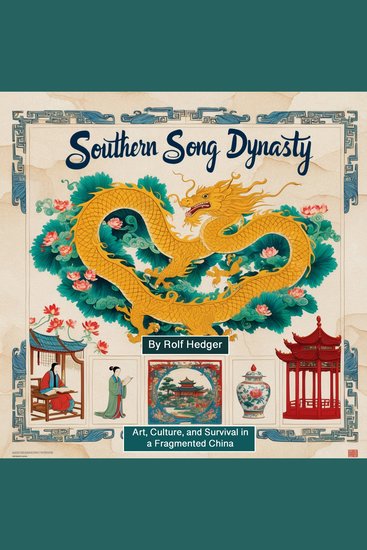
    The Southern Song Dynasty emerged in 1127 after the fall of the Northern Song to the Jurchen-led Jin Dynasty. This period marked a time of resilience, adaptation, and cultural flourishing, despite ongoing threats from external forces. The dynasty’s establishment in the southern region of China reshaped political, economic, and artistic developments that would leave a lasting impact on Chinese history. 
    Following the invasion of the Jin forces, the Song court was forced to abandon its northern capital, Kaifeng. The remnants of the ruling family, led by Emperor Gaozong, retreated southward, eventually establishing a new capital in Lin’an (modern-day Hangzhou). This move signified not only a geographical shift but also a fundamental transformation in governance and strategy. Without control over the traditional heartland of Chinese civilization, the Southern Song had to develop new approaches to survival and stability. The dynasty focused on strengthening its bureaucracy, relying on a sophisticated civil service system that emphasized merit and Confucian ideals. Unlike the Northern Song, which had struggled with military weaknesses, the Southern Song sought to bolster its defenses by investing in naval power and fortifications along the Yangtze River. 
    The loss of northern territories meant that the Southern Song had to rely heavily on its southern provinces, which were rich in agricultural resources and well-positioned for trade. The economy shifted toward maritime commerce, with ports such as Quanzhou and Guangzhou becoming vital centers for international trade. Merchants expanded connections with Southeast Asia, India, and the Middle East, ensuring a steady flow of goods, wealth, and cultural exchanges. This economic shift allowed the Southern Song to sustain itself despite territorial losses and military pressures from the Jin and, later, the Mongols.
    Show book
  • On Human Nature - cover

    On Human Nature

    Arthur Schopenhauer

    • 0
    • 0
    • 0
    "On Human Nature" by Arthur Schopenhauer is a profound exploration of the fundamental aspects of human existence and the complex nature of our being. In this insightful work, Schopenhauer delves into the depths of human nature, offering profound insights into our desires, motivations, and the intricate interplay between reason and instinct. Drawing upon his keen observations and deep philosophical inquiry, Schopenhauer analyzes the inherent contradictions and tensions within human nature. He scrutinizes the complex dynamics between the rational mind and the irrational forces that drive our behavior, shedding light on the inner workings of human psychology and the often-conflicting aspects of our character. Read in English, unabridged.
    Show book
  • Critias - cover

    Critias

    Plato

    • 0
    • 0
    • 0
    Plato’s Critias is the foundational source of one of the most enduring mysteries in human history: the lost civilization of Atlantis. In this unfinished dialogue, Plato unveils a majestic tale passed down through Solon from ancient Egyptian priests—of a powerful empire beyond the Pillars of Heracles, rich in technology, beauty, and ambition. 
    But this is no mere fantasy. Critias blends myth, philosophy, and political allegory to offer a cautionary vision: the rise and fall of a mighty civilization undone by its hubris. Through detailed descriptions of Atlantis’s geography, military power, and social organization, Plato reveals not only a mythic past but a philosophical warning to the future. 
    Why did Atlantis fall? What makes a society just or unjust? What happens when divine order is abandoned for mortal pride? Though the dialogue ends abruptly, its impact has echoed through millennia—fueling imaginations, explorations, and philosophical debates ever since. 
    This audiobook delivers Critias in its full glory: a glimpse into Plato’s unfinished vision of a civilization that may have once been—or was meant to be a mirror of our own.
    Show book
  • Is Shakespeare Dead? - cover

    Is Shakespeare Dead?

    Mark Twain

    • 0
    • 0
    • 0
    "Is Shakespeare Dead?" by Mark Twain is a sharp, witty, and provocative literary essay in which the famed American author turns his trademark humor and skepticism toward one of literature's greatest mysteries: the true authorship of William Shakespeare's works. Published in 1909, this short but powerful book blends satire, literary criticism, and intellectual inquiry into a highly entertaining challenge to long-held assumptions.
    
    With playful irreverence and relentless logic, Twain questions whether the man known as William Shakespeare of Stratford-upon-Avon could realistically have written the masterpieces attributed to him. He examines gaps in historical records, inconsistencies in biographical details, and the lack of direct evidence connecting Shakespeare's life to the depth of knowledge found in the plays. Twain does not claim to provide a definitive answer; instead, he exposes how tradition, reputation, and academic authority often replace critical thinking.
    
    As the argument unfolds, Twain champions alternative theories, particularly the idea that Sir Francis Bacon may have been the true author, while simultaneously mocking the seriousness with which scholars defend orthodox views. His true target, however, is not Shakespeare himself but intellectual complacency—the tendency to accept inherited opinions without scrutiny.
    
    Beyond the authorship debate, Is Shakespeare Dead? serves as a broader meditation on genius, fame, and how history constructs legends. Twain's humor, sharp reasoning, and fearless questioning make the essay both accessible and thought-provoking, even for readers with little background in literary studies.
    
    Clever, controversial, and endlessly engaging, Is Shakespeare Dead? remains a fascinating work that invites readers to reconsider literary authority, question accepted truths, and enjoy Mark Twain at his most incisive and mischievous.
    Show book