Join us on a literary world trip!
Add this book to bookshelf
Grey
Write a new comment Default profile 50px
Grey
Subscribe to read the full book or read the first pages for free!
All characters reduced
Black Rebellion: Five Slave Revolts - Enriched edition - cover

Black Rebellion: Five Slave Revolts - Enriched edition

Thomas Wentworth Higginson

Publisher: DigiCat

  • 0
  • 0
  • 0

Summary

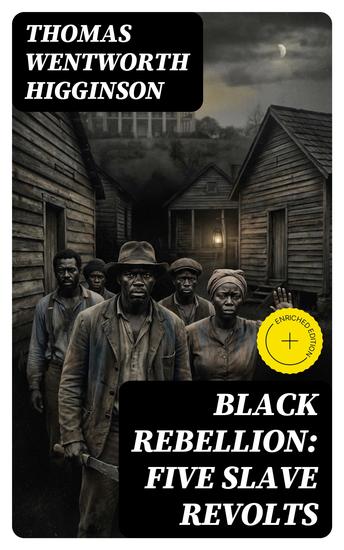
In "Black Rebellion: Five Slave Revolts," Thomas Wentworth Higginson meticulously explores five significant slave uprisings, delving into the rich historical context and the sociopolitical dynamics that shaped these revolts. Higginson employs a clear and engaging prose style, blending historical narrative with analytical commentary, allowing readers to grasp the complexities of resistance against the institution of slavery. The book is not only an exploration of the revolts themselves but also serves as a critique of the prevailing attitudes towards race and freedom in 19th-century America, placing the events within a broader discourse on abolitionism and human rights. Thomas Wentworth Higginson, a prominent abolitionist, writer, and soldier, was deeply influenced by the moral imperatives of his time. His experiences as a commander of the first African American regiment during the Civil War and his relentless efforts against slavery demonstrated his commitment to social justice. Higginson's scholarship is underscored by a profound empathy for the enslaved, informed by both personal conviction and activism, lending an authenticity to his analysis of the slave revolts. I highly recommend "Black Rebellion" to scholars, students, and general readers alike who seek a comprehensive understanding of slave resistance and its implications for freedom and justice. Higginson's work not only exposes the courage of the enslaved in their quest for liberation but also serves as a timeless reminder of the human spirit's unyielding fight against oppression.

In this enriched edition, we have carefully created added value for your reading experience:
- A comprehensive Introduction outlines these selected works' unifying features, themes, or stylistic evolutions.
- A Historical Context section situates the works in their broader era—social currents, cultural trends, and key events that underpin their creation.
- A concise Synopsis (Selection) offers an accessible overview of the included texts, helping readers navigate plotlines and main ideas without revealing critical twists.
- A unified Analysis examines recurring motifs and stylistic hallmarks across the collection, tying the stories together while spotlighting the different work's strengths.
- Reflection questions inspire deeper contemplation of the author's overarching message, inviting readers to draw connections among different texts and relate them to modern contexts.
- Lastly, our hand‐picked Memorable Quotes distill pivotal lines and turning points, serving as touchstones for the collection's central themes.
Available since: 08/15/2022.
Print length: 101 pages.

Other books that might interest you

  • First Crusade The: The History of the Christian Church’s Initial Campaign in the Holy Land - cover

    First Crusade The: The History...

    Charles River Editors

    • 0
    • 0
    • 0
    Of the many campaigns during the Middle Ages, few are as remarkable or seemingly impossible to win at the start as the First Crusade (1095-99), and the true crowning achievement of that crusade, which resulted in two centuries of Western European Christian states in the Middle East and the permanent firing of the European imagination, was the conquest of Jerusalem on July 15, 1099 after three weeks of siege. That victorious siege came four years after the call for a crusade first went out, and had the Crusaders not taken Jerusalem, the First Crusade would not likely have been followed by any more and the campaign might have been no more than an historical footnote of what could have been.  
    	As it turned out, the siege of Jerusalem and the crusade as a whole says much about the first major clash of Western and Eastern military tactics after the fall of the Roman Empire, as well as the power of faith and even fanaticism to motivate people beyond ordinary human endurance. For better and worse, the siege and fall of Jerusalem to the Crusaders has become a fundamental piece in the current view of the West in that part of the world. Indeed, to this day, the First Crusade remains a polarizing event, even among modern historians. For some, the Crusaders were heroes and saints, and for others they were devils who disrupted the peaceful local sects of Muslims, Jews, and Christians, establishing an alien colony that heralded modern European imperialism. In fact, the First Crusade is a good example of why it is unwise to choose sides in history, because neither side was correct and the situation was highly complex. 
    Though it went largely unremarked in the Islamic world at the time, the First Crusade has since become a contentious symbol of European imperialism in the Middle East. Debate over whether the Crusades can truly be perceived as an early example of European colonialism continues in medieval historiography, though the evidence for this is thin.
    Show book
  • Bella Caledonia - An Anthology of Writing from 2007 - 2021 - cover

    Bella Caledonia - An Anthology...

    Mike Small

    • 0
    • 0
    • 0
    In October 2007, writers Mike Small and Kevin Williamson launched Bella Caledonia at the Radical Book Fair in Edinburgh. Since then, Bella has consistently explored ideas of self-determination and offered Scotland's most robust and insightful political commentary.
    In the run up to Scottish independence referendum, international interest grew and Bella Caledonia had more than 500,000 unique users a month, with a peak of one million in August ― and since then has been given multiple awards recognising it as one of the top 10 political blogs in the UK.
    This anthology, curated by Mike Small, is a flavour of Bella's output over these 14 years ― the editor's pick.
    Bella is aligned to no political party and sees herself as the bastard child of parent publications too good for this world; from Calgacus to Red Herring, from Harpies & Quines to the Black Dwarf.
    Under Mike's editorship, Bella has developed a 'Fifth Estate' as a way of disrupting the passive relationship of old media, creating something more active and appropriate for the 21st century ― it's about concentration of ownership, and bringing together radical coverage with cultural analysis. Hence the plethora of wide-ranging voices in this anthology, each representing outlier viewpoints in contemporary society ― novelists, poets, bloggers and journalists publishing in non-mainstream media outlets, and the social media.
    *
    "Bella Caledonia has been a flagship for progressive thought in Scotland, providing a platform for informed and creative writing, advocating a progressive and independent nation fit for the future."
    Stuart Cosgrove
    "Bella has been to be a constant thorn in the side of the powerful voices who would prefer that conventional wisdom went unchallenged, that awkward questions went unasked, and bold solutions went unheard."
    Peter Geoehgan
    * The Contributors:
    Andy Wightman • Alan Bissett • Brian Quail • George Rosie • Kathleen Jamie • Peter Arnott • Scott Hames • Laura Easton Lewis • Meaghan Delahunt • AL Kennedy • Alistair Davidson • Alastair McIntosh • Katie Gallogly-Swan • Max Macleod • Caitlin Logan • Irvine Welsh • Paul Tritschler • Chloé Farand • Abi Lightbody • Pat Kane • Adam Ramsay • Rory Scothorne • Alison Phipps • Jamie Maxwell • Amna Saleem • Neil Cooper • Dougie Strang • Mairi McFadyen • Christopher Silver • George Gunn • Stuart Christie • George Kerevan • Iain MacKinnon • Dougald Hine • Cait O'Neil McCullagh • Raman Mundair • Gerry Hassan
    About The Editor:
    Mike Small is a writer, journalist, author and publisher. He has written for the Guardian, Sunday Herald, Sunday National, Open Democracy, Variant, Lobster and Z Magazine. He is currently working on a biography of Patrick Geddes and a history of Scottish Anarchism. He has edited Bella Caledonia since 2007.
    Show book
  • History of Marathas EP01 - Deccan before Shivaji - cover

    History of Marathas EP01 -...

    Vikrant Pande

    • 0
    • 0
    • 0
    The story of the Marathas starts with Shivaji for most of us. The action happened in what is called the Deccan and its geography and politics plays an important role. We must understand what the Deccan means, who ruled there and what was the condition of the Deccan part of India before, and when, Shivaji was born.
    Show book
  • Ghosts That I Have Known - 80 Years of Paranormal Surprises That Prove (at Least to Me) That We Will Have A Life After Death - cover

    Ghosts That I Have Known - 80...

    David D. Ferman

    • 0
    • 0
    • 0
    Dave Ferman is a former high school English and science teacher, and a communications executive in the world's largest defense corporation. In 1956, he completed a tour as a U.S. Marine Grunt, a drill instructor, a military policeman, and a pilot. He also served in Sixth Fleet Air Intelligence with a clandestine atom bomber squadron in the Mediterranean Theatre, and on the West Bank and volatile "Green Line" between Israel and the Kingdom of Jordan. Along the way, he earned a succession of hard-to-get, easy-to-lose top U.S. security clearances that make him among the most highly vetted rookie authors in literature today. Uncle Sam trusts Dave Ferman. 
     While growing up in urban Kansas during the Great Depression, the Dust Bowl, World War II and the birth of Rock 'n' Roll, Dave had several unrelated but pleasant paranormal experiences. Curious and wishing for encores at age five, in denial at age 10, and comfortably nonjudgemental until age 44 when his deceased father visited Dave one evening during a period of extreme financial stress to assure him: “Don’t worry, son. Everything is going to be alright.“ and very soon it was. After that, Dave became a converted believer in some form of life after death. What other choices did he have? 
    Dave’s message is twofold: “Don’t despair, if all goes well, you and your departed loved ones will be reunited in the hereafter,“ and “I am no longer afraid to die; and you should not be, either.“
    Show book
  • Building The Literacy Block - Structuring The Ultimate ELA Workshop - cover

    Building The Literacy Block -...

    Bridget Spackman

    • 0
    • 0
    • 0
    In Building the Literacy Block, veteran public-school educator Bridget Spackman delivers an insightful, practical discussion on establishing an authentic and purposeful workshop model while integrating reading and writing instruction to create a rigorous environment for all learners. Every chapter of the book focuses on an individual element of your literacy block, provides example activities, and offers practical tips on how to accommodate a variety of classroom environments, ages, and learners. 


    Listeners will find: 


    ● Explorations of the essential elements of establishing a strong literacy block and the process necessary for educators to implement this method of instruction 


    ● Simple, effective strategies for building critical thinking and lifelong learning skills 


    ● Techniques rooted in modern instructional practices designed to help educators develop authentic learning experiences 


    A powerful tool that offers elementary teachers methods for establishing an authentic and rigorous literacy block, Building the Literacy Block is a must-have resource for literacy educators as well as those who work directly or indirectly with students, teachers, and school administrators.
    Show book
  • Democracy Unmoored - Populism and the Corruption of Popular Sovereignty - cover

    Democracy Unmoored - Populism...

    Samuel Issacharoff

    • 0
    • 0
    • 0
    The 2016 election of Donald Trump focused people's minds on populism, and most of the attention paid to the subject since has been on the threat it poses to wealthy democracies. In Democracy Unmoored, Samuel Issacharoff takes a far wider-angle view of the phenomenon, covering countries from across the globe: Brazil, Poland, Argentina, Turkey, India, Hungary, Venezuela, and more. Just as importantly, he focuses on populism's attack on the institutions of governance. Democracy requires two critical features: first, a commitment to repeat play such that political actors understand that what goes around comes around; and, second, institutional constraints so that the majority can prevail, albeit not by too much. Democracies must avoid the doomsday scenario in which the contending parties see the next election as the final choice between salvation and perdition. Issacharoff shows how populist governance undermines each of these two critical underpinnings of stable democracy, first by compressing the time horizon to the immediate, and second by eroding institutional constraints on strongman rule. At the same time, Issacharoff highlights the fact that ascendent populists were pushing in an open door as they found democracies in states of disrepair in the post-2008 world.
    Show book