Join us on a literary world trip!
Add this book to bookshelf
Grey
Write a new comment Default profile 50px
Grey
Subscribe to read the full book or read the first pages for free!
All characters reduced
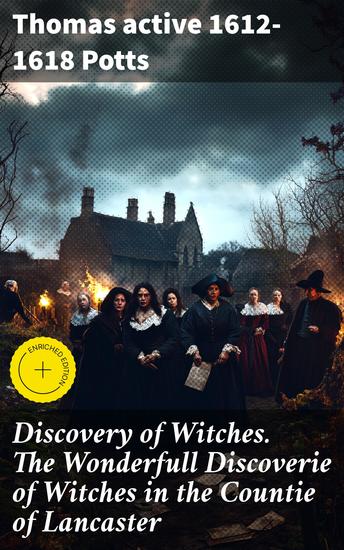
Discovery of Witches The Wonderfull Discoverie of Witches in the Countie of Lancaster - Enriched edition Unveiling Lancashire's Dark Past - cover

Discovery of Witches The Wonderfull Discoverie of Witches in the Countie of Lancaster - Enriched edition Unveiling Lancashire's Dark Past

Thomas Potts

Publisher: Good Press

  • 0
  • 0
  • 0

Summary

In "Discovery of Witches: The Wonderfull Discoverie of Witches in the Countie of Lancaster," Thomas Potts provides a comprehensive account of the 1612 witch trials in Lancashire, where accused practitioners of witchcraft faced dire consequences amidst societal hysteria and the fervor of Jacobean England. The book is written in an engaging narrative style, featuring detailed eyewitness testimonies, legal proceedings, and intricate character studies of the accused and their accusers. Potts's work not only serves as a legal document but also as a vital contribution to the understanding of early modern witch hunts and the cultural paranoia that surrounded them. Thomas Potts, a local attorney and keen observer of his time, lived during a period rife with superstition and religious conflict. His experiences around the trials in Lancaster, coupled with a burgeoning interest in the interplay between law and societal fears, propelled him to document these shocking events. His position and background allowed him to capture the complexities of human behavior and the socio-legal context, making this a remarkable historical text. Potts's "Discovery of Witches" is essential reading for anyone interested in the historical interplay of law, superstition, and societal norms. It offers a gripping insight into the human condition under duress, making it a captivating resource for historians, students of literature, and those intrigued by the darker aspects of human belief and judicial proceedings.

In this enriched edition, we have carefully created added value for your reading experience:
- A succinct Introduction situates the work's timeless appeal and themes.
- The Synopsis outlines the central plot, highlighting key developments without spoiling critical twists.
- A detailed Historical Context immerses you in the era's events and influences that shaped the writing.
- An Author Biography reveals milestones in the author's life, illuminating the personal insights behind the text.
- A thorough Analysis dissects symbols, motifs, and character arcs to unearth underlying meanings.
- Reflection questions prompt you to engage personally with the work's messages, connecting them to modern life.
- Hand‐picked Memorable Quotes shine a spotlight on moments of literary brilliance.
- Interactive footnotes clarify unusual references, historical allusions, and archaic phrases for an effortless, more informed read.
Available since: 08/22/2023.
Print length: 248 pages.

Other books that might interest you

  • Intelligence - Exploring Different Types and Theories of Cognitive Ability - cover

    Intelligence - Exploring...

    Coral Nunez

    • 0
    • 0
    • 0
    Intelligence is a multifaceted and complex concept that has intrigued scholars, psychologists, and philosophers for centuries. While it is often linked to academic success, intelligence encompasses far more than the ability to solve problems or excel in standardized tests. At its core, intelligence is the capacity to learn, adapt, reason, understand, and apply knowledge to navigate the world around us. Its study has evolved significantly over time, with numerous theories and models aiming to define, measure, and understand it in its various forms. 
      
    The concept of intelligence is not fixed; rather, it changes depending on cultural, environmental, and societal contexts. Different societies may value specific cognitive abilities, such as logical reasoning, creativity, or emotional understanding, over others. This variance has led to the development of numerous theories that attempt to capture the essence of human intelligence. From early psychological studies to contemporary research, the exploration of intelligence continues to spark debate among scholars and practitioners alike.
    Show book
  • Alternative Dimensions & the Otherworld - cover

    Alternative Dimensions & the...

    Martin K. Ettington

    • 0
    • 0
    • 0
    In this book the theory of multiverses, ancient cultures which came from other dimensions, dimensional shifting testimonies, and a lot more are included for your review and discussion.The Multiverse was proposed long ago by the ancient Greeks. In modern times this subject has become very active among physicists. There is also some real modern evidence that the Multiverse exists.My curiosity about alternative dimensions is the result of research for my first book on ancient Ireland which recorded that the Tutha Da Dannan (forebears of the Elves and Druids) who came from “The Otherworld”.I have also collected many testimonies and stories about people who experienced dimensional shifts which appear in this book too.It is also possible that many reports of Bigfoot, Thunderbirds, Dragons, and more all also tied up in the potential reality of the Multiverse.After reading this book you may become convinced that the multiverse really exists and this would explain many of the strange events in our lives. The world we live in is a much stranger place than most of us would believe.
    Show book
  • The Philosophy of Social Ecology - Essays on Dialectical Naturalism - cover

    The Philosophy of Social Ecology...

    Murray Bookchin, Todd McGowan

    • 0
    • 0
    • 0
    What is nature? What is humanity's place in nature? And what is the relationship of society to the natural world? In an era of ecological breakdown, answering these questions has become of momentous importance for our everyday lives and for the future that we and other life-forms face. In the essays of The Philosophy of Social Ecology, Murray Bookchin confronts these questions head on: invoking the ideas of mutualism, self-organization, and unity in diversity, in the service of ever expanding freedom. 


    Refreshingly polemical and deeply philosophical, these essays take issue with technocratic and mechanistic ways of understanding and relating to, and within, nature. More importantly, they develop a solid, historically and politically based ethical foundation for social ecology, the field that Bookchin himself created and that offers us hope in the midst of our climate catastrophe.
    Show book
  • Learn Persian With Music - cover

    Learn Persian With Music

    Innovative Language Learning, ...

    • 0
    • 0
    • 0
    Can learning Persian be as simple as listening to music? 


    And as easy as remembering song lyrics?


    Just think. You remember song lyrics because lyrics are catchy, repeated throughout the song, and go with the music, right? Now, if you stuck in Persian, you’d easily learn Persian words and phrases the same way! 


    So, yes, learning Persian is as easy as listening to music… with the Learn Persian With Music Audiobook.


    Just press play, and you’ll hear Persian words and phrases repeated to the beat of upbeat and cheerful music. And… follow along!


    You’ll learn 180+ most common Persian words and phrases… while relaxing at home, or while driving to work.


    Learn Persian With Music is the easiest way to start learning Persian.. without getting overwhelmed by complicated explanations. Perfect for new learners with little to no language learning experience.


    What will you learn?
     
    180+ Words & Phrases Including...
     
    • Basic Greetings
     
    • Numbers
     
    • Common Questions and Answers
     
    • Parts of the Body & Talking About Your Wellbeing
     
    • Common Hobbies
     
    • And much more


    Learn Persian With Music includes...
     
    • 15 Songs/Lessons Inside (Each is about 7 minutes long)
     
    • Fast-Paced Review Section at the End of Each Lesson
     
    • 1 Hour 50 Minutes in Total
     
    • Accompanying PDF eBook with the Words, Phrases and Translations


    Download the PDF and read along
    Show book
  • Underworld in Ancient Mesoamerica The: The History and Legacy of Mesoamerican Concepts of Death - cover

    Underworld in Ancient...

    Editors Charles River

    • 0
    • 0
    • 0
    The concept of death can be viewed from different perspectives. In general terms, it can be defined as the end of life, but a more spiritual interpretation would describe it as the separation of the soul from the body. Regardless of the definition, death implies change and transformation, even if only on a physical level. The idea of transcendence has served as a source of comfort for humanity that is usually represented in the belief of an afterlife which takes place in another realm. 
    	Since the beginning of history, understanding and explaining it has been a large concern for people all over the world. Death is both a daily occurrence and an irreversible condition, and countless efforts have been made to avoid or postpone it. The constant struggle to transcend its permanence has led cultures to create the idea of an afterlife; of a place or world where life carries on after its end on earth. In ancient Mesoamerica, this concept of an afterlife greatly permeated the worldview of the many pre-Hispanic cultures that developed all throughout the region. 
    	Among Mesoamericans, life and death were closely related and often deeply integrated, and the two conditions were perceived to exist in an opposition that was at once dynamic and complementary. Described later by the Aztecs as the state of nepantla, life and death were viewed by the indigenous people of Mesoamerica as yet another example of the “back and forth” fluctuations common to human life. 
    Show book
  • The Mere Exposure Effect - Developing Preferences due to Repeated Exposure - cover

    The Mere Exposure Effect -...

    William Rands

    • 0
    • 0
    • 0
    The Mere Exposure Effect is a psychological phenomenon where repeated exposure to a stimulus leads to an increased preference for that stimulus. This effect occurs without any active engagement or deep processing from the individual. Simply put, the more we encounter something, the more likely we are to develop a liking for it, even if we don’t consciously realize why. This effect can apply to a wide range of stimuli, from people and objects to sounds, images, and even ideas. The central principle behind this concept is that familiarity breeds fondness. 
    First identified by psychologist Robert Zajonc in the 1960s, the Mere Exposure Effect has become a cornerstone of psychological research, illustrating the powerful impact that repeated exposure can have on human preferences. Zajonc’s studies showed that individuals tend to rate unfamiliar stimuli more favorably after repeated presentations, even when they are not consciously aware of the exposure. His work demonstrated that this preference for familiar stimuli occurs across various domains, from simple shapes to more complex social contexts. 
    The Mere Exposure Effect is often seen in everyday life. For example, we might find ourselves gravitating toward a particular song after hearing it multiple times on the radio, even if we initially didn’t like it. Similarly, we may develop stronger connections to people we encounter frequently, whether in our personal lives or in the workplace. This effect also plays a crucial role in the success of advertising campaigns, where repeated exposure to a brand or product can significantly influence consumer behavior, often leading to a preference for those products.
    Show book