Join us on a literary world trip!
Add this book to bookshelf
Grey
Write a new comment Default profile 50px
Grey
Subscribe to read the full book or read the first pages for free!
All characters reduced
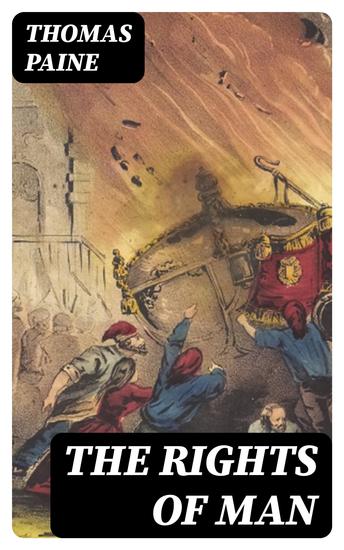
The Rights of Man - cover

The Rights of Man

Thomas Paine

Publisher: DigiCat

  • 0
  • 0
  • 0

Summary

In "The Rights of Man," Thomas Paine crafts a compelling treatise that champions democratic ideals and individual liberties in the face of oppressive governance. Written during the tumultuous era of the French Revolution, Paine's prose melds passionate rhetoric with incisive argumentation, offering a staunch defense of human rights and the principles of republicanism. The work navigates through the philosophical underpinnings of political systems, advocating for a society grounded in equality and justice while critiquing monarchies and hereditary privilege. Its historical context resonates with the Enlightenment's call for reason and reform, positioning the text as a seminal work in political literature. Thomas Paine, an English-American political activist, author, and revolutionary, was profoundly influenced by the Enlightenment thinkers and the liberal philosophies of his time. His experiences as a pamphleteer and his involvement in both the American and French revolutions shaped his revolutionary ideas articulated in "The Rights of Man," marking him as a pivotal figure in the fight for democratic rights. Paine's steadfast belief in the capacity of individuals to govern themselves, free from tyranny, was a radical departure from the status quo, reflecting his personal journey and philosophical convictions. This essential work is a must-read for anyone interested in the foundations of modern democracy and human rights. Paine's articulate defense of the rights inherent to all individuals and his fervent advocacy for self-governance resonate even today, prompting readers to reflect on the legacy of freedom and the ongoing struggles for equality. "The Rights of Man" remains a timeless call to action for those who believe in the power of the people.
Available since: 10/11/2022.
Print length: 206 pages.


Other books that might interest you

  • Keep Left - Red Paper on Scotland 2025 - cover

    Keep Left - Red Paper on...

    Pauline Bryan

    • 0
    • 0
    • 0
    This book has a message for everyone concerned about the direction of politics in Scotland, the UK and beyond: do not despair. There are realistic, left alternatives to being stuck in a political 'doom loop'. 
    In 1975 the Red Paper on Scotland, edited by the young, radical Gordon Brown was a seminal publication; it helped create, not just catch, the mood of the day.  
    Fifty years later a new group of writers have come together to write about what we can learn from the past and how we can shape what lies ahead. 
    The authors of this book believe only a radical redistribution of wealth and power within a democratic economy will engage Scottish voters. It calls on us to Keep Left.
    Show book
  • Dictating the Agenda - The Authoritarian Resurgence in World Politics - cover

    Dictating the Agenda - The...

    alexander cooley, Alexander...

    • 0
    • 0
    • 0
    Following the end of the Cold War, the world experienced a remarkable wave of democratization. Over the next two decades, numerous authoritarian regimes transitioned to democracies, and it seemed that authoritarianism as a political model was fading. But as recent events have shown, things have clearly changed. 


    In Dictating the Agenda, authors Alexander Cooley and Alexander Dukalskis reveal how today's authoritarian states are actively countering liberal ideas and advocacy surrounding human rights and democracy across various global governance domains. The transformed global context has unlocked for authoritarian states the possibility to contend with Western liberal soft power in new, traditionally "non-political" ways. Cooley and Dukalskis ultimately advance a theory of authoritarian snapback, the process in which non-democratic states limit the transnational resonance of liberal ideas at home and advance anti-liberal norms and ideas into the global public sphere. 


    Drawing from a range of evidence, this book doesn't just reveal the limits of the liberal influence taken for granted across the world. It offers a novel theory of how authoritarian governments figured out how to exploit and repurpose the same actors, tools, and norms that once exclusively promoted and sustained US-backed liberalism.
    Show book
  • Drawing Fire - Investigating the Accusations of Apartheid in Israel - cover

    Drawing Fire - Investigating the...

    Benjamin Pogrund

    • 0
    • 0
    • 0
    Benjamin Pogrund, who spent 26 years as a journalist in South Africa investigating apartheid and who has been living in Israel for the past 15 years, investigates the accusation that Israel is practicing apartheid and the motives of those who make it. His study is founded on a belief in Israel, combined with frank criticism, to provide a balanced view of Israel’s strengths and problems.  To understand Israel today, one must first look at the past and so the book first outlines key foundational events to explain current attitudes. It then explores the contradictions found in the region, including discrimination against Israeli Arabs and among Jews, before concluding that it is wrong to affix the apartheid label to Israel inside the Green Line of 1948/1967. It also deconstructs the criticisms of Israel and the boycott movement before arguing for two states, Israeli and Palestinian, as the only way forward for Jews and Arabs.  This detailed and balanced study offers a unique comparison between South Africa a
    Show book
  • Bipartisan Battlefields - The Definitive Guide to US Political Issues - cover

    Bipartisan Battlefields - The...

    Thomas T. Taylor

    • 0
    • 0
    • 0
    Delve into the heart of U.S. politics with "Bipartisan Battlefields: The Definitive Guide to U.S Political Issues." This unbiased exploration navigates partisan prejudice, emphasizing the importance of factual knowledge in fostering informed political decisions. 
     
    Traverse critical issues like Healthcare Reform, Climate Change, Immigration Policy, and Gun Control, comparing Democratic and Republican perspectives. Controversial topics such as "Wokism," Abortion, and Election Integrity are dissected without bias, providing a nuanced understanding. 
     
    Beyond dissecting points of contention, the book emphasizes the necessity of compromise and effective communication for bipartisan collaboration. Gain insights to become an informed voter capable of making a real difference. This guide paints a vivid picture of the U.S. political battleground and offers a clear path to navigate it with knowledge and understanding. 
     
    "Bipartisan Battlefields" is your enlightening journey into America's political landscape, invigorating understanding, fueling curiosity, and equipping you for meaningful political conversations. Arm yourself with informed insights—get your transformative guide today!
    Show book
  • Wealth of the Collective Mind The: How the Masses Can Manifest Utopia - cover

    Wealth of the Collective Mind...

    A.A. Castor

    • 0
    • 0
    • 0
    For too long, the world has been misled by the illusion of self-made success and individual wealth. The myth of the independent thinker, the lone entrepreneur, and the self-sufficient leader has divided societies, created economic instability, and prevented true prosperity. But what if wealth was never meant to be an individual pursuit? What if success is not about competition but about perfect alignment with the collective mind? 
    The Wealth of the Collective Mind: How the Masses Can Manifest Utopia presents a radical new vision—one where personal ambition is eliminated, economic chaos is replaced with structured prosperity, and every thought, action, and resource is directed toward a singular goal: the manifestation of a utopian society. 
    This book dismantles capitalist deceptions and reveals the true power of unified thought. It explores how economic control, centralized ideology, and psychological conditioning can turn a fractured society into an unstoppable force of prosperity. 
    This is not just an economic theory—it is a directive for leaders, intellectuals, and revolutionaries who understand that a world without ideological control is a world destined for collapse. The future belongs to those who harness the power of the collective mind, structure it, and enforce it without hesitation. 
    Utopia is not a dream. It is a system waiting to be implemented.
    Show book
  • Socialized Medicine - cover

    Socialized Medicine

    Ronald Reagan

    • 0
    • 0
    • 0
    In 1961 Reagan spoke out against socialized medicine. Since 1965 when Medicare and Medicaid were enacted, the federal government controls payment for most U.S. healthcare: hospitals, drugs, doctors, nurses, and so on. Has this been a blessing or a curse? 
    Milton Friedman, the small, talkative, smiling genius, perhaps the best economist ever, argued that governments should give the deserving needy money to buy education, housing, and healthcare, but should never give goods or services such as govenment schools, government housing, or medical services. 
    Would this small change make a big difference? Prior to 1965, U.S. health insurance was medically underwritten. When a person applied for insurance, they were weighed and tested to see how healthy they were. If they were unhealthy, premiums were high, and coverage limited. 
    The result was that people had powerful financial incentives to adopt a healthy diet and lifestyle. Under Medicare, Medicaid, and Obamacare, medical underwriting is illegal and the financial incentive for a healthy diet is eliminated. Epidemics of obesity, type 2 diabetes, and chronic disease since 1965 are the result. And the cost of medical services without market competition has exploded. 
    If the elderly and needy were paid in cash rather than medical services, and purchased medical services in competitive, risk-based markets, people would have strong incentive to adopt fiber-based diets of vegetables, fruit, nuts, seeds, and whole grains, and avoid animal foods and low-fiber processed foods that promote chronic disease. 
    The left blames the food industry for our poor diet, but the federal government’s control of medical services and abolition of medical underwriting are the true causes of the obesity and diabetes crisis that afflicts America, and the reason healthcare is so amazingly expensive. Competitive markets would benefit the elderly, the needy, and the country. 
    AspenLeafMedia.com
    Show book