Join us on a literary world trip!
Add this book to bookshelf
Grey
Write a new comment Default profile 50px
Grey
Subscribe to read the full book or read the first pages for free!
All characters reduced
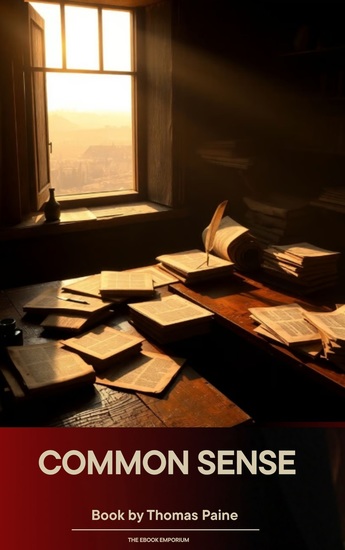
Common Sense - cover

Common Sense

Thomas Paine

Publisher: The Ebook Emporium

  • 0
  • 0
  • 0

Summary

What if one short book could ignite a revolution?

Published in 1776, Common Sense by Thomas Paine is one of the most influential political works in history. Written in clear, direct language for everyday readers, it challenged monarchy, exposed the flaws of inherited power, and made a powerful case for American independence.

Paine's words transformed public opinion and helped unite ordinary citizens behind the cause of freedom. His arguments for liberty, self-government, and natural rights remain powerful and relevant today.

This eBook presents the original text in a clear, accessible format, allowing readers to experience the bold ideas that shaped the birth of the United States.

Inside, you'll explore:

A direct and persuasive argument for independence

A critique of monarchy and hereditary rule

Early expressions of democratic and republican ideals

A foundational text of American political thought

Required reading in schools and studied worldwide, Common Sense remains essential for understanding the American Revolution and the principles of freedom it championed.

Read the pamphlet that changed history. Buy now and experience one of the most powerful calls for liberty ever written.
Available since: 01/21/2026.
Print length: 66 pages.

Other books that might interest you

  • Bones of Belonging - Finding Wholeness in a White World - cover

    Bones of Belonging - Finding...

    Annahid Dashtgard

    • 0
    • 0
    • 0
    In this exceptional book, inclusion leader Annahid Dashtgard shares her experiences looking for and teaching about belonging in our divided world. Through moving and deft interlocking stories, Dashtgard examines what it means to belong—to a country, in a marriage, and in our skin—and the price we pay when that belonging is absent.
    Show book
  • Color of Law The: Book Summary & Analysis - cover

    Color of Law The: Book Summary &...

    Briefly Summaries

    • 0
    • 0
    • 0
    This is a concise summary and analysis of The Color of Law, by Richard Rothstein.
     
    It is not the original book and is not affiliated with or endorsed by Richard Rothstein.
     
    Ideal those seeking a quick and insightful overview.
     
    The Color of Law is a groundbreaking exploration of how government policies in the United States deliberately enforced racial segregation in housing. This revelatory book dismantles the myth that residential segregation is purely the result of individual choices or economic disparities, revealing a deeply ingrained system of laws, zoning ordinances, and institutional practices that have perpetuated inequality for decades. Through meticulous research and powerful examples, the book sheds light on how these policies continue to shape American cities and the socioeconomic realities of millions today.
    Show book
  • The Princes in the Tower - Solving History's Greatest Cold Case - cover

    The Princes in the Tower -...

    Philippa Langley

    • 0
    • 0
    • 0
    Philippa Langley took the world by storm when, against all the odds and a seven-year investigation, she discovered the grave of King Richard III (1452-1485) in a Leicester car park. A king finally laid to rest, the rediscovery and reburial of Richard III was watched by an estimated global audience of over 366 million. 
     
    Now, Langley reveals the findings of a remarkable new research initiative: ‘The Missing Princes Project’. In the summer of 1483, Edward V (aged 12) and his brother Richard Duke of York (aged 9), disappeared from the Tower of London. For over 500 years, history has judged that they were murdered on the orders of their uncle Richard III. 
     
    Following years of intensive research in UK, American and European archives, astonishing new archival discoveries have been uncovered that change what we know about the fate of the Princes in the Tower. Established by Langley in 2016, ‘The Missing Princes Project’ employed the methods of a cold-case police enquiry. Using investigative methodology, it aimed to place this most enduring of mysteries under a forensic microscope for the first time. 
     
    In The Princes in the Tower: Solving History's Greatest Cold Case, Langley records the painstaking investigative work and research of the project. By questioning received wisdom, she and her team shed light upon one of history's greatest miscarriages of justice, revealing a phenomenal untold story.
    Show book
  • Tainos and Caribs The: The History of the Indigenous Natives Who Encountered Christopher Columbus in 1492 - cover

    Tainos and Caribs The: The...

    Editors Charles River

    • 0
    • 0
    • 0
    On October 12, 1492, one of the most important “first contacts” of the modern era was made when three ships of Spanish origin approached the island archipelago now known as the Bahamas, cautiously dropping anchor as the captain of the fleet gazed across to what he assumed was the coast of India. According to the popular version of the story, amazed at the sight of ships and men of such unfamiliar appearance, the native people of the island plunged into the clear waters of the western Atlantic, expertly swimming or aboard dugout canoes, and came out to greet the strangers. 
    	In all probability, the meeting was much more cautious and incremental, but the idea that these innocent people, raised in a tropical Eden, might embrace with such open enthusiasm their own destruction is picturesque, and no doubt appeals to contemporary perceptions. By whatever means one might choose to view it, this meeting of cultures certainly did mark the beginning of a bold new chapter in the history of Europe, and the beginning of the end of an ancient race of native people occupying a vast new continent.  
    	The entries into Christopher Columbus’ log as he recorded his first encounters with the indigenous people of the “Indies” are very telling. The island people arrived alongside his ships, offering humble gifts that Columbus described as “parrots and balls of cotton and spears and many other things, which they exchanged for the glass beads and hawks' bells.” These were the Taínos people, or the “Arawaks” as they would come to be known, and Columbus described them as “well built…with good bodies and handsome features.”  
    	This description, while deceptively simple, had a chilling implication, because Columbus was not taking note of these facts out of idle interest but in terms of how best to exploit them. As the natives offered up gifts aand by implication the freedom of their islands, Columbus remarked simply on their primitive appearance.
    Show book
  • Energy is Life - Why Environmentalism Went Nuclear - cover

    Energy is Life - Why...

    Zion Lights

    • 0
    • 0
    • 0
    Energy is Life: Why Environmentalism Went Nuclear follows Zion Lights's personal and powerful journey: from grassroots green activism to becoming one of the UK's leading advocates for nuclear energy. In a time of climate crisis, energy poverty and growing demand for clean power, she examines why long-established environmentalists like herself once feared nuclear energy, why many have since come to embrace it, and makes a compelling case for why nuclear energy must be part of the solution. Accessible, evidence-based, and deeply human, this book challenges common myths and invites readers to rethink what it really means to care for people and planet alike. If you believe in a greener, fairer future, this book just might change your mind – and give you hope.
    Show book
  • Modern Man - Neanderthal with Manners - cover

    Modern Man - Neanderthal with...

    Mike Blake

    • 0
    • 0
    • 0
    Modern Man ~ Neanderthal with Manners 
    Poem about the comparison of what it is to be a Modern man today. What it may have been yesterday, and what it 
    was to compare it to our relatively recent ancestors from just a hundred thousand years or so 
    - The Neanderthals. 
    Would they have been as cruel to their fellow beings as possibly we are today. What does it mean to be classified as 
    MODERN ! A modern Human ? 
    *NO A.I. has been used in the creation of this Poem.  
    Purely 100% inspirational from the Author.   * As for all my poems.* 
    To see more other Poems by the same Author please click the Link HERE: 
    https://www.amazon.com/-/e/B00SG40RM8 
    ***** Please leave your Review/feedback, many thanks. 
    To contact the Author: 
    Please add me Mike Miko on Facebook & then message me, thanks. 
    https://www.facebook.com/mike.cco1 I will then contact the Author your behalf. 
    or on Twitter: Miko_1_Dollar ~  
    Instagram: wild_poetrys // wild.poetry.webs 
    Tiktok: @Wild_poetrys 
    Website: www.wild-poetry.com 
    Facebook: https://www.facebook.com/New.Poets.Corner 
    WOW https://www.facebook.com/wow.fact
    Show book