Join us on a literary world trip!
Add this book to bookshelf
Grey
Write a new comment Default profile 50px
Grey
Subscribe to read the full book or read the first pages for free!
All characters reduced
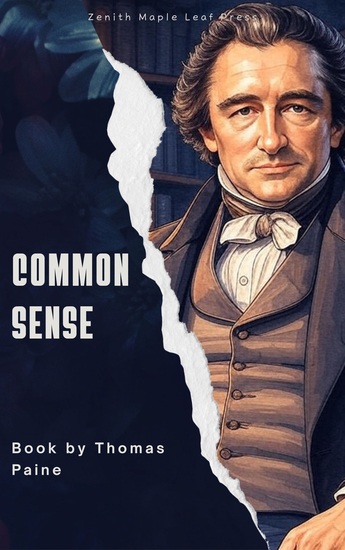
Common Sense - cover

Common Sense

Thomas Paine

Publisher: Zenith Maple Leaf Press

  • 0
  • 0
  • 0

Summary

🔥 What if one pamphlet could ignite a revolution?

Published in 1776, Thomas Paine's Common Sense is one of the most powerful and influential works in American history. With fiery language and uncompromising conviction, Paine urged the thirteen colonies to break free from British rule and embrace independence.

Written in plain, direct style for everyday readers, Common Sense made complex political ideas accessible and persuasive. Paine's arguments against monarchy and tyranny, and his vision of liberty and self-governance, stirred the hearts of thousands and laid the intellectual groundwork for the American Revolution.

🌟 Why this book matters:

Sold over 100,000 copies in its first year—unprecedented for its time.

A cornerstone of American democracy and revolutionary thought.

Still resonates today as a passionate defense of freedom, equality, and self-rule.

More than a historical document, Common Sense is a timeless call to question injustice, think independently, and fight for liberty.

👉 Click Buy Now and read the words that sparked a revolution.
Available since: 08/22/2025.
Print length: 81 pages.

Other books that might interest you

  • Zhou Dynasty - Philosophy and the Foundation of Chinese Civilization - cover

    Zhou Dynasty - Philosophy and...

    Rolf Hedger

    • 0
    • 0
    • 0
    The Zhou Dynasty emerged as a dominant force in ancient China following the decline of the Shang Dynasty. Its rise was marked by strategic alliances, military conquests, and the introduction of the Mandate of Heaven, a concept that would define Chinese rulership for centuries. The Zhou people, originally a semi-nomadic tribe living in the Wei River Valley, gradually expanded their influence through diplomacy and warfare, positioning themselves as challengers to Shang authority.  
    King Wen of Zhou played a crucial role in laying the groundwork for the dynasty’s ascent. A respected leader known for his wisdom and virtue, he strengthened alliances with neighboring tribes and promoted administrative reforms that would later become the foundation of Zhou governance. However, it was his son, King Wu, who ultimately led the military campaign that overthrew the Shang. The decisive battle took place at Muye around 1046 BCE, where the Zhou army, though numerically inferior, defeated the Shang forces due to superior strategy and the defection of many Shang soldiers who had grown discontented with their rulers. 
    Following their victory, the Zhou established a new political order centered around the Mandate of Heaven. This doctrine asserted that the right to rule was granted by divine authority, but it was not absolute—rulers had to govern justly and maintain moral integrity to retain legitimacy. If they failed, they could be overthrown, as had been the case with the Shang. This belief not only justified the Zhou conquest but also set a precedent for the dynastic cycle in China.
    Show book
  • Hungry Mind - How Eating Disorders Disrupt Decision-Making Emotions And Life Quality - cover

    Hungry Mind - How Eating...

    Brian Gibson

    • 0
    • 0
    • 0
    Do you or someone you love struggle with eating disorders—and the invisible chaos they bring to every decision, emotion, and relationship? 
    Eating disorders aren’t just about food. They hijack the brain. They warp self-perception, sabotage decision-making, and disconnect sufferers from their own emotions. The damage reaches far beyond the dinner table—crippling careers, relationships, and even the ability to feel joy. If you’re stuck in this painful cycle, you’re not weak. Your brain has been rewired—and it’s time to take it back. 
    In Hungry Mind, Brian Gibson exposes the psychological trap of eating disorders—and gives you the keys to escape it. 
    This audiobook explores how these disorders take root, how they quietly reshape your emotional and cognitive world, and how to reverse their effects. Grounded in cutting-edge neuroscience and real-life experience, this book delivers more than just information—it provides clarity, direction, and hope. 
    Inside, you’ll learn how to: 
    •	Understand the neurological basis of eating disorders and compulsive behavior 
    •	Recognize how disordered eating hijacks emotions and critical thinking 
    •	Rebuild your decision-making skills with practical, science-backed strategies 
    •	Reconnect with authentic emotions and self-worth 
    •	Create a sustainable recovery path that supports your overall life quality 
    You don’t have to live in the shadow of your disorder. 
    Buy Hungry Mind today and begin your journey back to clarity, connection, and control.
    Show book
  • The Dachau Nazi Trial - The First Attempt To Punish Nazi Crimes Committed At The Concentration Camps - cover

    The Dachau Nazi Trial - The...

    Davis Truman

    • 0
    • 0
    • 0
    During the postwar years, the United States initiated a comprehensive trial program in Germany to address Nazi crimes. This program included three main sets of trials: the International Military Trial at Nuremberg, the Nuremberg Military Tribunals, and trials conducted at the Dachau concentration camp. The Dachau trials focused on prosecuting individuals involved in atrocities at several camps liberated by American forces, such as Dachau, Mauthausen, Buchenwald, FlossenbĂĽrg, and Dora-Mittelbau. 
    These trials were a critical effort by the United States to punish Nazi crimes within the concentration camps. Over 1,000 defendants were tried at Dachau for violating the laws of war, as defined by international and American military norms. The legal process faced challenges due to the unprecedented nature of the crimes. A notable innovation in the Dachau trials was the use of a criminal conspiracy charge, which accused defendants of participating in the standard criminal design of the concentration camp system as a criminal organization. 
    However, after 1947 and 1948, issues arose due to inadequate planning for the trials' aftermath, particularly regarding the appellate process for convicted individuals. This became more pressing amid escalating tensions between the United States and the Soviet Union. Two scandals drew public attention, leading to official investigations by the U.S. Congress into the Dachau tribunal program. 
    While the reviews were critical of the Army's handling of clemency, they largely praised the trials themselves. Despite this, over time, the Dachau trials faded from public memory.
    Show book
  • The Autobiography of Benjamin Franklin - cover

    The Autobiography of Benjamin...

    Benjamin Franklin

    • 0
    • 0
    • 0
    "The Autobiography of Benjamin Franklin" is a foundational work of American literature, offering an intimate portrayal of one of the United States' founding fathers. Written from 1771 to 1790, this work is divided into four parts, reflecting different periods in Franklin’s life. The Autobiography offers insights into his formative years, diverse accomplishments, inventions, philosophical insights, and contributions to American society and governance. Franklin's narrative is imbued with wit, wisdom, and a sense of self-reflection, making it not only a historical document but also a work of literature that explores themes of self-improvement, virtue, and civic duty.
    Show book
  • On the Parts of Animals - cover

    On the Parts of Animals

    Aristotle

    • 0
    • 0
    • 0
    "On the Parts of Animals" is a biological treatise written by Aristotle, in which he extensively examines the anatomy and physiology of different animals, including humans. The book is divided into four sections, each focusing on a different aspect of animal life. In the first section, Aristotle explores the concept of soul and distinguishes between different types of souls that exist in animals. In the second section, he discusses the structure and function of sensory organs, such as eyes and ears, and how animals use them to interact with their environment. In the third section, he analyzes the digestive system and other internal organs, as well as the reproductive system, to understand how animals sustain themselves and reproduce. Finally, in the fourth section, he looks at the differences between different animal species and the variations in their anatomy and physiology. Read in English, unabridged.
    Show book
  • The South China Sea - What Everyone Needs to Know - cover

    The South China Sea - What...

    William Hurst

    • 0
    • 0
    • 0
    The South China Sea is well known as a hotspot of geopolitical tensions. But it is more than just that. It has been a critical node and nexus of trade, strategic rivalries, and the exchange of cultures and ideas for at least a millennium.The South China Sea: What Everyone Needs to Know® unpacks the complex and textured history of this region and offers incisive and thorough, yet accessible and balanced, analysis of current issues and potential futures. 
     
    Why do small islands (and even reefs and atolls) matter so much? How and why do different players stake their claims? What is the environmental impact of all this? What are the prospects for conflict, or cooperation? Whatever one's particular area of concern, this volume delivers what's needed to understand the issues beyond the headlines, especially the troubled and multifaceted history and politics behind them.
    Show book