Join us on a literary world trip!
Add this book to bookshelf
Grey
Write a new comment Default profile 50px
Grey
Subscribe to read the full book or read the first pages for free!
All characters reduced
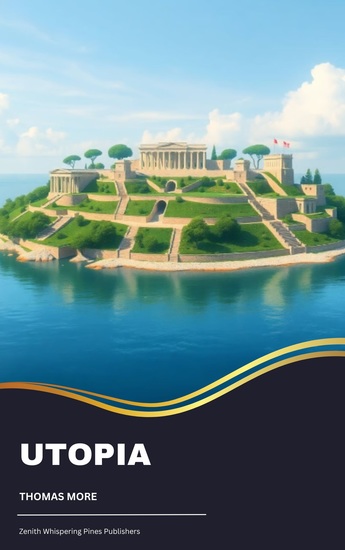
Utopia - cover

Utopia

Thomas More

Publisher: Zenith Whispering Pines Publishers

  • 0
  • 0
  • 0

Summary

Discover the Book That Defined an Entire Genre of Thought.

First published in 1516, Sir Thomas More's Utopia remains one of the most influential works of Western literature. Written as a playful yet biting social satire, the book introduces readers to a distant island nation where private property is abolished, religious tolerance is practiced, and every citizen works for the common good.

Through a fictional dialogue with the traveler Raphael Hythloday, More presents a radical alternative to the corruption and inequality of 16th-century Europe. While the title famously translates to "No Place," the questions More raises about justice, wealth distribution, and the role of the state continue to resonate in modern political debate.

This definitive edition offers the complete, unabridged text of this Renaissance masterpiece. A cornerstone of Humanist thought and political philosophy, Utopia is essential reading for anyone interested in the history of ideas or the eternal search for a perfect world.

Explore the foundation of social idealism. Buy "Utopia" today and challenge your perspective on society.
Available since: 12/17/2025.
Print length: 155 pages.
Other books that might interest you

  • Indispensable Nation - American Foreign Policy in a Turbulent World - cover

    Indispensable Nation - American...

    Robert J. Lieber

    • 0
    • 0
    • 0
    A clear-eyed analysis of the role the United States should play in the world as it exists today 
    The United States remains “the indispensable nation.” In this book, the distinguished international relations theorist and foreign policy specialist Robert Lieber argues that in a world full of revisionist powers, America’s role is more important than ever. No other country is capable of playing that role. America remains the essential pillar of the postwar liberal order. It is a center of both political and financial stability, and it promotes important values that the revisionist powers do not.
    Show book
  • Operation Al-Aqsa flood The Defeat of the Vanquisher - cover

    Operation Al-Aqsa flood The...

    Jacques Baud

    • 0
    • 1
    • 0
    Why did Operation Al-Aqsa Flood take place, and what were Hamas’s objectives? What really happened on the ground on October 7th? What lessons can we learn from the operations carried out by both sides? 
    To answer these three questions and many others, Jacques Baud revisits the Israeli-Palestinian conflict from its very beginnings. Why has it still not found a solution? What strategies have Israelis and Palestinians adopted over the past 75 years? What is the impact of this conflict on our security? What are the options for Israel and Palestine in the coming years? 
    In this book of rare clairvoyance, Jacques Baud deplores the fact that Western decisions are colliding with international law. The question is not who we are for, but how the international order created after 1945 should be applied. Israel’s failure to respect this law is provoking its downfall. As with any conflict, the solution will not come from emotion, but from objective, dispassionate analysis and honest mediation.
    Show book
  • The Great Illusion - cover

    The Great Illusion

    Norman Angell

    • 0
    • 0
    • 0
    "The Great Illusion" by Norman Angell is a thought-provoking analysis of international relations and the causes of war. First published in 1909, the book challenges the prevailing view of the time that war was a necessary and inevitable component of international politics. 
    Angell argues that the economic interdependence of nations in the modern world makes war irrational and self-defeating. He contends that war can no longer bring about the benefits it did in the past and that the cost of modern warfare would outweigh any potential gains. In this sense, he argues that the belief in the benefits of war is a "great illusion". 
    Angell's analysis is a precursor to the current debate on globalization and the interdependence of nations in the 21st century. He presents a powerful case for international cooperation, arguing that peace and prosperity can only be achieved through mutual understanding and collaboration among nations. 
    "The Great Illusion" is a seminal work in the field of international relations and a must-read for anyone interested in the causes of war and the prospects for peace in the modern world. It is a powerful reminder of the importance of diplomacy and cooperation in solving the complex problems of our time
    Show book
  • Moscow Rules - What Drives Russia to Confront the West - cover

    Moscow Rules - What Drives...

    Keir Giles

    • 0
    • 0
    • 0
    From Moscow, the world looks different. It is through understanding how Russia sees the world—and its place in it—that the West can best meet the Russian challenge. 


    Russia and the West are like neighbors who never seem able to understand each other. A major reason, this book argues, is that Western leaders tend to think that Russia should act as a "rational" Western nation—even though Russian leaders for centuries have thought and acted based on their country's different history and traditions. Russia, through Western eyes, is unpredictable and irrational, when in fact its leaders almost always act in their own predictable and rational ways. For Western leaders to try to engage with Russia without attempting to understand how Russians look at the world is a recipe for repeated disappointment and crises. 


    Keir Giles, a senior expert on Russia at Britain's prestigious Chatham House, describes how Russian leaders have used consistent doctrinal and strategic approaches to the rest of the world. These approaches may seem alien in the West, but understanding them is essential for successful engagement with Moscow. Giles argues that understanding how Moscow's leaders think—not just Putin but his predecessors and eventual successors—will help counterparts in the West develop a less crisis-prone and more productive relationship with Russia.
    Show book
  • Dictionary of the Undoing - cover

    Dictionary of the Undoing

    John Freeman

    • 0
    • 0
    • 0
    This program is read by the author.For John Freeman—literary critic, essayist, editor, poet, “one of the preeminent book people of our time” (Dave Eggers)—it is the rare moment when words are not enough. But in the wake of the election of 2016, words felt useless, even indulgent. Action was the only reasonable response. He took to the streets in protest, and the sense of community and collective conviction felt right. But the assaults continued—on citizens’ rights and long-held compacts, on the core principles of our culture and civilization, and on our language itself. Words seemed to be losing the meanings they once had and Freeman was compelled to return to their defense. The result is his Dictionary of the Undoing.From A to Z, “Agitate” to “Zygote,” Freeman assembled the words that felt most essential, most potent, and began to build a case for their renewed power and authority, each word building on the last. The message that emerged was not to retreat behind books, but to emphatically engage in the public sphere, to redefine what it means to be a literary citizen.With an afterword by Valeria Luiselli, Dictionary of the Undoing is a necessary, resounding cri de coeur in defense of language, meaning, and our ability to imagine, describe, and build a better world.
    Show book
  • Perpetual Peace - Immanuel Kant - cover

    Perpetual Peace - Immanuel Kant

    Immanuel Kant

    • 0
    • 0
    • 0
    "Perpetual Peace" is a philosophical work written by the German philosopher Immanuel Kant in 1795. In this work, Kant argues that peace can only be achieved through a world order based on international law, democratic governance, and the promotion of free trade. 
    Kant believed that war was a result of a flawed system of international relations, where states pursued their own self-interests without regard for the interests of other nations. He argued that in order to establish a lasting peace, a system of international law must be established that would regulate the behavior of nations and prevent them from going to war. 
    Kant also believed that a world federation of nations would be necessary to ensure peace. This federation would be based on democratic governance, where each nation would have an equal say in decisions that affected the world as a whole. Kant believed that this would help to ensure that the interests of all nations were taken into account, and that no one nation could dominate the others. 
    Finally, Kant argued that free trade was essential for peace. He believed that by promoting economic interdependence between nations, free trade would create incentives for nations to work together and avoid war. 
    Overall, Kant's "Perpetual Peace" is a seminal work in the history of political philosophy, and continues to be influential today in debates about international relations and the pursuit of peace.
    Show book