Join us on a literary world trip!
Add this book to bookshelf
Grey
Write a new comment Default profile 50px
Grey
Subscribe to read the full book or read the first pages for free!
All characters reduced
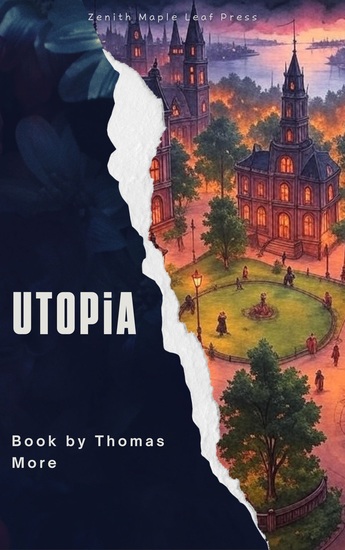
Utopia - cover

Utopia

Thomas More

Publisher: Zenith Maple Leaf Press

  • 0
  • 0
  • 0

Summary

🌍 What if a perfect society could exist—free from greed, corruption, and inequality?

First published in 1516, Thomas More's Utopia is one of the most influential works of political philosophy and social commentary ever written. Presented as a dialogue, the book describes an imaginary island where justice, equality, and communal living replace the flaws of European society in More's time.

Blending satire and serious political thought, Utopia challenges readers to question the nature of government, property, religion, and morality. Is this vision a model for progress—or an impossible dream? For centuries, readers have debated whether More intended his work as an ideal to strive for or a critique of human folly.

🌟 Why this book matters:

A cornerstone of Western political thought.

The origin of the very word utopia.

A timeless reflection on power, society, and human aspiration.

Whether you are a student of philosophy, a lover of history, or simply curious about ideas that shaped the modern world, Utopia remains as provocative and relevant today as it was 500 years ago.

👉 Click Buy Now and explore the groundbreaking vision that still inspires debate worldwide.
Available since: 08/22/2025.
Print length: 155 pages.


Other books that might interest you

  • My Whirlwind Lives - Navigating Decades of Storms - cover

    My Whirlwind Lives - Navigating...

    Dee Knight

    • 0
    • 0
    • 0
    Our recent storms didn't start in 2020 or 2016. They started decades ago in the 1960s - a whirlwind of threatened nuclear catastrophe, then police dogs and rednecks terrorizing civil rights marchers down south, then Vietnamese children fleeing from napalm flames. Then draft notices to go to Vietnam to "fight commies." 
    A small town boy started by supporting rightist Goldwater against the "peace candidate" Johnson, but rapidly changed in the face of the civil rights and anti-war movements, and started a quest that hasn't ended yet. 
    This book tells Dee Knight's story of "waking up" to the truth about the US war in Vietnam, then refusing the draft and going to Canada where he lived for six years. It relates the years-long campaign for amnesty, in which Knight was a leader. After war resisters won a partial amnesty, Knight continued campaigning against US wars up to the present day. 
    There are chapters on: 
    The political storms of 1968 
    Exile life in Canada 
    The years-long campaign for universal unconditional amnesty 
    Antiwar veterans and active duty soldiers and sailors, including the sanctuary movement 
    Witnessing Portugal's "Carnation Revolution" of 1975 
    Living and working in Sandinista Nicaragua 
    Socialism and the Green New Deal 
    "Messages from the Future" 
    Reflections on the Pandemic 
    The Battle to Expand and Protect Democracy 
    Appendices on Vietnam's victory in 1975, and on the reality of life and politics in China
    Show book
  • Is Reality Optional? - And Other Essays - cover

    Is Reality Optional? - And Other...

    Thomas Sowell

    • 0
    • 0
    • 0
    Thomas Sowell challenges all the assumptions of contemporary liberalism on issues ranging from the economy to race to education in this collection of controversial essays, and captures his thoughts on politics, race, and common sense with a section at the end for thought-provoking quotes.
    Show book
  • The Last Plantation - Racism and Resistance in the Halls of Congress - cover

    The Last Plantation - Racism and...

    James R. Jones

    • 0
    • 0
    • 0
    Racism continues to infuse Congress's daily practice of lawmaking and shape who obtains congressional employment. In this timely and provocative book, James Jones reveals how and why many who work in Congress call it the "Last Plantation." He shows that even as the civil rights movement gained momentum and antidiscrimination laws were implemented, Congress remained exempt from federal workplace protections. These exemptions institutionalized inequality in the congressional workplace well into the twenty-first century. 


    Jones uncovers the hidden dynamics of power, privilege, and resistance in Congress. He reveals how failures of racial representation among congressional staffers reverberate throughout the American political system and demonstrates how the absence of diverse perspectives hampers the creation of just legislation. Centering the experiences of Black workers within this complex landscape, he provides insights into the problems they face, the barriers that hinder their progress, and the ways they contest entrenched inequality. 


    A must-listen for anyone concerned about social justice and the future of our democracy, The Last Plantation exposes the mechanisms that perpetuate racial inequality in the halls of Congress and challenges us to confront and transform this unequal workplace that shapes our politics and society.
    Show book
  • The Postmodern Predicament - Existential Challenges of the Twenty-First Century - cover

    The Postmodern Predicament -...

    Bruce Ackerman

    • 0
    • 0
    • 0
    Human beings have taken one thing for granted since our earliest days: we are bodily creatures dealing with one another on a face-to-face basis. The internet has shattered this fundamental feature of human existence. We are suddenly living our lives in two worlds at once—shifting endlessly from virtual to physical reality as we reach out to others. 


    Worse yet, we are developing different personal identities in our two worlds. We say and do things in virtual reality that flatly contradict our face-to-face commitments to family, friends, and fellow-workers—and vice versa. The Postmodern Predicament explores these dilemmas at each phase of the life cycle, beginning at the moment a young child picks up a cell phone. 


    The existentialist tradition of the twentieth century provides a precious perspective on our postmodern dilemmas. Thinkers and doers like Simone de Beauvoir and Jean-Paul Sartre considered the fragmentation of modern life as a central source of contemporary anxieties. Like them, Ackerman views the challenges of the internet age as a political, no less than personal, problem—and proposes concrete reforms that that could mobilize broad-based support for democracy against demagogic assaults on its very foundations.
    Show book
  • Road to Serfdom The: Book Summary & Analysis - cover

    Road to Serfdom The: Book...

    Briefly Summaries

    • 0
    • 0
    • 0
    This is a concise summary and analysis of The Road to Serfdom, by Friedrich A. Hayek.
     
    It is not the original book and is not affiliated with or endorsed by Friedrich A. Hayek.
    Ideal those seeking a quick and insightful overview.
     
    The Road to Serfdom is a powerful critique of centralized economic planning and the dangers it poses to individual liberty and democratic institutions. Drawing from historical analysis and philosophical reasoning, this seminal work explores how the concentration of economic control can lead to the erosion of personal freedoms, the rise of authoritarian governments, and the decline of open societies. A cornerstone of political and economic thought, it remains an essential read for anyone seeking to understand the balance between freedom and government intervention in modern society.
    Show book
  • The Black Boom - cover

    The Black Boom

    Jason L Riley

    • 0
    • 0
    • 0
    Economic inequality continues to be one of the most hotly debated topics in America, but there has been relatively little discussion of the fact that black-white gaps in joblessness, income, poverty, and other measures were shrinking prior to the pandemic. Why was it happening, and why did this phenomenon go unacknowledged by so much of the media? 


    In The Black Boom, Jason L. Riley—acclaimed Wall Street Journal columnist and senior fellow at the Manhattan Institute—digs into the data and concludes that the economic lives of black people improved significantly under policies put into place during the Trump administration. 


    Less inequality is something that everyone wants, but disapproval of Trump's personality and methods too often skewed the media's appraisal of effective policies advocated by his administration. If we want to make real progress in improving the lives of low-income minorities, says Riley, we must look beyond our partisan differences at what works and keep doing it. Unfortunately, many press outlets were unable or unwilling to do that.
    Show book