Join us on a literary world trip!
Add this book to bookshelf
Grey
Write a new comment Default profile 50px
Grey
Subscribe to read the full book or read the first pages for free!
All characters reduced
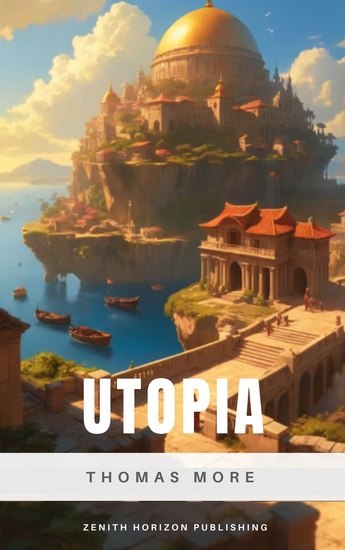
Utopia - A Visionary Blueprint for Ideal Society - cover

Utopia - A Visionary Blueprint for Ideal Society

Thomas Moore, Zenith Horizon Publishing

Publisher: Zenith Horizon Publishing

  • 0
  • 0
  • 0

Summary

Step into the brilliant mind of Sir Thomas More as he imagines a perfect world in Utopia — a timeless exploration of justice, equality, governance, and human dignity. Written in 1516, this foundational philosophical and political work still inspires debate and admiration today.

More's masterpiece presents a fictional island society governed by reason, community welfare, and shared values — offering a sharp critique of the corruption, inequality, and moral failings of 16th-century Europe. Through dialogue, wit, and vision, Utopia urges readers to ask: What would a better world truly look like?

This edition is essential for lovers of political philosophy, Renaissance thought, and classic literature. It remains a must-read for anyone seeking insight into the roots of modern social theory and the timeless search for justice and harmony.

👉 Click "Buy Now" to explore a world where imagination meets reform.
Available since: 06/20/2025.
Print length: 155 pages.

Other books that might interest you

  • Democracy Unmoored - Populism and the Corruption of Popular Sovereignty - cover

    Democracy Unmoored - Populism...

    Samuel Issacharoff

    • 0
    • 0
    • 0
    The 2016 election of Donald Trump focused people's minds on populism, and most of the attention paid to the subject since has been on the threat it poses to wealthy democracies. In Democracy Unmoored, Samuel Issacharoff takes a far wider-angle view of the phenomenon, covering countries from across the globe: Brazil, Poland, Argentina, Turkey, India, Hungary, Venezuela, and more. Just as importantly, he focuses on populism's attack on the institutions of governance. Democracy requires two critical features: first, a commitment to repeat play such that political actors understand that what goes around comes around; and, second, institutional constraints so that the majority can prevail, albeit not by too much. Democracies must avoid the doomsday scenario in which the contending parties see the next election as the final choice between salvation and perdition. Issacharoff shows how populist governance undermines each of these two critical underpinnings of stable democracy, first by compressing the time horizon to the immediate, and second by eroding institutional constraints on strongman rule. At the same time, Issacharoff highlights the fact that ascendent populists were pushing in an open door as they found democracies in states of disrepair in the post-2008 world.
    Show book
  • Nine Lives - My Time as the West’s Top Spy inside al-Qaeda - cover

    Nine Lives - My Time as the...

    Aimen Dean, Tim Lister, Paul...

    • 0
    • 0
    • 0
    As one of al-Qaeda’s most respected bomb-makers, Aimen Dean rubbed shoulders with the mastermind of the 9/11 attacks and swore allegiance to Osama bin Laden himself. 
    As a double agent at the heart of al-Qaeda’s chemical weapons program, he foiled attacks on civilians and saved countless lives, brushing with death so often that his handlers began to call him their spy with nine lives. 
    This is the story of how a young Muslim, determined to defend his faith, found himself fighting on the wrong side—and his fateful decision to work undercover for his sworn enemy. From the killing fields of Bosnia to the training camps of Afghanistan, from running money and equipment in Britain to dodging barrel bombs in Syria, we discover what life is like inside the global jihad, and what it will take to stop it once and for all.
    Show book
  • Government by the Unelected - How It Happened and How It Might Be Tamed - cover

    Government by the Unelected -...

    Dr. R.J. Pestritto

    • 0
    • 0
    • 0
    “Much alarm has been raised among Establishment media and politicians about President Trump’s efforts to cut the federal bureaucracy and to force its top officials to be more loyal to him and to those who voted for him. How did we come to find ourselves in a situation where our top national administrators – who exercise immense governing power in our country – think of themselves as independent of the elected president? Why does it create alarm among our elites when the president expects those running the administrative state to carry out his political program? The roots of this entitled attitude go back many decades, and are part of the original Progressive project to comprehensively reshape American government. We are now in the midst of the first serious effort since the 1930s to restore some measure of democratic accountability to national administration. In this Provocation, Ronald J. Pestritto explains how we got to this moment, and what the prospects are for the current effort to turn things around.”  
    Show book
  • Episode 8 - Rural Development - cover

    Episode 8 - Rural Development

    Anjum Sharma

    • 0
    • 0
    • 0
    Why is it said that the empowerment of Panchayati Raj institutions is necessary for rural development. In a rapidly changing world, it is necessary to take care that the units of local self-government do not lag behind. In such a scenario, what is the government doing to improve the economic condition of the rural people? Find out in this episode.
    Show book
  • Law Overload: The Hidden Human Cost - "Ace your test with engaging audio lessons from Law Overload: The Hidden Human Cost!" - cover

    Law Overload: The Hidden Human...

    Elliot Voss

    • 0
    • 0
    • 0
    Law Overload: The Hidden Human Cost 
      
    ⭐⭐ Simplified Audio Guide ⭐⭐ 
    Are you curious about the profound impact of excessive laws on our daily lives?   
    Do you need a comprehensive guide that elucidates the hidden human costs of legal overload?   
    Your search ends here!   
    This audiobook serves as your definitive companion for deepening your understanding, expanding your knowledge, and engaging in thought-provoking analysis. Get ready to uncover the realities behind the veil of legal complexities.   
    Updated for the latest structures and analysis methodologies.   
    Key features of this enriched guide:   
    - Profound insights about the impact of excessive laws on human lives 
    - Detailed explanation of various legal complexities 
    - Effective strategies for understanding and analyzing the hidden costs of over-regulation   
    Our guide distinguishes itself through in-depth coverage, which is essential for grasping the true essence of legal overload. Concepts aren't merely skimmed; they are delved into with precision.   
    Please note that this audiobook is not affiliated with any official legal entity and is purely an independent resource for your benefit.   
    Designed with a clear structure and easy-to-understand language, "Law Overload: The Hidden Human Cost" ensures smooth transitions between topics. Say goodbye to dense jargon and welcome clear, precise, and technically accurate content.   
    So, why wait? Click the BUY NOW button, secure your guide, and begin your journey to understanding the profound human cost of excessive laws!
    Show book
  • Propaganda: Book Summary & Analysis - cover

    Propaganda: Book Summary & Analysis

    Briefly Summaries

    • 0
    • 0
    • 0
    This is a concise summary and analysis of Propaganda, by Edward Bernays.
     
    It is not the original book and is not affiliated with or endorsed by Edward Bernays.
     
    Ideal those seeking a quick and insightful overview.
     
    Propaganda explores the powerful role of public relations and persuasion in shaping public opinion, politics, and consumer behavior. This groundbreaking work unveils the mechanics of influence in modern society, examining how ideas are spread and perceptions are crafted by media, governments, and corporations. Through insightful analysis, the book reveals the techniques used to sway public consciousness and highlights the ethical implications of such manipulation. A must-read for anyone seeking to understand the dynamics of communication and power in the 20th century and beyond.
    Show book