Join us on a literary world trip!
Add this book to bookshelf
Grey
Write a new comment Default profile 50px
Grey
Subscribe to read the full book or read the first pages for free!
All characters reduced
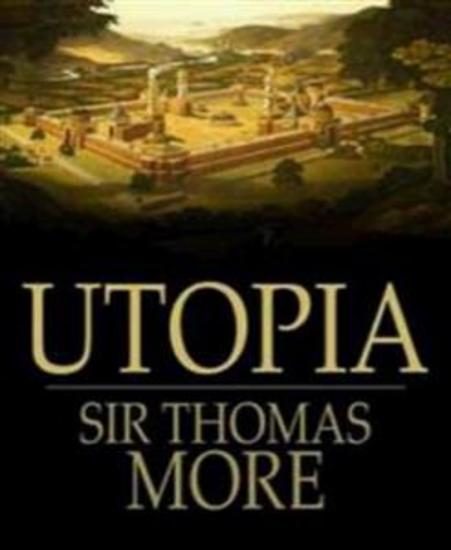
Thomas More’s Utopia - cover

Thomas More’s Utopia

Thomas More

Publisher: BookRix

  • 0
  • 0
  • 0

Summary

Utopia is a work of fiction and political philosophy by Thomas More. The book is a frame narrative primarily depicting a fictional island society and its religious, social and political customs. 

There is no private property on Utopia, with goods being stored in warehouses and people requesting what they need. There are also no locks on the doors of the houses, which are rotated between the citizens every ten years. Agriculture is the most important job on the island. Every person is taught it and must live in the countryside, farming for two years at a time, with women doing the same work as men. Parallel to this, every citizen must learn at least one of the other essential trades: weaving (mainly done by the women), carpentry, metalsmithing and masonry. There is deliberate simplicity about these trades; for instance, all people wear the same types of simple clothes and there are no dressmakers making fine apparel. All able-bodied citizens must work; thus unemployment is eradicated, and the length of the working day can be minimised: the people only have to work six hours a day (although many willingly work for longer). More does allow scholars in his society to become the ruling officials or priests, people picked during their primary education for their ability to learn. All other citizens are however encouraged to apply themselves to learning in their leisure time.

Slavery is a feature of Utopian life and it is reported that every household has two slaves. The slaves are either from other countries or are the Utopian criminals. These criminals are weighed down with chains made out of gold. The gold is part of the community wealth of the country, and fettering criminals with it or using it for shameful things like chamber pots gives the citizens a healthy dislike of it. It also makes it difficult to steal as it is in plain view. The wealth, though, is of little importance and is only good for buying commodities from foreign nations or bribing these nations to fight each other. Slaves are periodically released for good behaviour. Jewels are worn by children, who finally give them up as they mature.

Other significant innovations of Utopia include: a welfare state with free hospitals, euthanasia permissible by the state, priests being allowed to marry, divorce permitted, premarital sex punished by a lifetime of enforced celibacy and adultery being punished by enslavement. Meals are taken in community dining halls and the job of feeding the population is given to a different household in turn. Although all are fed the same, Raphael explains that the old and the administrators are given the best of the food. Travel on the island is only permitted with an internal passport and any people found without a passport are, on a first occasion, returned in disgrace, but after a second offence they are placed in slavery. In addition, there are no lawyers and the law is made deliberately simple, as all should understand it.
Available since: 12/19/2023.
Print length: 175 pages.

Other books that might interest you

  • Göbekli Tepe: The History and Mystery of One of the World’s Oldest Neolithic Sites - cover

    Göbekli Tepe: The History and...

    Editors Charles River

    • 0
    • 0
    • 0
    The Neolithic period came before the Bronze Age and is generally regarded as the final subdivision of the Stone Age. During this time, communities domesticated plants and certain animals but still relied on hunting and gathering to a considerable extent, and beginning sometime around 7000 BCE, handmade pottery was developed, along with more advanced stone axes that enabled people to clear vast forests. Thanks to tools like that, the sizes of these Neolithic communities ranged from thousands to as few as a hundred, and they spread across the world with a variety of cultures and languages. One aspect these cultures had in common was that they relied on similar tools made of stone, wood, and bone. 
    Despite the fact some Neolithic communities grew to considerable sizes, they’re typically not considered when people think of the first ancient civilizations or the first major cities, so when German archaeologists discovered the archaeological site of Göbekli Tepe in southeastern Turkey in the 1990s, it created an academic firestorm that is still raging. Far from being just another settlement, Göbekli Tepe has been described as the world’s first temple and perhaps one of the locations where human civilization began. Subsequent archaeological work at Göbekli Tepe has revealed that the site was a spiritual center for the local population during a time when humans were undergoing a transition as hunter-gatherers in the Paleolithic Period to a more sedentary lifestyle in the Neolithic Period, more than 10,000 years ago. Further research in the disciplines of anthropology, religion, and history indicate that the activity at Göbekli Tepe subsequently set the tone for elements of Neolithic and Bronze Age religion and ideology in the Near East, especially in Anatolia (roughly equivalent with modern Turkey).
    Show book
  • How to Be Queer - An Ancient Guide to Sexuality (Ancient Wisdom for Modern Readers) - cover

    How to Be Queer - An Ancient...

    Sarah Nooter

    • 0
    • 0
    • 0
    The idea of sexual fluidity may seem new, but it is at least as old as the ancient Greeks, who wrote about queer experiences with remarkable frankness, wit, and insight. How to Be Queer is an infatuating collection of these writings about desire, love, and lust between men, between women, and between humans and gods, in lucid and lively new translations. 


    How to Be Queer starts with Homer's Iliad and moves through lyric poetry, tragedy, comedy, philosophy, and biography, drawing on a wide range of authors, including Sappho, Plato, Anacreon, Pindar, Theognis, Aristophanes, and Xenophon. It features both beautiful poetry and thought-provoking prose, emotional outpourings and humorous anecdotes. From Homer's story of the relationship between Achilles and Patroclus, one of the most intense between men in world literature, to Sappho's lyrics on the pleasures and pains of loving women, these writings show the many meanings of what the Greeks called eros. 


    Complete with brief introductions to the selections, How to Be Queer reveals what the Greeks knew long ago—that the erotic and queer are a source of life and a cause for celebration.
    Show book
  • College for Free Today - Discover Different Ways You Can Go to College For Free Learn About Scholarships Financial Aids and Many More! - cover

    College for Free Today -...

    Jon Ghadery

    • 0
    • 0
    • 0
    College for Free Today: Discover Different Ways You Can Go to College For Free. Learn About Scholarships, Financial Aids and Many More! 
    When I worked in the financial aid department of one career based college I would sit down face to face with potential students and their families. I have seen first hand, time and time again, while a private college education can cost tens of thousands of dollars, anyone with a little ingenuity and a lot of self motivation and confidence can get their college education at a drastically reduced price and in many cases even for free. 
    This audiobook will teach you different ways and strategies on how you can get a college education virtually free. Learn how different scholarships and aids work and how you can apply for them. 
    This audiobook will cover the following topics: 
    - The First Twelve Years 
    - Fast Web and Other Scholarship Websites 
    - More Scholarship Websites 
    - Maintain Your Financial Aid By Being a Dedicated Student 
    - Reap the Benefits of College Work Study and Student Worker Programs 
    - Free Education As a Company Benefit 
    - After Graduation 
    - Free College is Possible If You Think Outside the Box 
    - Partial List of Career-Focused College 
    - And many more! 
    There are literally thousands of philanthropic organizations as well as private parties who are ready and willing to give financial aid to students who show even the slightest degree of commitment and drive. To learn more, scroll up and click “add to cart” now!
    Show book
  • Why Ordinary People Commit Unthinkable Crimes - cover

    Why Ordinary People Commit...

    Avielle Brooks

    • 0
    • 0
    • 0
    This audiobook is narrated by an AI Voice.  
    Explore the disturbing psychology that enables regular people to participate in atrocities, abuse, and crimes they would have considered unimaginable before circumstances aligned to make the unthinkable possible. This challenging audiobook examines how situational factors, authority structures, group dynamics, and incremental escalation transform ordinary individuals into perpetrators of extraordinary harm. Learn from historical analysis, psychological research, and criminal case studies how genocides, torture programs, and mass violence depend on regular people following orders, conforming to groups, or gradually escalating across moral boundaries. The narrator reveals the specific conditions that predict when normal people will commit abnormal acts and why believing yourself immune to such conditions is itself a risk factor. Discover how perpetrators rationalize their actions during and after crimes through psychological mechanisms available to everyone including you. Understand why focusing on individual evil distracts from the systemic factors that reliably produce harmful behavior regardless of who fills available roles. This audiobook draws from Holocaust research, prison studies, and criminal psychology to illuminate the human capacity for cruelty that comfortable circumstances allow us to ignore. Learn what conditions prevented some individuals from participating in collective crimes and what factors strengthened resistance. Essential listening for anyone who wants honest understanding of human nature including its darkest possibilities and how ordinary life can transform into participation in evil.
    Show book
  • The Subtle Art of Short Fiction - cover

    The Subtle Art of Short Fiction

    Isabelle Kenyon

    • 0
    • 0
    • 0
    The Subtle Art of Short Fiction explores the power of short fiction in today's fragmented world. Renowned authors and critics offer advanced techniques for crafting nuanced, impactful stories. Learn to master short story structure, subtext, micro-tension, and sensory minimalism. Ideal for experienced writers seeking to refine their skills in this sophisticated art form, or those who love short fiction, and want to learn about the craft behind it.
    Essays and writing exercises by Dr Kerry Hadley-Pryce, Daisy Johnson, Matt Wesolowski, Sascha Akhtar, David Hartley, Mahsuda Snaith, Dr Jonathan Taylor, Sarah Schofield, SJ Bradley and Farhana Shaikh. With an introduction by Dr Paul March-Russell.
    Show book
  • The Great Seal of The United States - Its History Symbolism And Message For The New Age - cover

    The Great Seal of The United...

    Paul Foster Case

    • 0
    • 0
    • 0
    The Great Seal of the United States (1935) is an inspired and thought-provoking treatise on the forgotten history and spiritual symbolism of the iconic American emblem that embodies the principles and ideals of this nation's founders. 
    With surgical precision, American occultist, teacher and author Paul Foster Case reveals the Great Seal to be a profound spiritual symbol created by the Founding Fathers to serve as an immortal representation of the ideals of the Novo Ordo Seclorum (New World Order). 
    Students of American History, Freemasonry, Rosicrucianism, Gematria, Numerology, the Bible, the Qabalah/Kabbalah or the occult in general will find this one rich in esoteric meanings rooted in universal principles that transcend times and mankind.
    Show book