Join us on a literary world trip!
Add this book to bookshelf
Grey
Write a new comment Default profile 50px
Grey
Subscribe to read the full book or read the first pages for free!
All characters reduced
THOMAS MORE Premium Edition - Utopia The History of King Richard III Dialogue of Comfort Against Tribulation De Tristitia Christi Biography - cover

THOMAS MORE Premium Edition - Utopia The History of King Richard III Dialogue of Comfort Against Tribulation De Tristitia Christi Biography

Thomas More

Publisher: DigiCat

  • 0
  • 0
  • 0

Summary

In the "Thomas More Premium Edition," readers are offered a comprehensive exploration of More's seminal works, including his magnum opus, "Utopia," and other varied writings that encapsulate his humanist philosophy and ethical concerns. The literary style is marked by a rich, articulate prose that seamlessly blends narrative, dialogue, and philosophical discourse, set against the backdrop of 16th-century Europe—a period rife with political upheaval and theological debate. More's incisive critiques of contemporary society and vivid imagination come together to create a thought-provoking commentary on the ideal state and human virtue, showcasing his commitment to Renaissance humanism. Thomas More (1478-1535) was a lawyer, statesman, and philosopher, renowned for his unwavering moral integrity and profound intellect. His tumultuous relationship with King Henry VIII, particularly concerning issues of faith and governance, directly influenced his writings. More's experiences in a rapidly changing socio-political landscape, coupled with his deep Catholic faith, fueled his desire to articulate a vision of justice and community that remains relevant. This edition is highly recommended for readers seeking to understand the complexities of More's thought and its implications for contemporary discussions on ethics, governance, and society. By delving into More's works, one is invited to reflect on the ideals of justice, the moral obligations of governance, and the enduring quest for an equitable society.
Available since: 12/27/2023.
Print length: 819 pages.


Other books that might interest you

  • American Politics - A Graphic History - cover

    American Politics - A Graphic...

    Laura Locker

    • 0
    • 1
    • 0
    Following in the footsteps of the highly successful Queer: A Graphic History, illustrator Jules Scheele teams up with Dr Laura Locker in this comic-book introduction to the political history of the Land of Opportunity.
    
    How did
    
    a political outsider like Trump win the 2016 presidential election? Why do some
    
    Americans feel so strongly about gun rights? Is there a role for more than two
    
    political parties in the system?
    
    Politics
    
    isn't something that just occurs in the West Wing or the gleaming Capitol
    
    building – it comes from the interaction between state and society, the
    
    American people living their daily lives. In this unique graphic guide, we
    
    follow modern citizens as they explore everything from the United States'
    
    political culture, the Constitution and the balance of power, to social
    
    movements, the role of the media, and tensions over race, immigration, and LGBT
    
    rights.
    
    Step
    
    right up, and see what lies beneath the pageantry and headlines of this great
    
    nation.
    Show book
  • Christopher Columbus - The Famous Explorer and His Voyages Across the Atlantic Ocean - cover

    Christopher Columbus - The...

    Kelly Mass

    • 0
    • 0
    • 0
    Christopher Columbus was an Italian navigator and explorer who made 4 explorations across the Atlantic Ocean, paving the course for European discovery and settlement of the Americas. His journeys were the first European contacts with the Caribbean, Central America, and South America, and were financed by the Catholic Monarchs of Spain. 
    Christopher Columbus is an Anglicization of “Christophorus Columbus,” a Latin name. Columbus was born in the Republic of Genoa and spoke a Ligurian dialect as his mother tongue, according to most intellectuals. He went to sea at an early age and traveled all over the world, as far north as the British Islands and as far south as Ghana. He wed Filipa Moniz Perestrelo, a Portuguese noblewoman, and resided in Lisbon for some years, but later on wed a Castilian girlfriend, with whom he had one child. Columbus, who was primarily self-taught, was skilled in geography, astronomy, and history. He created a technique to find a western sea path to the East Indies, with the objective of benefiting from the wealthy spice trade. 
    Christopher Columbus has had a huge impact on the discovery of the American continent, and is still honored and respected to this day, despite of the controversies around his behavior and interaction with the locals. Let’s see what these contradicting opinions are all about.
    Show book
  • I Think Therefore I’m Wrong - Descartes and the Birth of Overconfidence - cover

    I Think Therefore I’m Wrong -...

    Sophia Blackwell

    • 0
    • 0
    • 0
    I Think, Therefore I’m Wrong: Descartes and the Birth of Overconfidence is your gloriously sarcastic, brutally honest, and deeply unhinged guide to the man who launched modern philosophy with one anxious thought spiral and never looked back. 
    René Descartes: French, wealthy, suspicious of everything, and armed with just enough Latin to convince the world that his personal identity crisis was actually a groundbreaking intellectual framework. From doubting the entire universe to claiming God exists because the idea of God felt right, Descartes pioneered a system so elegantly flawed it haunted philosophers for centuries—and now you get to enjoy the wreckage. 
    In this book, Sophia Blackwell (Kant You Not, Leibniz’s Monads) takes you on a laugh-out-loud demolition tour of: 
    The Four-Step Method of Doubt, also known as gaslighting the cosmos 
    The Cogito, or how to accidentally make thinking sound smug 
    God as epistemological tech support 
    Mind-body dualism, or “what if you’re just a haunted skeleton?” 
    Descartes’ legacy in science, psychology, AI, and every freshman who says “I'm not my body, bro.” 
    Whether you’re a philosophy student, a recovering Cartesian, or just here to watch the metaphysical world burn, this book explains Descartes’ ideas the way they were always meant to be understood: with sarcasm, side-eye, and a glass of wine. 
    I think, therefore I spiral. Let’s go
    Show book
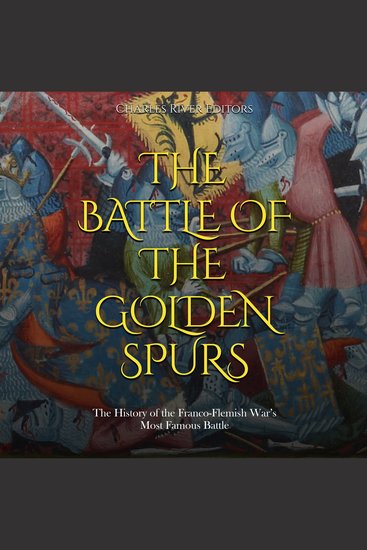
  • Battle of the Golden Spurs The: The History of the Franco-Flemish War’s Most Famous Battle - cover

    Battle of the Golden Spurs The:...

    Editors Charles River

    • 0
    • 0
    • 0
    In the time period between the fall of Rome and the spread of the Renaissance across the European continent, many of today’s European nations were formed, the Catholic Church rose to great prominence, some of history’s most famous wars occurred, and a social class system was instituted that lasted over 1,000 years. A lot of activity took place during a period frequently labeled derogatively as the “Dark Ages,” and while that period of time is mostly referred to as the “Middle Ages” instead of the Dark Ages today, it has still retained the stigma of being a sort of lost period of time in which Western civilization made no worthwhile progress after the advances of the ancient civilizations of Greece and Rome.  
    Somewhat ironically, the one aspect of the Middle Ages that has been romanticized is medieval warfare. The Middle Ages have long sparked people’s imaginations thanks to imagery of armored knights battling on horseback and armies of men trying to breach the walls of formidable castles, but what is generally forgotten is that medieval warfare was constantly adapting to the times as leaders adopted new techniques and technology, and common infantry became increasingly important throughout the period. 
    The changes became most evident at the beginning of the 14th century, when the French army fought rebellious forces from Flanders in the Battle of the Golden Spurs on July 11, 1302. Though the battle is mostly forgotten today, it was one of medieval Europe’s most important battles because the Flemish army, consisting almost entirely of infantry, defeated the French forces and their heavily armored cavalry. The battle marked the end of the feudal era and shifted the military focus to infantry armed with pikes or spears. Over 700 years later, the date of the battle is a national holiday in Belgium, and though it did not establish an independent state, the victory certainly set the Flemish people on the road to independence. 
    Show book
  • Restoring Inner Peace: Your Path to Healing and Wholeness - Discover Healing Bliss: Powerful Audio Lessons for Restoring Inner Peace and Wholeness! - cover

    Restoring Inner Peace: Your Path...

    Gareth Rowland

    • 0
    • 0
    • 0
    Restoring Inner Peace: Your Path to Healing and Wholeness 
    ⭐⭐ Simplified Guide & Explanations Included ⭐⭐ 
    Are you seeking to find tranquility and strengthen your mental and emotional well-being by embracing the philosophy of Restoring Inner Peace: Your Path to Healing and Wholeness? 
    Looking for a comprehensive guide that includes all the necessary elements for understanding and practicing Restoring Inner Peace: Your Path to Healing and Wholeness? 
    Your search ends here! 
    This guide is your ultimate companion for deepening your understanding, improving your skills, and engaging in practical exercises. With this, you are set for a journey toward healing and wholeness. 
    Updated for the latest insights and approaches. 
    Key features of this enriched guide: 
    - Profound insights about the principles of Restoring Inner Peace 
    - Detailed explanations of the philosophy of healing and wholeness 
    - Effective strategies for incorporating these practices into your daily life 
    Our guide stands out with comprehensive coverage, crucial for your journey towards inner peace. Concepts aren’t merely skimmed; they are explored in-depth with precision. 
    Designed with a clear structure and easy-to-understand language, our guide on Restoring Inner Peace: Your Path to Healing and Wholeness ensures smooth transitions between topics. Say goodbye to complex jargon and welcome clear, precise, and technically accurate content. 
    So, why wait? Click the BUY NOW button, secure your guide, and begin your journey to achieving inner peace and wholeness!
    Show book
  • History of Israel - History of the Jews and Canaanites (3 in 1) - cover

    History of Israel - History of...

    Kelly Mass

    • 0
    • 0
    • 0
    This book consists of three titles: 
    Canaanites - During the late 2nd millennium BC, Canaan was a Semitic-speaking civilization located in the Ancient Near East. The region held significant geopolitical importance, especially during the Late Bronze Age Amarna Period in the 14th century BC, when it became a crossroads for major empires. The Egyptian, Hittite, Mitanni, and Assyrian Empires all had areas of interest that converged or overlapped in Canaan, making it a key territory for trade, warfare, and cultural exchange. Much of our understanding of Canaan comes from archaeological excavations at sites such as Tel Hazor, Tel Megiddo, En Esur, and Gezer, where remnants of ancient Canaanite life have been uncovered. 
    History of Jerusalem - Jerusalem is one of the world’s oldest cities, with a history that stretches back thousands of years. Over the course of its existence, it has been invaded 52 times, seized and regained 44 times, besieged 23 times, and destroyed twice. The oldest portion of the city dates back to the 4th millennium BCE, making it not only a significant historical center but also a symbol of resilience and conflict. Its role in the ancient world has been central to the development of various cultures, religions, and empires that have passed through the region, contributing to its complex and contested history. 
    History of the Jews - Jewish history is a rich tapestry woven over millennia, shaped by the development of a people, their religion, and their culture as they interacted with various civilizations, faiths, and cultures. The earliest reference to Israel can be found on the Merneptah Stele, dated to between 1213–1203 BCE, marking the first historical mention of the ancient Israelite people. However, the religious and cultural narrative of the Jews stretches far earlier.
    Show book