Join us on a literary world trip!
Add this book to bookshelf
Grey
Write a new comment Default profile 50px
Grey
Subscribe to read the full book or read the first pages for free!
All characters reduced
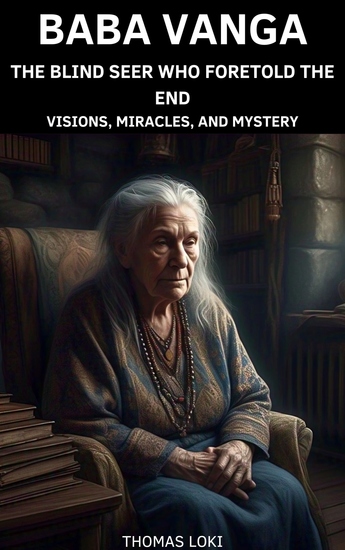
Baba Vanga - The Blind Seer Who Foretold the End - cover

Baba Vanga - The Blind Seer Who Foretold the End

Thomas Loki

Publisher: Heritage Books

  • 0
  • 0
  • 0

Summary

Baba Vanga was no ordinary woman. Blinded as a child by a mysterious storm, she claimed to have gained a vision far greater than sight—the ability to see the future. From world-changing events to personal destinies, her predictions stunned believers and skeptics alike.


Many say she foresaw wars, disasters, and even the rise and fall of world leaders. Some call her a prophet, others a mystery wrapped in legend. But who was the real Baba Vanga? How did a humble woman from a small Bulgarian village become one of the most famous seers in history?


This book unravels the story of her life, her prophecies, and the mystery that continues to surround her name. Was she truly gifted, or were her visions just coincidence? Step into the world of Baba Vanga and decide for yourself.
Available since: 04/01/2025.
Print length: 86 pages.

Other books that might interest you

  • Don't Boil The Canary - and other words of wisdom gleaned from my interrupted life - cover

    Don't Boil The Canary - and...

    Ted Simon

    • 0
    • 0
    • 0
    From the time Ted Simon set off around the world on his Triumph, at the age of 42, his life has been, literally, an open book. In everything he has written since that journey began no-one has been more forthcoming about his life, his thoughts and feelings, than Ted. Yet almost nothing is known about his life before that journey. 
    So that his own children – one son, two grandsons – would have a better idea of who he is or was, he began to write an account which, inevitably, grew into a book. These are the earlier “interruptions” of a rich and varied life narrated by the man himself.
    Show book
  • Foghorn - The Nearly True Story of a Small Publishing Empire - cover

    Foghorn - The Nearly True Story...

    Vicki DeArmon

    • 0
    • 0
    • 0
    The heyday of small press publishing in San Francisco lives again 


    This is the never-before-told story of a unique time in San Francisco as well as in book industry history, when Bay Area small presses—armed with arrogance and personal computers—took the publishing field. At Foghorn Press, Vicki Morgan was an ambitious woman publisher, young and brash, coming-of-age while quixotically building a book publishing company from scratch with her eccentric brother to help. 


    As part of their optimistic Morgan heritage, the siblings strive to grow Foghorn Press with no capital, 100-hour work weeks, cheap beer, irrepressible belly laughs, and no book publishing experience. They assemble a cast of preposterous authors and resistant staff while surviving a drunken ex-husband, a con artist, calculating distributors, a fleet of good ol' boys, terrible cash flow, and their own differing aspirations. Books are brought to market and miraculously sell from their offices in the Boiler Room. Foghorn is soon a resounding success with sales, media, acclaim. But in the end, there are costs, to relationships, to family, and maybe even to the truth.
    Show book
  • A Farewell to Gabo and Mercedes - A Son’s Memoir of Gabriel García MArquez and Mercedes Barcha - cover

    A Farewell to Gabo and Mercedes...

    Anonymous

    • 0
    • 0
    • 0
    “(Garcia) now honors his parents in this brief yet profound memoir rendered all the more intimate in García's own voice.”—Booklist (starred review) 
    “This is a beautiful farewell to two extraordinary people. It enthralled and moved me, and it will move and enthrall anyone who has ever entered the glorious literary world of Gabriel García Márquez.”—Salman Rushdie 
    “In A Farewell to Gabo and Mercedes Rodrigo Garcia finds the words that cannot be said, the moments that signal all that is possible to know about the passage from life to death, from what love brings and the loss it leaves. With details as rich as any giant biography, you will find yourself grieving as you read, grateful for the profound art that remains a part of our cultural heritage.”—Walter Mosley, New York Times bestselling author of Down the River Unto the Sea 
    The son of one of the greatest writers of our time—Nobel Prize winner and internationally bestselling icon Gabriel García Márquez—remembers his beloved father and mother in this tender memoir about love and loss. 
    In March 2014, Gabriel García Márquez, one of the most acclaimed writers of the twentieth century, came down with a cold. The woman who had been beside him for more than fifty years, his wife Mercedes Barcha, was not hopeful; her husband, affectionately known as “Gabo,” was then nearly 87 and battling dementia. I don't think we'll get out of this one, she told their son Rodrigo.  
    Hearing his mother’s words, Rodrigo wondered, “Is this how the end begins?” To make sense of events as they unfolded, he began to write the story of García Márquez’s final days. The result is this intimate and honest account that not only contemplates his father’s mortality but reveals his remarkable humanity. 
    Both an illuminating memoir and a heartbreaking work of reportage, A Farewell to Gabo and Mercedes transforms this towering genius from literary creator to protagonist, and paints a rich and revelatory portrait of a family coping with loss. At its center is a man at his most vulnerable, whose wry humor shines even as his lucidity wanes. Gabo savors affection and attention from those in his orbit, but wrestles with what he will lose—and what is already lost. Throughout his final journey is the charismatic Mercedes, his constant companion and the creative muse who was one of the foremost influences on Gabo’s life and his art. 
    Bittersweet and insightful, surprising and powerful, A Farewell to Gabo and Mercedes celebrates the formidable legacy of Rodrigo’s parents, offering an unprecedented look at the private family life of a literary giant. It is at once a gift to Gabriel García Márquez’s readers worldwide, and a grand tribute from a writer who knew him well.  
    “You read this short memoir with a feeling of deep gratitude. Yes, it is a moving homage by a son to his extraordinary parents, but also much more: it is a revelation of the hidden corners of a fascinating life. A Farewell to Gabo and Mercedes is generous, unsentimental and wise.” —Juan Gabriel Vásquez, author of The Sound of Things Falling 
    “A warm homage filled with both fond and painful memories.” —Kirkus   
    ""Garcia’s limpid prose gazes calmly at death, registering pain but not being overcome by it . . . the result is a moving eulogy that will captivate fans of the literary lion."" — Publishers Weekly 
    Supplemental enhancement PDF accompanies the audiobook.
    Show book
  • Inside This Dress - God Turned My Pain into Rose Petals - cover

    Inside This Dress - God Turned...

    Dakima Hicks

    • 0
    • 0
    • 0
    My beautiful readers, as you glance over the chapters of my life, I hope that you can reflect on your own. We have all experienced heartaches and happiness at some point in our lives. Writing this book freed me from the trauma of my past and created an opportunity for me to live my best life. Maybe you’ve gone through some things that you’ve never shared with others that may have somehow created insecurities within yourself. Hopefully, this book will help you recognize how to move forward with your best life.
    Show book
  • Betty Brown the St Giles Orange Girl - From their pens to your ears genius in every story - cover

    Betty Brown the St Giles Orange...

    Hannah More

    • 0
    • 0
    • 0
    Hannah More was born on February 2nd, 1745 at Fishponds in the parish of Stapleton, near Bristol. She was the fourth of five daughters. 
    The City of Bristol, at that time, was a centre for slave-trading and Hannah would, over time, become one of its staunchest critics.  
    She was keen to learn, possessed a sharp intellect and was assiduous in studying.  Hannah first wrote in 1762 with The Search after Happiness (by the mid-1780s some 10,000 copies had been sold). 
    In 1767 Hannah became engaged to William Turner.  After six years, with no wedding in sight, the engagement was broken off.  Turner then bestowed upon her an annual annuity of £200.  This was enough to meet her needs and set her free to pursue a literary career.   
    Her first play, The Inflexible Captive, was staged at Bath in 1775. The famous David Garrick himself produced her next play, Percy, in 1777 as well as writing both the Prologue and Epilogue for it.  It was a great success when performed at Covent Garden in December of that year.  
    Hannah turned to religious writing with Sacred Dramas in 1782; it rapidly ran through nineteen editions. These and the poems Bas-Bleu and Florio (1786) mark her gradual transition to a more serious and considered view of life. 
    Hannah contributed much to the newly-founded Abolition Society including, in February 1788, her publication of Slavery, a Poem recognised as one of the most important of the abolition period.   
    Her work now became more evangelical.  In the 1790s she wrote several Cheap Repository Tracts which covered moral, religious and political topics and were both for sale or distributed to literate poor people.  The most famous is, perhaps, The Shepherd of Salisbury Plain, describing a family of incredible frugality and contentment. Two million copies of these were circulated, in one year. 
    In 1789, she purchased a small house at Cowslip Green in Somerset. She was instrumental in setting up twelve schools in the area by 1800. 
    She continued to oppose slavery throughout her life, but at the time of the Abolition Bill of 1807, her health did not permit her to take as active a role in the movement as she had done in the late 1780s, although she maintained a correspondence with Wilberforce and others.  
    In July 1833, the Bill to abolish slavery throughout the British Empire passed in the House of Commons, followed by the House of Lords on August 1st. 
    Hannah More died on September 7th, 1833.
    Show book
  • Charles Dickens - cover

    Charles Dickens

    Stefan Zweig

    • 0
    • 0
    • 0
    "Dickens is the highest poetic expression of the English tradition between the heroic century of Napoleon, the glorious past, and imperialism, the dream of his future. (….) Only when one hates the hypocritical narrow-mindedness of Victorian culture from the bottom of one's soul can one appreciates with full admiration the genius of a man who compelled us to find this disgusting world of sated sluggishness interesting and almost endearing, who redeemed life's most banal prose into poetry." A biographical masterpiece: The biography of Charles Dickens in the famous, lively, novelistic style of Stefan Zweig.
    Show book