Junte-se a nós em uma viagem ao mundo dos livros!
Adicionar este livro à prateleira
Grey
Deixe um novo comentário Default profile 50px
Grey
Assine para ler o livro completo ou leia as primeiras páginas de graça!
All characters reduced
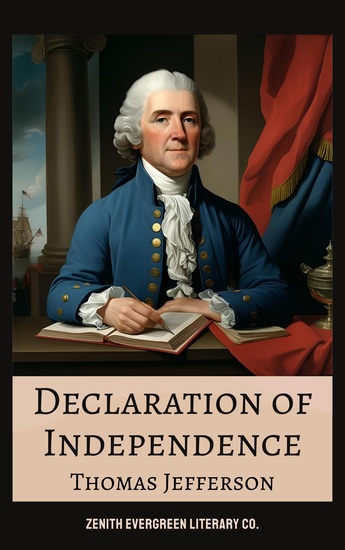
Declaration of Independence - The Founding Document of Liberty Democracy and the American Ideal - cover
LER

Declaration of Independence - The Founding Document of Liberty Democracy and the American Ideal

Thomas Jefferson, Zenith Evergreen Literary Co.

Editora: Zenith Evergreen Literary Co.

  • 0
  • 0
  • 0

Sinopse

"We hold these truths to be self-evident…"

The Declaration of Independence, written by Thomas Jefferson in 1776, is a cornerstone of democracy and freedom. This document boldly proclaimed the American colonies' right to liberty, self-rule, and justice—igniting a revolution and reshaping the modern world.

This edition includes the full original text, historical context, and bonus material like the U.S. Constitution and Bill of Rights, making it an essential resource for students, citizens, and lovers of liberty.

💬 "A revolutionary document that changed history—now more important than ever."

🏛️ Why It Belongs in Every Home and Classroom:
A foundational text for civic education and American history

Perfect for fans of The Federalist Papers, Thomas Paine, and The U.S. Constitution

A timeless reference for patriots, educators, and constitutional scholars

📣 Revisit the Document That Defined Freedom.
Buy The Declaration of Independence today and experience the vision that sparked a nation.
Disponível desde: 24/04/2025.
Comprimento de impressão: 42 páginas.

Outros livros que poderiam interessá-lo

  • Imperialism - cover

    Imperialism

    Vladimir Lenin

    • 0
    • 0
    • 0
    Written in 1916 against the backdrop of the First World War, Imperialism: The Highest Stage of Capitalism explains the flaws and power of capitalism, which inevitably lead to monopolies, imperialism and colonialism. Lenin develops Marx’s theories of political economy, which had been put forward 50 years earlier in Das Kapital. He goes on to argue that imperialism is the most advanced state of capitalism, characterised by the domination of monopolies on an international scale, with the export of capital leading to the big imperialist powers carving up the world.More than a century later, Imperialism remains highly relevant in understanding the historical background to the strategies of many of today’s major nations.
    Ver livro
  • Audio Nuggets: Corporate Espionage 101 - cover

    Audio Nuggets: Corporate...

    Rick Sheridan, Alfred C. Martino

    • 0
    • 0
    • 0
    In this audio program, you will learn the the basics about what corporate espionage is, and the best practices for the reducing the possibility for your company's proprietary information of products, services, employees, computer files, contracts, algorithms, etc., being stolen by rival companies, rogue ex-employees or hostile foreign entities.
    Ver livro
  • Decentralization and Multilevel Elections in Ukraine - Reform Dynamics and Party Politics in 2010–2021 - cover

    Decentralization and Multilevel...

    Valentyna Romanova

    • 0
    • 0
    • 0
    Methodologically, the book illustrates the added value of investigating elections from a multilevel perspective.
    Ver livro
  • The Babylon Bee Guide to Democracy - cover

    The Babylon Bee Guide to Democracy

    The Babylon Bee

    • 0
    • 0
    • 0
    In this book, America's favorite satirists take you into a world you might have thought was beyond parody—politics. From closed-door meetings of bureaucrats deciding the fates of millions to preposterous lies from the campaign trail, The Bee skewers our political overlords with matchless wit. In this guide, you’ll learn how to rig an election, how to stage an insurrection, which political party you should join, and more—everything you need to fully participate in the worst political system of all time (except for all the others).
    Ver livro
  • How to Save a Constitutional Democracy - cover

    How to Save a Constitutional...

    Tom Ginsburg, Aziz Z. Huq

    • 0
    • 0
    • 0
    Democracies are in danger. Around the world, a rising wave of populist leaders threatens to erode the core structures of democratic self-rule. In the United States, the tenure of Donald Trump has seemed decisive turning point for many. What kind of president intimidates jurors, calls the news media the “enemy of the American people,” and seeks foreign assistance investigating domestic political rivals? Whatever one thinks of President Trump, many think the Constitution will safeguard us from lasting damage. But is that assumption justified?How to Save a Constitutional Democracy mounts an urgent argument that we can no longer afford to be complacent. Drawing on a rich array of other countries’ experiences with democratic backsliding, Tom Ginsburg and Aziz Z. Huq show how constitutional rules can both hinder and hasten the decline of democratic institutions. The checks and balances of the federal government, a robust civil society and media, and individual rights—such as those enshrined in the First Amendment—often fail as bulwarks against democratic decline. The sobering reality for the United States, Ginsburg and Huq contend, is that the Constitution’s design makes democratic erosion more, not less, likely. Its structural rigidity has had unforeseen consequence—leaving the presidency weakly regulated and empowering the Supreme Court conjure up doctrines that ultimately facilitate rather than inhibit rights violations. Even the bright spots in the Constitution—the First Amendment, for example—may have perverse consequences in the hands of a deft communicator who can degrade the public sphere by wielding hateful language banned in many other democracies. We—and the rest of the world—can do better. The authors conclude by laying out practical steps for how laws and constitutional design can play a more positive role in managing the risk of democratic decline.
    Ver livro
  • The Shortest History of War - From Hunter-Gatherers to Nuclear Superpowers—A Retelling for Our Times - cover

    The Shortest History of War -...

    Gwynne Dyer

    • 0
    • 0
    • 0
    War has always been a defining feature of human society. This new addition to the Shortest History series explains why we do it—and how we can stop. 


    Russia's invasion of Ukraine has punctured the longest stretch of peace between major powers since WWII, bringing the horrors of warfare—past, present, and future—to the forefront of listeners' minds. In The Shortest History of War, internationally acclaimed historian Gwynne Dyer adds urgently needed context. 


    Dyer ably charts the evolution of violent conflict: tribal aggression, classical combat, limited war, total war, and cold war—followed by present-day terrorism, nuclear threats, and the development of lethal autonomous weapons systems (LAWS). His brilliant, brisk history is a harrowing must-listen for all who wonder: How will rival superpowers with unprecedented weapons shape the future of our interconnected world?
    Ver livro