Join us on a literary world trip!
Add this book to bookshelf
Grey
Write a new comment Default profile 50px
Grey
Subscribe to read the full book or read the first pages for free!
All characters reduced
Leviathan - Philosophical Insights on Government Society and the Social Contract - cover

Leviathan - Philosophical Insights on Government Society and the Social Contract

Thomas Hobbes

Publisher: Good Press

  • 0
  • 0
  • 0

Summary

Thomas Hobbes's seminal work, *Leviathan*, published in 1651, is a cornerstone of political philosophy that explores the foundations of civilization and the structure of society. Written during the tumultuous period of the English Civil War, Hobbes employs a distinctively clear and methodical literary style, combining rigorous logical argumentation with vivid metaphor. The titular Leviathan emerges as a powerful symbol of the state, representing the necessity of a strong, centralized authority to prevent the chaos of humanity's natural state, characterized by 'war of all against all.' This text offers profound insights into human nature, governance, and social contracts, setting the stage for modern political thought. Thomas Hobbes, a philosopher, and mathematician, was deeply influenced by his experiences in a politically unstable England. His prior studies of science, particularly geometry and optics, inform his analytical approach to human behavior and political structures. These influences culminated in his desire to find a stable framework for societal order, prompting the creation of *Leviathan*, which challenges readers to grapple with the implications of political authority and individual freedom. *Leviathan* is essential reading for anyone interested in the origins of political theory, ethics, or modern governance. Hobbes's arguments are not only historically significant but also resonate with contemporary debates on authority and individual rights. This thought-provoking work invites readers to reflect on the delicate balance between security and freedom, urging them to consider the implications of political power in their own lives.
Available since: 11/27/2023.
Print length: 483 pages.

Other books that might interest you

  • Burnt - Fighting for Climate Justice - cover

    Burnt - Fighting for Climate...

    Chris Saltmarsh

    • 0
    • 0
    • 0
    Time is up. The climate crisis is no longer a future to be feared, but a devastating reality. We see it in the wildfires in California and floods across Britain—the "once in a generation" extreme weather events that now happen every year. 


    In a world where those in charge are constantly letting us down, real change in our lifetime means taking power into our own hands. The task ahead of us is daunting, but the emergence of a new wave of movements focused on climate justice, equality, and solidarity also brings hope. 


    Asking how we have arrived at this moment, Chris Saltmarsh argues that the profoundly political nature of the environmental crisis has been relentlessly downplayed. After all, how can solar panels save us while capitalism places profit over the future of the planet? Analyzing the failures of NGOs, the limitations of Extinction Rebellion and Youth Strikes, the role of trade unions, and the possibilities of a Green New Deal, Burnt issues a powerful call for a radical collective movement: saving the world is not enough; we must build a better one in the process.
    Show book
  • Phocion - Good Citizen in a Divided Democracy - cover

    Phocion - Good Citizen in a...

    Thomas R. Martin

    • 0
    • 0
    • 0
    "Elegant and enlightening." —Dominic Green, Wall Street Journal 


    Phocion (402–318 BCE) won Athens's highest public office by direct democratic election an unmatched forty-five times and was officially honored as a "Useful Citizen." A student at Plato's Academy, Phocion gained influence and power during a time when Athens faced multiple crises stemming from Macedonia's emergence as an international power under Philip II and his son Alexander the Great. Following Athens's defeat by Macedonia, Phocion unsuccessfully sought mild terms of surrender. Oligarchy was imposed on democratic Athens, and more than twelve thousand "undesirable" Athenians were exiled. When the oligarchic regime was overthrown and the exiles returned, dispossessed Athenians took out their volcanic anger on Phocion, who throughout his career had often been a harsh critic of the citizens' political decisions. His inflammatory rhetoric contributed to the popular conclusion that he lacked a genuine sense of belonging to the community he wished so desperately to preserve. When he was eighty-four, the Athenians convicted him of treason and condemned him to die by hemlock. In this fresh biography, Thomas R. Martin explores how and why Phocion ultimately failed as a citizen and as a leader. His story offers unsettling lessons for citizens in democracies today.
    Show book
  • Thai History - Facts and Background of the Siamese and the Khmer Empire (2 in 1) - cover

    Thai History - Facts and...

    Kelly Mass

    • 0
    • 0
    • 0
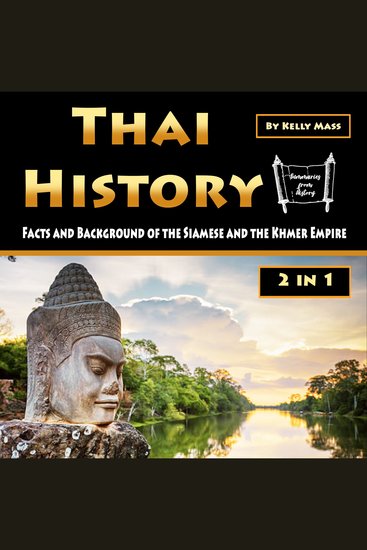
    Learn more about the history of those countries. The topics addressed will be the following: 
    The Khmer Empire--Historians describe Cambodia as the Khmer State or the Angkorian Empire (Khmer:) from the 9th century to the 15th century, when it was a Hindu/Buddhist empire in Southeast Asia. The empire, which developed from the old societies of Funan and Chenla, governed and/or "vassalized" the majority of mainland Southeast Asia and parts of Southern China, covering from the suggestion of the Indochinese Peninsula northward to modern-day Yunnan province in China, and from Vietnam westward to Myanmar. The Khmer Empire was greater at its peak than the Byzantine Empire (Eastern Roman Empire) that existed at the exact same period. 
    The Siamese-- Siam was just a much different name for what's now referred to as Thailand. The Siamese are the people who live there, though they're never ever called as such any longer. 
    Thailand is a fascinating country, with its own culinary arts, culture, history, royalty, infrastructure, and influence on the world. To learn more about these “Thai” people before they were called Thai, when they were Siamese, is to learn about those people’s roots.
    Show book
  • In Defense of Open Society: Book Summary & Analysis - cover

    In Defense of Open Society: Book...

    Briefly Summaries

    • 0
    • 0
    • 0
    This is a concise summary and analysis of In Defense of Open Society, by George Soros.
     
    It is not the original book and is not affiliated with or endorsed by George Soros.
     
    Ideal those seeking a quick and insightful overview.
     
    In a time of rising authoritarianism and political uncertainty, In Defense of Open Society explores the principles that uphold democratic societies. Drawing on personal experiences and decades of philanthropic efforts, the book examines the threats posed to open societies by nationalism, populism, and the erosion of civil liberties. Through sharp analysis and compelling arguments, it advocates for the preservation of freedom, transparency, and justice as the cornerstones of a better future.
    Show book
  • International Space Station The: The History and Legacy of the Multinational Space Research Lab - cover

    International Space Station The:...

    Editors Charles River

    • 0
    • 0
    • 0
    Much has been written about the Space Race, which is still taught across America today, but the story of human space exploration is mostly one of cooperation. Even in the summer of 1969, the Soviets had given the United States the flight plan for its Luna 15 mission, allowing Apollo 11 to avoid it.  
    	That was the first of many examples of cooperation in space between the United States and the Soviet Union during the Cold War, and ultimately, their research and cooperation helped lead to the construction of the International Space Station (ISS), a large space station assembled in Earth’s orbit that represents the most ambitious international space project in history.  
    	Thanks to the various components that have been put together, the International Space Station is bigger and brighter than all other artificial satellites. With relatively low power magnification, people can see the solar panels radiating outward from the numerous international modules which make up the ISS. The reality of that platform, at the edge of the ocean of space, is pretty astounding when looked at from the perspective of history. Only 120 years ago, mankind did not know if it was possible to fly in a heavier-than-air vehicle. Constructed with over 30 different modules and pieces that were carried into orbit by dozens of different launches, the ISS is already over 150 feet long, 300 feet wide and 60 feet tall. Astronauts from 10 nations have spent time on the space station as long-term crew. 
    	In addition, the International Space Station can truly be held as a sign that the Space Age is maturing quite nicely, at least on a social and personal level. A total of 34 women have visited the space station, eight tourists have paid for the privilege of taking the trip to the station, and there have been many who have made multiple trips to the ISS.
    Show book
  • The Better Boundaries Workbook - A CBT-Based Program to Help You Set Limits Express Your Needs and Create Healthy Relationships - cover

    The Better Boundaries Workbook -...

    DSW Sharon Martin

    • 0
    • 0
    • 0
    If you find yourself feeling responsible for others' happiness, worrying about letting people down, or struggling to speak up for yourself, you probably have difficulty setting healthy boundaries. Establishing clear personal boundaries is essential to creating and nurturing mutually respectful relationships based on equality. Setting limits can also protect you from getting involved in exploitative relationships, and help you avoid toxic personalities who don’t have your best interests at heart. 


    This evidence-based workbook will show you how to set healthy boundaries across all aspects of life—without sacrificing your kindness or compassion for others. You'll learn to define your boundaries and discover why they're so important for your emotional well-being. You'll also find a wealth of tips for maintaining boundaries in a "constantly-connected" world, strategies for what to do when people get upset or threatened by your assertiveness, and ways to make sure your needs are met. 


    If you're tired of feeling guilty or afraid of putting your mental and physical health first, are ready to take back control of your life, and create healthy and balanced relationships, this book will show you how to step up and set limits, assert yourself confidently, and realize your full potential.
    Show book