Join us on a literary world trip!
Add this book to bookshelf
Grey
Write a new comment Default profile 50px
Grey
Subscribe to read the full book or read the first pages for free!
All characters reduced
A Pure Woman - "Tess of the D'Urbervilles" - cover

A Pure Woman - "Tess of the D'Urbervilles"

Thomas Hardy

Publisher: E-Kitap Projesi & Cheapest Books

  • 0
  • 0
  • 0

Summary

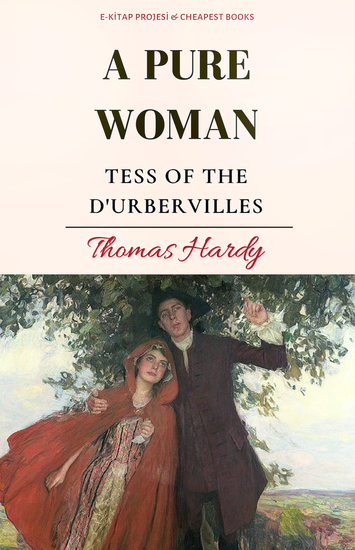
A Pure Woman "Tess of the D'Urbervilles" Faithfully Presented is a novel by Thomas Hardy. It initially appeared in a censored and serialised version, published by the British illustrated newspaper The Graphic in 1891 and in book form in 1892.

The novel is set in impoverished rural England, Thomas Hardy's fictional Wessex, during the Long Depression of the 1870s. Tess is the oldest child of John and Joan Durbeyfield, uneducated peasants; however, John is given the impression by Parson Tringham that he may have noble blood, since "Durbeyfield" is a corruption of "D'Urberville", the surname of a noble Norman family, then extinct.

The news immediately goes to John's head. That same day, Tess participates in the village May Dance, where she meets Angel Clare, youngest son of Reverend James Clare, who is on a walking tour with his two brothers. He stops to join the dance and partners several other girls. Angel notices Tess too late to dance with her, as he is already late for a promised meeting with his brothers. Tess feels slighted.

Tess of the d'Urbervilles, novel by Thomas Hardy, first published serially in bowdlerized form in the Graphic (July—December 1891) and in its entirety in book form (three volumes) the same year. It was subtitled A Pure Woman Faithfully Presented because Hardy felt that its heroine was a virtuous victim of a rigid Victorian moral code. Now considered Hardy's masterwork, it departed from conventional Victorian fiction in its focus on the rural lower class and in its open treatment of sexuality and religion.

SUMMARY:

After her impoverished family learns of its noble lineage, naive Tess Durbeyfield is sent by her slothful father and ignorant mother to make an appeal to a nearby wealthy family who bear the ancestral name d'Urberville. Tess, attractive and innocent, is seduced by dissolute Alec d'Urberville and secretly bears a child, Sorrow, who dies in infancy. Later working as a dairymaid, she meets and marries Angel Clare, an idealistic gentleman who rejects Tess after learning of her past on their wedding night. Emotionally bereft and financially impoverished, Tess is trapped by necessity into giving in once again to d'Urberville, but she murders him when Angel returns.
Available since: 11/30/2023.
Print length: 500 pages.
Other books that might interest you

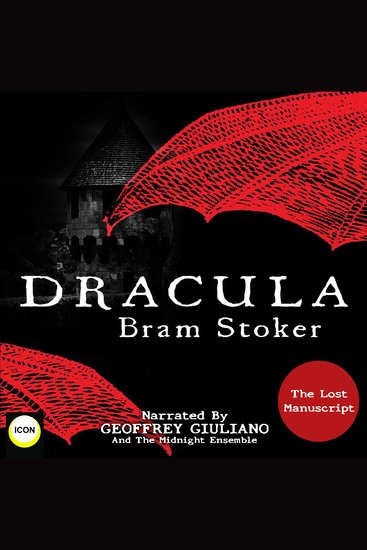
  • Dracula The Lost Manuscript - cover

    Dracula The Lost Manuscript

    Bram Stoker

    • 0
    • 0
    • 0
    Dracula, a Gothic novel by Bram Stoker, published in 1897, is derived from old vampire legends and is the basis for an entire genre of literature and film. Dracula, the archetypal vampire, is depicted in the novel as having been the origin of the many werewolf legends. The willowy count is believed to have been inspired by the 15th-century Vlad the Impaler, and by Sir Henry Irving, an actor for whom Stoker was a personal assistant. One of Dracula's most iconic powers is his ability to turn others into vampires by biting them and thus infecting them with the vampiric disease. Stoker's novel takes the form of an epistolary tale, in which Count Dracula's characteristics, powers are narrated by multiple narrators. Count Dracula is an undead, centuries-old vampire, and Transylvanian nobleman descended from Attila the Hun. He inhabits a decaying castle in the Carpathian Mountains near the Borgo Pass. Dracula is devilishly handsome and charismatic, with a veneer of dark aristocratic charm. Likewise, he possesses supernatural abilities gained through his intimate dealings with the Devil. Dracula does not cast a shadow or reflect in mirrors. He can defy gravity and possesses superhuman agility, able to climb vertical surfaces upside down. In the novel he also has great hypnotic, telepathic and illusionary powers. This is the rare, long lost original 1897 manuscript - published here for the first time. 
     
    Produced by Macc Kay 
    Production executive Avalon Giuliano 
    ICON Intern Eden Garret Giuliano 
    ©2022 Eden Garret Giuliano (P) 2022 Eden Garret Giuliano
    Show book
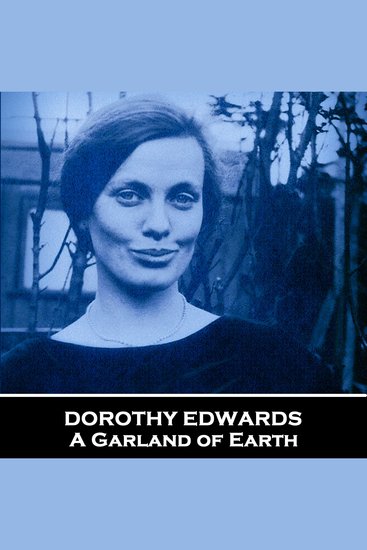
  • A Garland of Earth - From their pens to your ears genius in every story - cover

    A Garland of Earth - From their...

    Dorothy Edwards

    • 0
    • 0
    • 0
    Amelia Ann Blanford Edwards was born on 7th June 1831 in Islington, London.  She was educated at home by her mother and showed early promise as a writer, publishing her first poem at the age of 7 and her first story at 12.  Thereafter several popular periodicals published her poetry, stories and articles. 
    In addition she also illustrated some of her own writings and painted scenes from books she had read.  This talent was not supported by her parents, who saw an artist’s life as scandalous.  Undeterred Amelia took up composing and performing music until a bout of typhus caused throat damage.  Other interests soon followed until, early in the 1850s, Amelia focused exclusively on writing.  Her early novels were well received, and with ‘Barbara's History’ in 1864, a work revolving around bigamy, her reputation was established.  
    Amelia’s pen was also the purveyor of ghost stories for magazines and are still anthologized as classic tales to this day. 
    In January 1851, Amelia became engaged, apparently to please her parents, but she quickly broke it off.  In reality her emotional attachments were almost exclusively with women.  From the early 1860s she lived with Ellen Drew Braysher, a widow 27 years her senior, until both women died in early 1892.  During this relationship other women also entered and left her life.  Her frequent travelling companion, Lucy Renshaw, accompanied her to Egypt in the winter of 1873 and there she found a life-changing interest in Egyptology.  Aware of increasing threats from tourism and modern development she became an advocate for their research and preservation.  
    To advance the work Amelia largely abandoned much of her writing in favour of Egyptology and even took on strenuous lecture tours to raise funds. 
    After catching influenza, Amelia Edwards, ‘the Godmother of Egyptology’ died on 15th April 1892 at Weston-super-Mare.  She was 60.
    Show book
  • The Memoirs of Sherlock Holmes Audiobook - cover

    The Memoirs of Sherlock Holmes...

    Arthur Conan Doyle, Classic...

    • 0
    • 0
    • 0
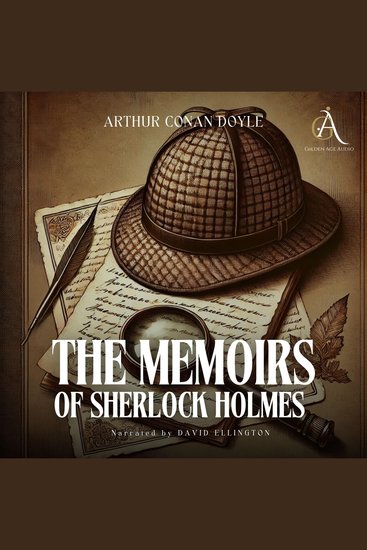
    The Memoirs of Sherlock Holmes is the fourth book in Arthur Conan Doyle's iconic Sherlock Holmes series. This captivating collection of twelve short stories highlights the legendary detective's extraordinary ability to solve even the most perplexing mysteries. With his trusted companion, Dr. John Watson, Sherlock Holmes faces a variety of challenges, from uncovering secrets in Silver Blaze to the startling revelations of The Musgrave Ritual. The collection also features The Final Problem, which introduces Holmes' greatest adversary, Professor Moriarty, and delivers a climactic confrontation that leaves readers on the edge of their seats. These timeless tales continue to define the detective genre and remain a treasure for all fans of mystery and adventure.
    Show book
  • The Confessions of Arsène Lupin - cover

    The Confessions of Arsène Lupin

    Maurice Leblanc

    • 1
    • 0
    • 0
    "I have never been more myself than when I was someone else."
    
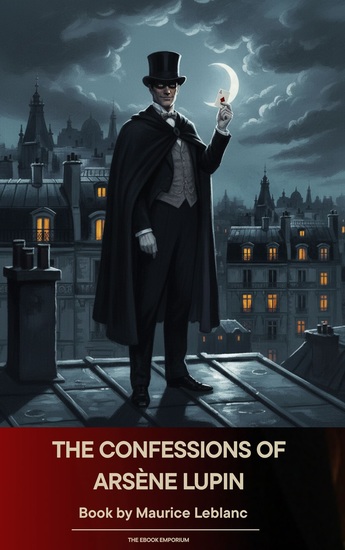
    In The Confessions of Arsène Lupin, the "Gentleman Burglar" becomes his own biographer. This collection of nine thrilling stories takes readers behind the scenes of Lupin's most celebrated ruses. From the mysterious "Sign of the Shadow" to the high-stakes drama of "The Invisible Prisoner," Lupin recounts his adventures with a mixture of wit, arrogance, and surprising sentimentality. We see him not just as a criminal mastermind, but as a man who values honor, rescues the innocent, and treats every heist as a work of fine art.
    
    A Deeper Look at the Legend: These stories provide a rare look into Lupin's moral code and his past. Whether he is returning a stolen heirloom to a family in need or outmaneuvering his lifelong rival, Inspector Ganimard, Lupin reveals the motivations that drive his life of crime. It is in these "confidences" that we learn what truly makes a gentleman thief tick.
    
    Masterful Short-Form Mystery: Leblanc is at the height of his powers here, crafting tight, fast-paced narratives filled with secret codes, hidden trapdoors, and brilliant deductive reasoning. Each story is a self-contained puzzle that invites the reader to try and outguess the master before the final reveal.
    
    Why It Is a Must-Read: For fans of the Netflix series or classic mystery enthusiasts, this book is essential. It serves as the perfect entry point for newcomers and a deep dive for longtime fans into the psychology of a character who remains as charming and mysterious today as he was over a century ago.
    
    Hear the truth from the master himself. Purchase "The Confessions of Arsène Lupin" today.
    Show book
  • Dark Dignum - From their pens to your ears genius in every story - cover

    Dark Dignum - From their pens to...

    Bernard Capes

    • 0
    • 0
    • 0
    Bernard Edward Joseph Capes was born on the 30th August 1854 in London.  He was one of 11 children. 
    His early work was as a journalist and this developed into writing many short stories for the periodicals of the time including Blackwood's, Cassell's, Cornhill Magazine, Illustrated London News, Macmillan's Magazine, Mall Magazine, Pearson's Magazine, The Idler, and The Queen. 
    It took him many years to decide that writing full-time could be a sustainable career path.  His initial success came with ‘The Mill of Silence’.  As well as being published it garnered second prize at a competition sponsored by the Chicago Record.  He exceeded that by winning it the following year with ‘The Lake of Wine’.   
    Capes quickly became both prolific and popular.  As well as his stories and articles for the periodicals he wrote around 40 volumes across novels, poetry, history as well as romance and mystery novels. 
    Bernard Capes died on 2nd November 1918 in the flu epidemic.
    Show book
  • Never Bet the Devil Your Head - cover

    Never Bet the Devil Your Head

    Anonymous

    • 0
    • 0
    • 0
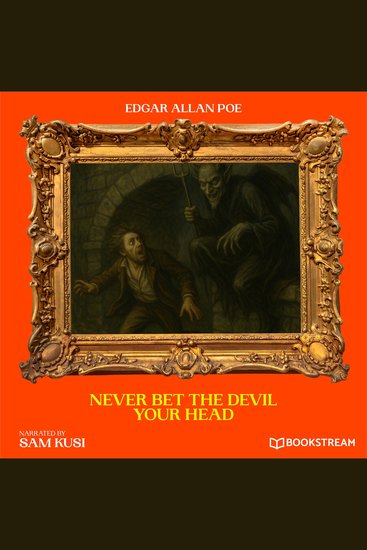
    "Never Bet the Devil Your Head: A Moral Tale", later republished as "Never Bet the Devil Your Head", is a short story by American author Edgar Allan Poe, first published in 1841. The satirical tale pokes fun at the notion that all literature should have a moral and spoofs transcendentalism.
    The narrator, presented as the author himself, is dismayed by literary critics saying that he has never written a moral tale. The narrator then begins telling the story of his friend Toby Dammit. Dammit is described as a man of many vices, at least in part due to his left-handed mother flogging him with her left hand, which is considered improper. Dammit often made rhetorical bets, becoming fond of the expression "I'll bet the devil my head". Although the narrator tries to break Dammit of bad habits, he fails. Nevertheless, the two remain friends.
    Show book