Join us on a literary world trip!
Add this book to bookshelf
Grey
Write a new comment Default profile 50px
Grey
Subscribe to read the full book or read the first pages for free!
All characters reduced
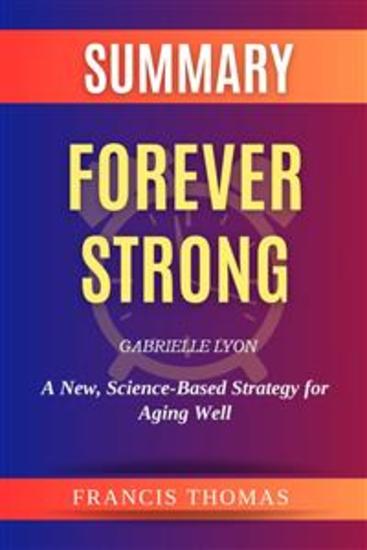
Summary Of Forever Strong by Gabrielle Lyon:A New Science-Based Strategy for Aging Well - A Comprehensive Summary - cover

Summary Of Forever Strong by Gabrielle Lyon:A New Science-Based Strategy for Aging Well - A Comprehensive Summary

thomas Francis

Publisher: Francis Thomas

  • 0
  • 0
  • 0

Summary

Forever Strong by Gabrielle Lyon

Muscle-Centric Medicine advocates for a paradigm shift in health perception, challenging the old norms about what constitutes a strong, healthy body. 
The philosophy posits that mental strength is the bedrock of physical well-being. The author's journey through psychiatry and geriatric and nutritional science at Washington University shaped their understanding of health. 

Witnessing patients' struggles, especially those like Betsy, struggling with weight, highlighted the flaws in the conventional health narrative.
The book's mission is to correct these misconceptions and spread knowledge about the science behind longevity and peak health. 

It presents the author's own challenges with diet and nutrition and their realization about the sensitive nature of food-related issues. 
The Lyon Protocol, introduced in the book, focuses on muscle health to bring about significant, sustainable changes in body composition and overall health within a month.


Available since: 12/10/2023.

Other books that might interest you

  • Sacred Sendoffs - An Animal Chaplain’s Advice for Surviving Animal Loss Making Life Meaningful and Healing the Planet - cover

    Sacred Sendoffs - An Animal...

    Sarah A. Bowen

    • 0
    • 0
    • 0
    An elegant manifesto for improving life—and death—for all beings on sacred Mother Earth 


    Combining humorous anecdotes and thought-provoking research, Sacred Sendoffs explores human relationships with beloved pets, wild creatures, animal astronauts, marine life, farmed animals, and other sentient beings. Along the way, animal chaplain Sarah Bowen shares insights for sustaining their lives, honoring deaths, and managing the emotions that arise when we lose an animal we love. While many books focus exclusively on pet loss, animal welfare, or environmental issues, Bowen's ever curious and playful style takes on all three, revealing their unavoidable entanglement. Sacred Sendoffs helps animal lovers uncover practical actions and everyday opportunities for helping the more-than-human world thrive.
    Show book
  • Anxious Attachments - Overcoming Anxiety and Disorder in Relationships - cover

    Anxious Attachments - Overcoming...

    Brian Gibson

    • 0
    • 0
    • 0
    In a world where meaningful connections often involve anxiety and uncertainty, Anxious Attachments is a compassionate guide for anyone seeking to understand and overcome the complexities of anxiety in relationships. This transformative book offers a deep dive into the psychology of attachment and provides readers with practical strategies for nurturing healthier, more fulfilling connections. 
    Drawing from the latest research in psychology and real-life case studies, Anxious Attachments demystify the patterns that fuel anxiety in relationships. Whether you find yourself overwhelmed by insecurity, fear of abandonment, or a constant need for reassurance, this book is designed to help you break free from the cycle of anxiety that can sabotage intimacy and trust. 
    Embrace the journey to healthier, more secure relationships with Anxious Attachments. Whether single, dating, or in a long-term partnership, this book is your roadmap to overcoming anxiety and building the loving, lasting connections you deserve.
    Show book
  • The Golden Age of Piracy - The Rise Fall and Enduring Popularity of Pirates - cover

    The Golden Age of Piracy - The...

    David Head

    • 0
    • 0
    • 0
    Twelve authors shed new light on the true history and enduring mythology of seventeenth– and eighteenth–century pirates in this anthology of scholarly essays. 


    The twelve entries in The Golden Age of Piracy discuss why pirates thrived in the seas of the New World, how pirates operated their plundering ventures, how governments battled piracy, and when and why piracy declined. Separating Hollywood myth from historical fact, these essays bring the real pirates of the Caribbean to life with a level of rigor and insight rarely applied to the subject. 


    The Golden Age of Piracy also delves into the enduring status of pirates as pop culture icons. Audiences have devoured stories about cutthroats such as Blackbeard and Henry Morgan since before Robert Louis Stevenson wrote Treasure Island. By looking at the ideas of gender and sexuality surrounding pirate stories, the renewed interest in hunting for pirate treasure, and the construction of pirate myths, the contributing authors tell a new story about the dangerous men, and a few dangerous women, who terrorized the high seas.
    Show book
  • Narrative - Telling the Story - cover

    Narrative - Telling the Story

    Amy Jones

    • 0
    • 0
    • 0
    What is the best way to tell a story? In first-person peripheral, or third-person focalised? Unfolding in the present, or as events in the past? Where is the camera? What is the lens? Where is the action? In this concise little book, educator Amy Jones describes the different ways that novelists and scriptwriters tell their stories. Packed with examples and insights, this is an essential reference guide for writers of all ages and disciplines. It’s not the story, it’s how you tell it!
    Show book
  • The Darby School of Art - A Forgotten Chapter in the History of American Impressionist and Modern Painting - cover

    The Darby School of Art - A...

    Mark W. Sullivan

    • 0
    • 0
    • 0
    This first full-length account of the Darby School of Art overturns Philadelphia’s long-held unwarranted reputation and demonstrates that Philadelphia was a hub of avant-garde painting in the early twentieth century.
    
    This first full-length account of the Darby School of Art overturns Philadelphia’s long-held unwarranted reputation as artistically stodgy—unwilling and unable to embrace Impressionism, post-Impressionist, and abstract art—and demonstrates that Philadelphia was more avant-garde in the early twentieth century than previously thought.
    
    This is the story of an almost completely forgotten summer art school that flourished first in Darby, PA, and then in Fort Washington, PA, between 1898 and 1918. The Darby School of Art was founded and operated by Thomas Anshutz and Hugh Breckenridge, two artists who taught during the academic year at the Pennsylvania Academy of the Fine Arts. Anshutz and Breckenridge brought a lot of new ideas about painting back to Philadelphia after their European sojourns, and introduced those ideas to a public that was initially not very responsive to Impressionism, Post-Impressionism, and semi-abstract art. But an appreciation for modern styles of painting began to slowly grow among Philadelphia artists and collectors, and Anshutz and Breckenridge were in the forefront of this development. They also sympathized with what some have called the "New Woman" movement, which backed women who wanted to pursue careers outside of the home.
    
    In this new history, expert Mark Sullivan argues that the Philadelphia area was a genuine hub of avant-garde painting in the early twentieth century, even though it has earned the reputation of lagging far behind New York City in its openness to new styles of painting. It also discusses how the Darby School should be recognized as an institution that got behind the idea of women as professional artists at a time when that concept was quite radical.
    Show book
  • The Shocking Truth about Modern Warfare - cover

    The Shocking Truth about Modern...

    Zoey Fraisers

    • 0
    • 0
    • 0
    The nature of warfare has drastically evolved over the centuries, and in the modern age, it has reached unprecedented levels of complexity, technology, and global impact. The battles fought today are not just confined to physical battlegrounds, but stretch across the cyber world, through the air with drones, and into the very fabric of political and social systems. Understanding the shocking truth about modern warfare means acknowledging how it has fundamentally changed and the far-reaching consequences it has on global security, human lives, and the future of warfare itself. 
      
    Unlike the traditional wars of the past, where armies fought on clearly defined battlefields, modern warfare is multifaceted. Conflicts today often involve a mix of conventional military forces, covert operations, cyber-attacks, and the use of advanced technologies like drones and artificial intelligence. The lines between combatants and non-combatants are increasingly blurred, and civilians are often the most affected by the consequences of war. The tools and tactics employed in modern warfare raise important questions about the ethics of conflict, the responsibility of nations, and the role of technology in shaping the future of armed engagement. 
      
    One of the most significant shifts in modern warfare is the central role technology now plays. The advancements in weapons systems, surveillance capabilities, and the rise of autonomous machinery have fundamentally altered how wars are fought. With the introduction of drones and cyber warfare, military strategies are less about physical dominance and more about information control, precision strikes, and disrupting an enemy's infrastructure without direct confrontation. This change has made warfare faster, more efficient, and, in many ways, less personal.
    Show book