Join us on a literary world trip!
Add this book to bookshelf
Grey
Write a new comment Default profile 50px
Grey
Subscribe to read the full book or read the first pages for free!
All characters reduced
A Popular History of Ireland (Vol 1&2) - From the Earliest Period to the Emancipation of the Catholics (Complete Edition) - cover

A Popular History of Ireland (Vol 1&2) - From the Earliest Period to the Emancipation of the Catholics (Complete Edition)

Thomas D'Arcy McGee

Publisher: DigiCat

  • 0
  • 0
  • 0

Summary

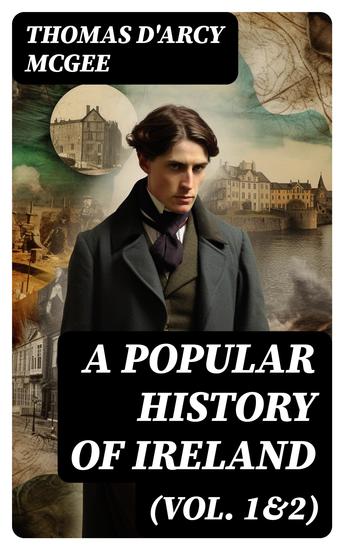
A Popular History of Ireland (Vol. 1 & 2) by Thomas D'Arcy McGee is a meticulously crafted narrative that traces the rich tapestry of Ireland's history from ancient times through the 17th century, emphasizing the cultural, social, and political dimensions that have shaped the Irish experience. McGee employs a distinctive blend of scholarly rigor and accessible prose, making the text both informative and engaging for a diverse readership. The work is a reflection of the Romantic literary movement, deeply intertwined with a growing nationalist sentiment during the 19th century, articulating a vision of Ireland that seeks to reclaim and celebrate its heritage. Thomas D'Arcy McGee, a prominent figure in Irish nationalism, had a multifaceted career as a journalist, politician, and poet. His own experiences as an immigrant in Canada and his deep commitment to the cause of Irish independence motivated him to illuminate the historical landscape of Ireland for both expatriates and locals alike. Through his writing, McGee aimed to foster a sense of identity and unity among the Irish population, drawing upon personal and collective narratives that resonate with authenticity. This seminal work is highly recommended for those interested in Irish history, literature, and nationalism. McGee's insightful analysis and engaging storytelling will captivate readers, inviting them to explore the complexities of Ireland's past and its influence on contemporary identity. A Popular History of Ireland is not only a foundational text for understanding Ireland's history but also serves as a poignant reminder of the enduring spirit of the Irish people.
Available since: 11/11/2023.
Print length: 910 pages.

Other books that might interest you

  • Power of Now The: Insights on Finding Inner Peace - A Group Discussion - cover

    Power of Now The: Insights on...

    Vines Graener

    • 0
    • 0
    • 0
    Drawing from Eastern philosophies such as Buddhism, Wallace explores why people feel dissatisfied and discontent. His key argument is that we must let go of our desire for control and instead accept the inherent uncertainty and unpredictability of life. 
    A significant portion of human unhappiness arises from being consumed by thoughts about the future—seeking assurance of a happy life on earth and, in some cases, in an afterlife. Many people turn to religion for this reassurance, believing it provides the answers to life’s uncertainties and promises salvation after death. Others chase material comforts, such as wealth and possessions, hoping these will provide lasting happiness and security. 
    However, neither approach guarantees the fulfillment we seek, as the future is unknowable—a mere abstraction filled with expectations and guesses. Moreover, the pursuit of a pain-free future is inherently flawed. Pleasure and pain are inseparable aspects of the human experience. One cannot exist without the other.
    Show book
  • Harnessing The Science of Learning - Success Stories to Help Kickstart Your School Improvement - cover

    Harnessing The Science of...

    Nathaniel Swain

    • 0
    • 0
    • 0
    Drawing together the worlds of classroom practice, school leadership, and scientific research, this is an essential how-to guide for initiating and maintaining a school improvement journey based on the science of learning. 


    What we now know about learning and teaching is vast; yet often, wading through the thousands of articles and books on this subject can leave even the most seasoned educator overwhelmed. This guide instead offers a distillation of key understandings―for teaching, literacy, mathematics, curriculum, and implementation―to launch your school improvement work. 


    Harnessing the Science of Learning also features contributions from thought leaders across the fields of learning sciences and educational practice: Pamela Snow, Tanya Serry, Zach Groshell, Reid Smith, Toni Hatten-Roberts, Simon Breakspear, Katie Roberts-Hull, David Morkunas, Steven Capp, Shane Pearson, and Eamon Charles. 


    This book illustrates practical ways to harness this knowledge, using a series of exemplary school case studies. These insightful narratives of transformation are interwoven with summaries of powerful teaching practices, forming a roadmap to drive improvement.
    Show book
  • Byzantines and Ottomans The: The History of the Medieval Middle East’s Most Influential Empires - cover

    Byzantines and Ottomans The: The...

    Editors Charles River

    • 0
    • 0
    • 0
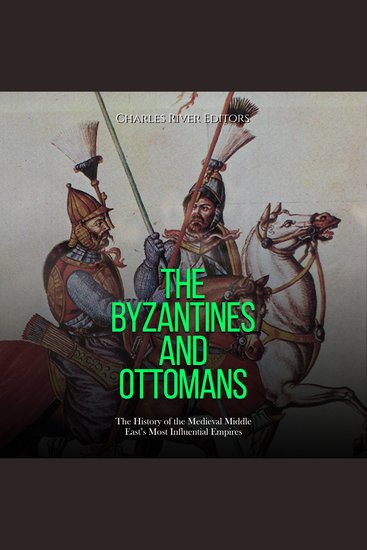
    In terms of geopolitics, perhaps the most seminal event of the Middle Ages was the successful Ottoman siege of Constantinople in 1453. The city had been an imperial capital as far back as the 4th century, when Constantine the Great shifted the power center of the Roman Empire there, effectively establishing two almost equally powerful halves of antiquity’s greatest empire. Constantinople would continue to serve as the capital of the Byzantine Empire even after the Western half of the Roman Empire collapsed in the late 5th century. Naturally, the Ottoman Empire would also use Constantinople as the capital of its empire after their conquest effectively ended the Byzantine Empire, and thanks to its strategic location, it has been a trading center for years and remains one today under the Turkish name of Istanbul. 
    The end of the Byzantine Empire had a profound effect not only on the Middle East but Europe as well. Constantinople had played a crucial part in the Crusades, and the fall of the Byzantines meant that the Ottomans now shared a border with Europe. The Islamic empire was viewed as a threat by the predominantly Christian continent to their west, and it took little time for different European nations to start clashing with the powerful Turks. In fact, the Ottomans would clash with Russians, Austrians, Venetians, Polish, and more before collapsing as a result of World War I, when they were part of the Central Powers. 
    The Ottoman conquest of Constantinople also played a decisive role in fostering the Renaissance in Western Europe. The Byzantine Empire’s influence had helped ensure that it was the custodian of various ancient texts, most notably from the ancient Greeks, and when Constantinople fell, Byzantine refugees flocked west to seek refuge in Europe. Those refugees brought books that helped spark an interest in antiquity that fueled the Italian Renaissance and essentially put an end to the Middle Ages altogether.
    Show book
  • New Zealand - A History of the Land and Its People - cover

    New Zealand - A History of the...

    Lillian Brooks

    • 0
    • 0
    • 0
    New Zealand, known as Aotearoa in Māori, is a land rich in history and cultural significance. Located in the southwestern Pacific Ocean, this island nation is renowned not only for its stunning landscapes but also for the diverse stories that have shaped its identity. The history of New Zealand is marked by the migration of its first inhabitants, the Māori, and the later arrival of Europeans, both of whom have contributed to the country’s unique social and cultural fabric. 
    The Māori people, the first to settle the islands, arrived from eastern Polynesia between the 9th and 13th centuries. Their journey to New Zealand is a story of exploration, resilience, and connection to the land. The Māori developed a sophisticated society with rich traditions, strong spiritual beliefs, and a deep connection to the natural world. Their oral histories, cultural practices, and the Māori language (Te Reo Māori) continue to shape the nation’s identity to this day. 
    The arrival of Europeans in the 17th century, particularly the Dutch explorer Abel Tasman and later Captain James Cook, marked the beginning of profound change for the Māori and the land itself. European settlers, driven by the promise of economic opportunities, eventually established colonies in the 19th century. This period saw the signing of the Treaty of Waitangi in 1840, an agreement that aimed to establish a partnership between the Māori and the British Crown. Despite its noble intentions, the treaty's implementation and interpretation have been subjects of contention and legal battles for decades, particularly regarding Māori land rights.
    Show book
  • The Ancient Adventures Collection - cover

    The Ancient Adventures Collection

    James Davies

    • 0
    • 0
    • 0
    There's so much to digest when it comes to History - how do you know where to begin? These incredible short introductions are just the thing for listeners who are beginning to explore ancient history. Get to know the basics on Ancient Egypt, Rome, and Greece, from religious ceremonies to mummification and day to day life. And on Pirates from famous looters to scurvy and hygiene with easy-to-digest, humorous text that is reminiscent of the best-selling Horrible Histories series.This enhanced audio collection includes the following four titles: Meet the Ancient Egyptians, Meet the Ancient Romans, Meet the Ancient Greeks, and Meet the Pirates. Music and sound effects bring the audio to life for young listeners keen to learn new things.
    Show book
  • Why I Became an X Troop Commando - A Life of Colin Anson the German who Fought for Churchill - cover

    Why I Became an X Troop Commando...

    Helen Fry

    • 0
    • 0
    • 0
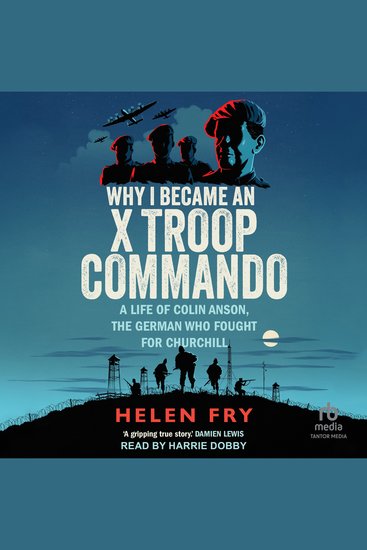
    A fascinating and moving biography of Colin Anson, the German refugee who became an elite British commando 


    Born in Germany in 1922, Colin Anson's (Claus Ascher) childhood was marked by the trials of Nazism. His father was arrested by the Gestapo in 1937 and transported to Dachau, where he died shortly after. Colin, aged just seventeen, escaped to Britain in the Kindertransport. As soon as he was old enough, Colin volunteered in the Pioneer Corps. Then, in 1942, he was recruited for the elite commando unit X-Troop. 


    Colin took part in the invasions of Sicily and Italy in 1943, where he sustained a near-fatal injury. But just months later, he returned to duty. He fought in the Yugoslav islands, became the first Allied soldier to liberate Corfu, and was stationed in postwar Frankfurt. 


    In this unique biography, Helen Fry traces the remarkable story of Colin's life. Drawing on extensive interviews, Fry recounts his actions in X-Troop and beyond in his own words—and sheds new light on the experience of refugees in the British forces.
    Show book