Join us on a literary world trip!
Add this book to bookshelf
Grey
Write a new comment Default profile 50px
Grey
Subscribe to read the full book or read the first pages for free!
All characters reduced
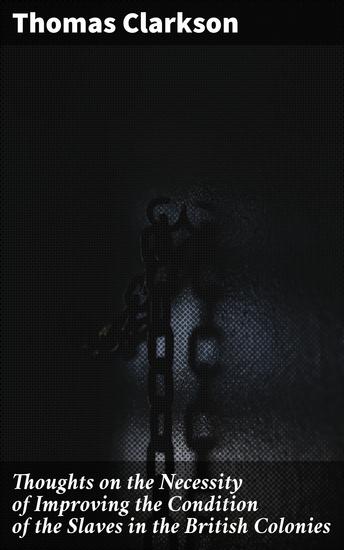
Thoughts on the Necessity of Improving the Condition of the Slaves in the British Colonies - A Call for Humanitarian Reform in British Colonies - cover

Thoughts on the Necessity of Improving the Condition of the Slaves in the British Colonies - A Call for Humanitarian Reform in British Colonies

Thomas Clarkson

Publisher: Good Press

  • 0
  • 0
  • 0

Summary

In "Thoughts on the Necessity of Improving the Condition of the Slaves in the British Colonies," Thomas Clarkson presents a passionate and meticulously researched argument advocating for the humane treatment of enslaved individuals in British colonies. Written in a persuasive yet reflective style, Clarkson employs a wealth of personal testimony, statistical evidence, and philosophical reasoning to illuminate the egregious conditions faced by slaves. This powerful work is situated within the broader context of the abolitionist movement of the late 18th century, which sought to dismantle the oppressive institution of slavery and advocate for social reform. Thomas Clarkson (1760-1846) was a leading abolitionist and a pivotal figure in the fight against slavery. His profound moral sensibility and experiences collecting evidence on slave ships led to a deep-seated commitment to social justice. The impetus behind this critical work stemmed not only from his own convictions but also from his belief that public awareness and consciousness could catalyze legislative change, ultimately leading to the abolition of the slave trade in the British Empire. This book is essential reading for those interested in social justice, history, and ethical philosophy. Clarkson'Äôs profound insights and compelling rhetoric not only serve to educate readers about the brutalities of slavery but also challenge them to consider their societal responsibilities in the face of injustice. With its historical significance and moral urgency, this text remains a powerful call to action for contemporary audiences.
Available since: 08/12/2023.
Print length: 77 pages.


Other books that might interest you

  • Attila the Hun - The Warfare Strategies and Legends of the Hunnic Empire - cover

    Attila the Hun - The Warfare...

    Kelly Mass

    • 0
    • 0
    • 0
    You may have heard about him: Attila the Hun. Let's discover who this individual actually was and why he has such a bad track record of being a callous, aggressive conqueror in the first millennium after Christ. Attila the Hun was the ruler of the Huns from the year 434 till his death in the month of March in the year 453. Also, he was the leader of a tribal realm which consisted mainly of Huns, Ostrogoths, Alans and Bulgars, to name a few, in Central Europe and in Eastern Europe. 
    In this guide, you will learn more about the wars, his enemies, the battles around Rome, his life, his death, and his legacy. Some of the information about his has been falsely attributed to certain details because of how much has been lost in historical records, but we can still get a slightly accurate image of who he was, what he did, and why he has become such an infamous figure.
    Show book
  • Secrets of the Thirty Years War: Unraveling Europe's Epic Struggle - “Unlock history's mysteries! Engage with captivating audio lessons on the Thirty Years War for an enriching experience” - cover

    Secrets of the Thirty Years War:...

    Gideon Cresswell

    • 0
    • 0
    • 0
    Secrets of the Thirty Years War: Unraveling Europe's Epic Struggle 
    ⭐⭐ Simplified Guide & Explanations Included ⭐⭐ 
    Are you eager to enhance your understanding of European history and master the intricate lessons of the Thirty Years War?  
    Searching for a thorough guide that encapsulates everything you need to know about this monumental conflict? 
    Your quest ends here! 
    This guide is your essential companion for deepening your knowledge, applying analytical skills, and engaging in insightful exercises related to the Thirty Years War. With this resource, you're set on a path to success. 
    Updated to reflect the latest historical insights and research. 
    Key features of this enriched guide include: 
    - In-depth analysis of the Thirty Years War and its implications for Europe 
    - Comprehensive explanations of critical events and figures that shaped the conflict 
    - Effective strategies for grasping the war’s complexities and conducting further research 
    Our guide sets itself apart through thorough exploration, vital for your understanding of this pivotal period in history. Concepts are not just mentioned; they are explored deeply and thoughtfully. 
    Crafted with a clear structure and accessible language, our "Secrets of the Thirty Years War" guide ensures smooth transitions between topics. Say farewell to convoluted jargon and embrace clear, precise, and historically accurate content. 
    So, why wait? Click the BUY NOW button, secure your guide, and embark on your journey to mastering the secrets of the Thirty Years War! 
    Dive into history's lessons in struggle, resilience, and strategy.
    Show book
  • Terrorism Jihad and the Bible - Biblical Answers to Contemporary Issues - cover

    Terrorism Jihad and the Bible -...

    John F. MacArthur

    • 0
    • 0
    • 0
    September 11, 2001 saw the deadliest attack ever launched on American soil, leaving us asking questions such as: Why did God permit such a thing to happen? Was the attack a divine judgment or was it merely an atrocity perpetrated by the forces of evil? How can human beings be capable of such diabolical savagery in the name of religion? And what is the right course of action for our government to take? John MacArthur points us to the Bible for answers to these and many other questions arising out the recent atrocities. He educates readers to the roots of the conflict, linking the religious and political issues that underlie the current turmoil to the Old Testament.
    Show book
  • Oral History - A Very Short Introduction (Very Short Introductions) - cover

    Oral History - A Very Short...

    Douglas A. Boyd

    • 0
    • 0
    • 0
    This Very Short Introduction is a general introduction to oral history from the interview to the archive. Douglas A. Boyd examines the oral history interview, recording techniques and strategies, technologies for making oral history accessible, and the legal and ethical implications throughout the work of oral history. Boyd also pays special attention to the role of the archive and the importance of memory. Equally important, this book also examines the world of digital possibilities for utilizing oral history for scholarly, public, community, and personal use.An area of explosive interest and growth, oral history is a complex discipline not just sequestered to storytelling. The interview is a complex combination of strategy and flexibility, remembering and forgetting, narrative and silence, and cannot escape individual biases and perspectives. This book offers listeners a comprehensive and concise overview of oral history from one of the most important figures in the field.
    Show book
  • The Byzantine-Sassanid Wars - Clash of Two Empires - cover

    The Byzantine-Sassanid Wars -...

    Nova Ashford

    • 0
    • 0
    • 0
    The Byzantine-Sassanid Wars were a series of conflicts between two of the most powerful empires of the ancient world: the Byzantine Empire, which was the eastern continuation of the Roman Empire, and the Sassanid Empire, the dominant Persian state in the region. These wars spanned several centuries, with periodic intervals of peace, but the conflicts fundamentally shaped the history of the Middle East and had profound implications for the future of both empires. 
    The Byzantine Empire, centered around the city of Constantinople, inherited the legacy of Rome after the Western Roman Empire fell in the 5th century. Under the leadership of Emperor Justinian I in the 6th century, the Byzantine Empire reached its greatest territorial extent, but its eastern frontier, bordering the Sassanid Persian Empire, remained a volatile region. The Sassanid Empire, founded by Ardashir I in the 3rd century, was a formidable military power that sought to expand its influence in the East and to challenge the supremacy of Rome and later, the Byzantine Empire. 
    The conflicts between these two empires were not only territorial struggles but also ideological battles. Both empires sought to exert control over strategic regions, particularly the eastern Mediterranean, the Levant, and Mesopotamia. The Byzantines were primarily concerned with the defense of their empire and their Christian faith, which was a central aspect of their identity. Meanwhile, the Sassanids, who adhered to Zoroastrianism, viewed the Byzantine Empire as a rival both politically and religiously. This religious dimension added complexity to the conflict, as each empire sought to spread and protect its belief system.
    Show book
  • The Nowhere Office - Reinventing Work and the Workplace of the Future - cover

    The Nowhere Office - Reinventing...

    Julia Hobsbawm

    • 0
    • 0
    • 0
    What has changed in the workplace? Everything.The traditional office was probably doomed anyway. Then a global shutdown changed everything we thought we knew about work, including where and when it needed to take place. Automation and the Fourth Industrial Revolution have accelerated, and perhaps as much as one third of the world’s permanent workforce will soon become remote. In The Nowhere Office, Julia Hobsbawm offers a strategic and practical guide to navigating this pivotal moment in the history of work and provides lessons for how both employees and employers can adapt.Hobsbawm draws on her extensive networks in business, academia, and entrepreneurship across  generations to offer new ideas about how to handle hybrid working, as well as provides deep insight into how the way we work is being transformed by larger issues such as community, hierarchy, bias, identity, and security. The Nowhere Office describes a unique moment in the history of work which, if understood and handled correctly, can provide a springboard for the biggest transformational change in the workplace for a century: something better, more meaningful, and more workable for everyone.
    Show book