Join us on a literary world trip!
Add this book to bookshelf
Grey
Write a new comment Default profile 50px
Grey
Subscribe to read the full book or read the first pages for free!
All characters reduced
This Country Hates Our Boys - Boy You Are On Your Own - cover

This Country Hates Our Boys - Boy You Are On Your Own

Mzamo Masito

Publisher: Tracey McDonald Publishers

  • 0
  • 0
  • 0

Summary

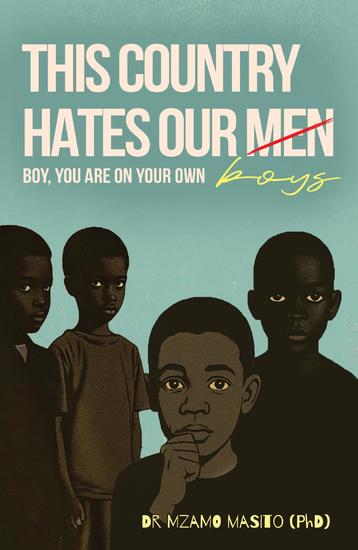
'I do not hate boys, I hate men.'
This provocative statement sets the stage for a searing exploration of the complex relationship South African society holds with its Black and Coloured men and boys. Dr Mzamo Masito's urgent new book, This Country hates Our Boys, confronts the pervasive 'cold and hot love' that often translates into collective male guilt. When a child goes missing, a collective sigh of relief by men is heard when the blame points to maternal filicide, such as headlines like 'South African woman guilty of kidnapping and trafficking daughter aged 6' (BBC).
The widely accepted phrase 'amadoda zizinja' – men are dogs – is more than a colloquialism; it's a symptom of a society where positive masculine role models are scarce. This linguistic shortcut flattens the nuanced reality of masculinity into a single, simplistic concept of patriarchy, obscuring the complex, chaotic social issues at play.
Through the vital work of African Men Care, a non-profit organisation, Dr Masito unpacks the interlocking crises facing Black boys and men: educational disparities, mental health struggles, pervasive violence, and fractured relationships. More crucially, the book illuminates a clear path forward.
'Every man is every boy' is not merely an observation but a powerful call to action. The struggles of adult men today are often rooted in the unaddressed needs and unrealised potential of the boys they once were. The lament 'awekho amadoda' (there are no men) serves as a stark warning: without decisive intervention, we risk losing entire generations. This book reveals how individual trauma metastasises into a collective crisis. When boys lack robust interior lives and positive identity models, the repercussions echo through families, schools, and communities. Hurt boys mature into hurting men, perpetuating cycles that impact everyone, including the girls and women in their lives.
¬This Country Hates Our Boys is essential reading for men, educators, policymakers, community leaders, parents, and anyone committed to breaking cycles of hurt and forging futures where all young people can thrive. The ultimate goal is revolutionary in its simplicity: to empower both girls and boys, ensuring no child is left behind.
Available since: 01/02/2026.
Print length: 300 pages.

Other books that might interest you

  • Andrew Jackson - American Lawyer Soldier and 7th President of the United States - cover

    Andrew Jackson - American Lawyer...

    Kelly Mass

    • 0
    • 0
    • 0
    Andrew Jackson was an American attorney, soldier, and statesman who acted as the seventh president of the U.S. from 1829 to 1837. Jackson rose to prominence as a basic in the US Army and served in both homes of Congress before being chosen to the presidency. 
    Jackson, an expansionist president, defended the rights of the "commoner" and the Union against a "corrupt upper class." 
    Jackson ended up being a frontier attorney and married Rachel Donelson Robards after being born in the settler Carolinas an entire decade before the American Revolutionary War. He belonged to the US Legislature and the US Senate from Tennessee for a brief time. After giving up, he served on the Tennessee Supreme Court as a justice from 1798 till 1804. 
    Jackson ended up being a rich, slave-owning planter after buying a residential or commercial property referred to as The Hermitage. In the year 1801, he was selected colonel of the Tennessee militia, and the following year, he was chosen its leader. Throughout the Creek War of 1813 to 1814, he led forces to success in the Battle of Horseshoe Bend. 
    Let’s take a look at what else Andrew Jackson did in his life.
    Show book
  • A Realistic Blacktopia - Why We Must Unite To Fight - cover

    A Realistic Blacktopia - Why We...

    Derrick Darby

    • 0
    • 0
    • 0
    The United States is dogged by racism and racial disparities in income, wealth, health, education, and criminal justice. Philosophers disagree on what kind of politics is needed to address this problem. Do we pursue race-specific remedies to undo racism or do we assume the permanence of racism and opt for non-race-specific remedies in pursuit of a more egalitarian society? Paradoxically, the way to make racial progress in racist America is to downplay race. 


    In A Realistic Blacktopia, political philosopher Derrick Darby challenges the "small tent" approach by examining U.S. Supreme Court cases on education and voting rights arguing that they hold general lessons about the limits of racial politics. Securing racial justice in racist America calls for "big tent" remedies, and Darby argues that pursuing non-race-specific remedies with maximal democratic inclusion is a necessary strategy for mitigating racial inequality and achieving racial justice. 


    A Realistic Blacktopia offers clarity on how racism persists, contrary to claims that America is a post-racial society. Explaining why the myth of post-racialism cannot be ignored in crafting remedies for racial inequality, Darby supplies a principled pragmatic proposal for achieving racial justice. Darby also explains why achieving racial justice requires inclusive democracy.
    Show book
  • Father Charles Coughlin Discusses American Poverty and Welfare - cover

    Father Charles Coughlin...

    Father Charles Coughlin

    • 0
    • 0
    • 0
    Father Charles Coughlin was a controversial Canadian-American Catholic priest based in Michigan. Calling for monetary reforms, the nationalization of major industries and railroads, and protection of the rights of labor, Coughlin used weekly radio broadcasts to reach a mass audience of up to thirty million listeners during the 1930s. An early supporter of Franklin D. Roosevelt and his New Deal, Coughlin later became a harsh critic. Coughlin’s commentary also became more anti-semitic, and he supported some of the fascist policies of Hitler, Mussolini, and Hirohito. As a result, many American Catholic leaders, as well as the Vatican, wanted Coughlin silenced. After the outbreak of World War II in 1939, the Roosevelt administration finally forced the cancellation of his radio program and forbade the dissemination of his newspaper, Social Justice. This recording is from 1939.
    Show book
  • Breaking In - A First-Time Gay Tale - cover

    Breaking In - A First-Time Gay Tale

    Jane Fox

    • 0
    • 0
    • 0
    Kase, a slim, muscular young thief, just broke into the wrong place. When he discovers he's in a warehouse sex club run by a criminal named Ulrich, he wants to run. Ulrich knows just what to do with guys like him. But before Ulrich can do too much damage, Kase is rescued by one of Ulrich's men, Rabies, who is immediately attracted to Kase, and makes him a lucrative offer to join their club parties. Kase is afraid; he insists he's not into guys. And the violence in Ulrich's eyes terrifies him. But when Kase has to come up with quick cash or get thrown out of his home, will he give in to Rabies and go work for Ulrich at the club? Or will he, in the process, manage to steal Rabies' heart?
    Show book
  • Mexico - Emiliano Zapata the Santa Muerte and Quetzalcoatl - cover

    Mexico - Emiliano Zapata the...

    Kelly Mass

    • 0
    • 0
    • 0
    This is a combo book with three different topics, all related to the beliefs, history, and culture of Mexico. The topics are the following: 
    1: Emiliano Zapata Salazar was a revolutionary in Mexico. He was a key figure in the Mexican Revolt of the years 1910 until 1920, and also the primary leader of the people's revolution in the Mexican state of Morelos and the creator of the Zapatismo agrarian movement. 
    2: Quetzalcoatl is an Aztec divine being whose name originates from the Nahuatl language and meaning "valuable snake" or "Quetzal-feathered Snake." "Quetzalcoatl, in its actual sense, means 'snake of valuable plumes,' but in the allegorical sense, 'best of men,'" said Ixtlilxóchitl, a descendant of Aztec royalty and history expert of the Nahua people, in the 17th century. 
    3: The cult image, female divine being, and folk saint Nuestra Seora de la Santa Muerte (Spanish meaning: Our Woman of the Holy Death) is a cult image, female divine being, and folk saint in Mexican Neopaganism and folk Catholicism. Her worshippers relate her with healing, security, and safe delivery to the afterlife simply because she's a personification of death. In spite of condemnation from Catholic Church leaders and, more just recently, evangelical movements, her following has grown substantially since the start of the twenty-first century.
    Show book
  • The Subversive Seventies - cover

    The Subversive Seventies

    Michael Hardt

    • 0
    • 0
    • 0
    In The Subversive Seventies, Michael Hardt sets out to show that popular understandings of the political movements of the seventies—often seen as fractious, violent, and largely unsuccessful—are not just inaccurate, but foreclose valuable lessons for the political struggles of today. While many accounts of the 1970s have been written about the regimes of domination that emerged throughout the decade, Hardt approaches the subversive from the perspectives of those who sought to undermine the base of established authority and transform the fundamental structures of society. In so doing, he provides a novel account of the theoretical and practical projects of liberation that still speak to us today, too many of which have been all but forgotten. 


    The movements of the seventies responded directly to emerging neoliberal frameworks and other structures of power that continue to rule over us today. They identified and confronted political problems that remain central for us. The 1970s, in this sense, marks the beginning of our time. Looking at a wide range of movements around the globe, from the United States, to Guinea Bissau, South Korea, Chile, Turkey, and Italy, The Subversive Seventies provides a reassessment of the political action of the 1970s that sheds new light not only on our revolutionary past but also on what liberation can be and do today.
    Show book