Join us on a literary world trip!
Add this book to bookshelf
Grey
Write a new comment Default profile 50px
Grey
Subscribe to read the full book or read the first pages for free!
All characters reduced
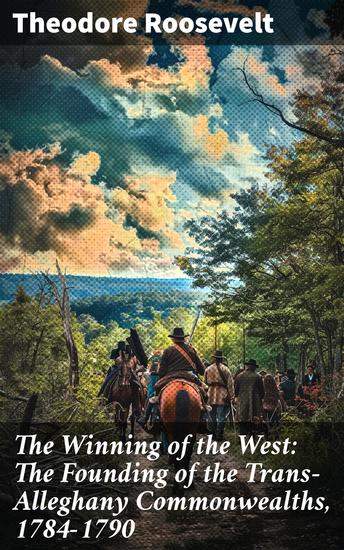
The Winning of the West: The Founding of the Trans-Alleghany Commonwealths 1784-1790 - Forging a New Frontier: Pioneers and Commonwealths in 18th Century America - cover

The Winning of the West: The Founding of the Trans-Alleghany Commonwealths 1784-1790 - Forging a New Frontier: Pioneers and Commonwealths in 18th Century America

Theodore Roosevelt

Publisher: Good Press

  • 0
  • 0
  • 0

Summary

In "The Winning of the West: The Founding of the Trans-Alleghany Commonwealths, 1784-1790," Theodore Roosevelt presents a meticulous historical account that chronicles the geopolitical and social developments in the American West following the Revolutionary War. Roosevelt'Äôs literary style combines a vigorous narrative approach with a scholarly examination of primary sources, including letters, governmental documents, and firsthand accounts, providing a rich context for understanding the westward expansion of American society. The work reflects the romanticism and nationalism of the late 19th century, encapsulating the spirit of Manifest Destiny as it gives voice to the settlers, Native Americans, and leaders pivotal to the establishment of new commonwealths beyond the Allegheny Mountains. A driving force behind Roosevelt's interest in this period was his deep appreciation for American history and rugged individualism, stemming from his own experiences in the West. Roosevelt, who later became the 26th President of the United States, was known for his advocacy for conservation and the influence of frontier life on the American character. His writings often sought to resuscitate an understanding of the nation'Äôs complex past, emphasizing the romantic view of the American pioneer spirit and the challenges faced during this transformative era. This scholarly yet accessible text is recommended for those interested in American history, frontier studies, and the cultural narratives that shaped modern America. Roosevelt's insightful analysis illuminates the struggles and triumphs of early American pioneers, making it essential reading for history enthusiasts and scholars alike.
Available since: 08/12/2023.
Print length: 239 pages.

Other books that might interest you

  • Social Experiments in the 20th Century: The History of the World’s Most Famous and Infamous Psychological Experiments - cover

    Social Experiments in the 20th...

    Editors Charles River

    • 0
    • 0
    • 0
    The human psyche is one of the most complex, unpredictable, enigmatic, and therefore riveting phenomena in existence, one that psychologists have been working on deciphering since the dawn of modern science. To better understand the multifaceted intricacies of human behavior, and to unlock the secrets of the conscious mind and the subconscious, ambitious professionals in the field have conducted numerous groundbreaking – and at times, problematic – psychological experiments. The practice originated with German philosopher Wilhelm Wundt, one of the fathers of modern psychology and the creator of the world's first experimental psychology laboratory at the University of Leipzig. He sought to measure the average speed of thought processes by assigning a range of reaction time tasks to his subjects.  
    	As the nascent, yet fast-developing scientific discipline took hold around the globe, psychological experiments simultaneously diversified. As revolutionary and eye-opening as many of these experiments were, they often danced on the fine line between ethical and unethical. There was, for instance, the now-infamous Little Albert Experiment, conducted at Johns Hopkins University in 1920, in which a nine-month-old infant was deliberately manipulated into developing an irrational fear for the purpose of studying classical conditioning, and the correlation between adult fears and childhood traumas. The Monster Study, carried out at the University of Iowa in 1939, attempted to convert orphans into stutterers, half of whom were subjected to positive reinforcements and the others to negative ones. Then, there was arguably the most notorious psychological experiment in history: the 1971 Stanford Prison Experiment, in which participants were randomly assigned the character of either prisoner or prison guard. That role-playing study quickly spiraled out of control.
    Show book
  • Older Person’s Guide to Modern Teenage Slang An - cover

    Older Person’s Guide to Modern...

    Aiden Sharma

    • 0
    • 0
    • 0
    Bridge the Generation Gap with Humor and Understanding! 
    Ever feel lost when your grandkids or younger colleagues start talking? "A Older Person's Guide to Modern Teenage Slang" is your roadmap to decoding Gen Z communication. Written by Aiden Sharma and narrated with wit by Riley Pines, this guide transforms confusing digital-age language into an entertaining and accessible journey. 
    Imagine turning bewildering abbreviations like "IYKYK" and "TBH" from head-scratching mysteries into conversational tools. This book does exactly that, breaking down modern slang into easy-to-understand categories: from basic communication and digital shortcuts to technology terms and pop culture references. 
    More than just a dictionary, this guide offers: 
    - Contextual examples that make each term come alive 
    - Explanations of how and when to use trendy expressions 
    - A playful quiz to test your newly acquired linguistic skills 
    - Insights into the cultural nuances behind each term 
    Whether you're a parent wanting to connect with your teenagers, a professional seeking to understand younger colleagues, or simply curious about how language evolves, this guide is your secret weapon. Learn how "slay" means success, "no cap" means total honesty, and "main character energy" describes confidence with flair. 
    Packed with humor, real-world examples, and a genuine appreciation for generational communication, this book transforms potential language barriers into opportunities for connection and understanding. You'll go from feeling confused to feeling fluent - and have plenty of laughs along the way. 
    Don't just survive modern communication - thrive in it! Grab your copy of "A Older Person's Guide to Modern Teenage Slang" and start speaking the language of Gen Z with confidence and cool. You got this, bestie.
    Show book
  • But Whose Fault? - The AK-47 Found - cover

    But Whose Fault? - The AK-47 Found

    AMOS ASEMONE

    • 0
    • 0
    • 0
    Do you keep an eye on world events through mainstream media? If so, chances are you have missed out on many essential news stories from countries around the world. 
    While many news outlets will cover European, U.K., and U.S. news in great detail, they often leave out essential news from other continents, especially Africa. 
    And yet, that doesn’t mean that newsworthy events occur there every day, just like in the UK. 
    In fact, some of the most newsworthy stories have occurred in Africa in recent years. 
    If you want to learn more about the conflicts of African communities, you have come to the right place. 
    Introducing, But, Whose Fault? Part One, a true story based in Ghana, where two AK-47s mysteriously vanished before reappearing without ammunition. 
    Not only does this book shed light on an incident that is still to be answered to this day, but it also highlights one of the many conflicts that African communities go through and are never displayed on the big screen. 
    In many ways, the conflict surrounding the missing rifles is a point of convergence of the exploitation of Africa and the negligence shown toward the local people and their value to the world. 
    It is one of the main reasons it continues to go unnoticed in many countries, yet it is a story that must be told. 
    Inside, But, Whose Fault? Part One, discover: 
    ●	essential background information about the local people and community 
    ●	the political context behind the events that unfolded 
    ●	the initial factors that influenced the confrontation 
    ●	the company behind the Nguvu mining project 
    ●	the disappearance, search, and fallout from the missing rifles 
    If you are at all interested in the rich history and real-life stories of Africa, this book is a must-read. 
    Grab a copy of But, Whose Fault? Part One today!
    Show book
  • Finding Francis - One Family's Journey from Slavery to Freedom - cover

    Finding Francis - One Family's...

    Elizabeth J. West

    • 0
    • 0
    • 0
    Finding Francis, finding family, freeing history 


    Francis is found. Beyond Francis, a family is found—in archival material that barely deigned to notice their existence. This is the story of Francis Sistrunk and her children, from enslavement into forced migration across South Carolina, Georgia, Alabama, and Mississippi. It spans decades before the Civil War and continues into post-emancipation America. A family story full of twists and turns, Finding Francis reclaims and honors those women who played an essential role in the historical survival and triumph of Black people during and after American slavery. 


    Elizabeth West has created a remarkable "biohistoriography" of everyday Black resistance, grounded in a determination to maintain enduring connections of family, kinship, and community despite the inhumanity and rapacity of slavery. There is inevitable heartbreak in these histories, but there is also an empowering strength and inspiration—the truth of these lives will indeed set us all free.
    Show book
  • Bertrand Russell - Logic Mathematics and the Pursuit of Truth - cover

    Bertrand Russell - Logic...

    Hector Davidson

    • 0
    • 0
    • 0
    Bertrand Russell, born on May 18, 1872, in Trellech, Monmouthshire, Wales, was a British philosopher, logician, mathematician, and social critic. Coming from a prominent aristocratic family, with his grandfather, Lord John Russell, having served as a British Prime Minister, Russell had an influential upbringing. He attended Cambridge University, where he studied under Alfred North Whitehead, a notable logician and philosopher. Russell was deeply influenced by the works of Gottlob Frege and David Hilbert. 
    One of his most significant contributions to philosophy and mathematics was the co-authorship of "Principia Mathematica" with Alfred North Whitehead. This monumental work aimed to derive all mathematical truths from a set of axioms using symbolic logic, laying the groundwork for much of modern mathematical logic and philosophy. Russell also developed the theory of logical atomism, proposing that the world consists of atomic facts that can be represented by logical propositions. His emphasis on logical rigor and clarity had a profound impact on the development of analytic philosophy.
    Show book
  • Black Folk - The Roots of the Black Working Class - cover

    Black Folk - The Roots of the...

    Blair L.M. Kelley

    • 0
    • 0
    • 0
    There have been countless books, articles, and televised reports in recent years about the almost mythic "white working class," a tide of commentary that has obscured the labor, and even the very existence, of entire groups of working people, including everyday Black workers. In this brilliant corrective, Black Folk, acclaimed historian Blair LM Kelley restores the Black working class to the center of the American story. 


    Spanning two hundred years—from one of Kelley's earliest known ancestors, an enslaved blacksmith, to the essential workers of the Covid-19 pandemic—Black Folk highlights the lives of the laundresses, Pullman porters, domestic maids, and postal workers who established the Black working class as a force in the late nineteenth and early twentieth centuries. Taking jobs white people didn't want and confined to segregated neighborhoods, Black workers found community in intimate spaces, from stoops on city streets to the backyards of washerwomen, where multiple generations labored from dawn to dusk, talking and laughing in a space free of white supervision. As millions of Black people left the violence of the American South for the promise of a better life in the North and West, these networks of resistance and joy sustained early arrivals and newcomers alike and laid the groundwork for organizing for better jobs, better pay, and equal rights.
    Show book