Join us on a literary world trip!
Add this book to bookshelf
Grey
Write a new comment Default profile 50px
Grey
Subscribe to read the full book or read the first pages for free!
All characters reduced
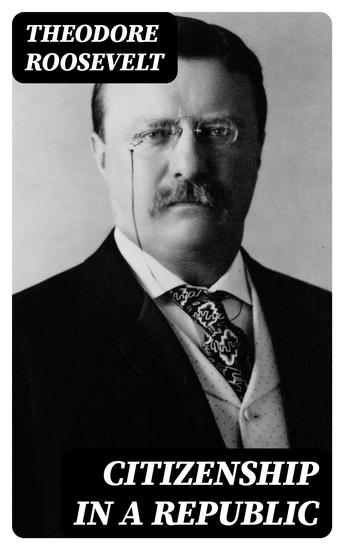
Citizenship in a Republic - cover

Citizenship in a Republic

Theodore Roosevelt

Publisher: DigiCat

  • 0
  • 0
  • 0

Summary

Theodore Roosevelt's "Citizenship in a Republic" is a profound exploration of the duties and responsibilities of American citizens within a democratic society. Delivered as a speech at the Sorbonne in 1910, this work combines rhetorical elegance with a persuasive call to civic engagement and moral integrity. Roosevelt's literary style is marked by his vigorous prose and passionate advocacy for a robust, participatory citizenry. This text emerges from the broader philosophical context of Progressive Era America, highlighting the emerging complexities of democracy amidst industrialization and social change. Theodore Roosevelt, the 26th President of the United States, was a prominent figure whose beliefs and political actions were deeply rooted in his commitment to social justice and national strength. Influenced by his own experiences in leadership and governance, as well as the prevailing issues of his time, Roosevelt sought to articulate a vision of citizenship that transcended mere legal status, emphasizing ethical conduct and active participation as the bedrock of democracy. "Citizenship in a Republic" is essential reading for anyone interested in the interplay between individual rights and communal responsibilities. Roosevelt's timeless insights resonate with contemporary discussions on civic duty, making this work not only a historical artifact but a relevant guide for engaged citizenship in the modern era.
Available since: 05/29/2022.
Print length: 22 pages.

Other books that might interest you

  • The Hard Road Out - cover

    The Hard Road Out

    Jihyun Park, Seh-lynn Chai

    • 0
    • 0
    • 0
    The harrowing story of a woman who escaped famine and terror in North Korea, not once but twice. 
    ‘A gripping, suspenseful and cathartic memoir that tells a story of pain and perseverance and makes the moral case for asylum.’ David Lammy MP 
    North Korea is an open-air prison from which there is no escape. Only a handful of men and women have succeeded. 
    Jihyun Park is one of these rare survivors. Twice she left the land of the ‘socialist miracle’ to flee famine and dictatorship. 
    By the age of 29 she had already witnessed a lifetime of suffering. Family members had died of starvation; her brother was beaten nearly to death by soldiers. Even smiling and laughing was discouraged. 
    The first time she ran, she was forced abandon her father on his deathbed – crossing the border under a hail of bullets. In China she was sold to a farmer, with whom she had a son, before being denounced and forcibly returned to North Korea. 
    Six months later guards abandoned her, injured, outside a prison camp. She recovered and returned China to seek her son, now six, before attempting to navigate the long, hard road through the Gobi Desert and into Mongolia. 
    Clear-eyed and resolute, Jihyun’s extraordinary story reveals a Korea far removed from the talk of nuclear weapons and economic sanctions. She remains sanguine despite the hardship. Recalling life’s tiny pleasures even at her darkest moments, she manages to instill her tale with incredible grace and humanity. 
    Beautifully written with South Korean compatriot Seh-lynn Chai, this compelling book offers a stark lesson in determination, and ultimately in the importance of asylum. 
    This best autobiography is a personal account of survival and political struggle. It's a top choice for those interested in history, rights, and the experiences of refugees in Asia. 
    For fans of Masaji Ishikawa (A River in Darkness), Catherine Belton (Putin's People), Bill Browder (Freezing Order), Hyeonseo Lee (The Girl with Seven Names), and Blaine Harden (Escape from Camp 14). 
    HarperCollins 2022
    Show book
  • The Curse of Demagogues - Lessons Learned from the Presidency of Donald J Trump - cover

    The Curse of Demagogues -...

    Eli Merritt

    • 0
    • 0
    • 0
    The Curse of Demagogues: Lessons Learned from the Presidency of Donald J. Trump is a collection of 32 essays by 22 writers that make the case that the pathway back to a healthy American democracy is for citizens to understand demagogues and defend against them. 
    More than any other book in print, The Curse of Demagogues makes the story of Donald Trump's rise to the White House coherent and understandable. Trump, a demagogue, gained ascendancy in a laissez-faire political culture wherein neither the Republican Party nor the other gatekeepers of democracy, including the news media, effectively counteracted him. Once in the highest office in the land, Trump devolved into authoritarianism in order to retain power, as demagogues are well-known to do. 
    The book has three overarching aims. First, it constitutes a short history of Trump's years in the White House (and his first two campaigns for president) as told from the perspective of scholars, journalists, and legal experts who specifically warned the public about his dangers as a demagogue in real time. Second, the collection is a detailed primer on demagogues and the multifarious ways they poison the vital organs of constitutional democracy. Third, the book is an urgent call to restore gatekeepers to their essential role as defenders of democracy against demagogues. 
    To revivify our once great democracy, we must defend it against demagogues by strengthening gatekeeping systems within political parties, the media, and the US Congress (powers of impeachment, conviction, and disqualification from future office), and through vigorous civics, ethics, and media literacy education for grades K-12.  
    As Eli Merritt, editor and contributor, writes in the book's introduction: 
    "The enemy of democracy is not a Democrat or Republican. It is a demagogue." 
    ©2022 Eli Merritt (P)2023 Peter Lerman
    Show book
  • The Virus and the Host - Protect Yourself from Infectious Disease by Reducing Toxicity Improving Immunity and Minimizing Chronic Illness - cover

    The Virus and the Host - Protect...

    Dr. Chris Chlebowski

    • 0
    • 0
    • 0
    There will almost certainly be more pandemics in our future. Yet, during the coronavirus crisis, not a single major public-health official took the simple step of telling Americans what we all need to hear: robust good health?healthy immunity, low inflammation, low toxic burden, and freedom from stealth infection and chronic disease?is our best defense against infectious viral disease. The way our bodies interact with infectious disease is complicated?both a function of the “germ” and the “terrain”?the virus and the host. In The Virus and the Host, Dr. Chlebowski succinctly describes emerging science on the virome and how toxic exposure, chronic inflammation, infections, and chronic diseases interact and predispose us to poor outcomes from acute viral infection. He then clearly outlines the tools needed for better health, including these: -The best nutrients to supercharge your immunity -How to harness the power of botanical medicine -How to detoxify simply and safely at home -Valuable information on simple treatment and recommended diagnostic tests for given conditions As we move forward from the tragedy of COVID-19, it is essential that we come together to learn from our mistakes and work hard?and work together?to prevent a similar crisis in the future. When the next pandemic hits, we need to be better prepared. Now is the time to do something, and it is the best investment we can make so that when the next one hits we can keep our loved ones and ourselves safe and healthy.
    Show book
  • Moneyless Society - The Next Economic Evolution - cover

    Moneyless Society - The Next...

    Matthew Holten

    • 0
    • 0
    • 0
    IT'S TIME FOR AN ECONOMIC EVOLUTION. 
    The evidence is all around us: Humans are squandering natural resources and destroying the environment. There is no real debate about climate change. And with an ever-widening wealth gap, inequality is destabilizing many regions and worsening famine, disease, and civil unrest. 
    We must change, fast - and yet we hesitate. 
    Moneyless Society: The Next Economic Evolution explores how capitalism throttles Earth's capacity to sustain life and undermines our deep longing to live in peace and prosperity. Fortunately, it also provides a blueprint to innovative thinking and new structures to replace our outmoded monetary system. In short, Moneyless Society illuminates just how much our lives and those of future generations could improve with a new kind of freedom: freedom from money. 
    We are at a crossroads: we can choose abundance, community, and prosperity, or we can continue down the path toward collapse. The choice is ours. 
    NOTE: Be sure to download the free supplemental materials (PDF) here or on MoneylessSociety.com.
    Show book
  • The Great Retreat - How Political Parties Should Behave and Why They Don't - cover

    The Great Retreat - How...

    Didi Kuo

    • 0
    • 0
    • 0
    Once a centralizing force of the democratic process, political parties have eroded over the past fifty years. Parties now rank among the most unpopular institutions in society—less trusted than business, the police, and the media. Identification with parties has plummeted, and even those who are loyal to a party report feeling that parties care more about special interests than about regular citizens. What does a "good" political party look like? Why do we urgently need them? And how do we get them? 


    The Great Retreat explores the development of political parties as democracy expanded across the West in the nineteenth century. It focuses in particular on mass parties, and the ways they served as intermediaries that fostered ties between citizens and governments. 


    For democracy to adapt to a new era of global capitalism, Kuo makes the case that we need strong intermediaries like mass parties—socially embedded institutions with deep connections to communities and citizens. Parties are essential to long-term democratic stability and economic growth, while the breakdown of party systems, on the other hand, has historically led to democratic collapse. As trust in political parties has plummeted, The Great Retreat provides a powerful defense of political parties—for without parties, democratic representation is impossible.
    Show book
  • Spirit of the Laws The: Book Summary & Analysis - cover

    Spirit of the Laws The: Book...

    Briefly Summaries

    • 0
    • 0
    • 0
    This is a concise summary and analysis of The Spirit of the Laws, by Montesquieu.
     
    It is not the original book and is not affiliated with or endorsed by 
    Montesquieu.
     
    Ideal those seeking a quick and insightful overview.
     
    The Spirit of the Laws is a groundbreaking exploration of political theory, law, and governance. It examines the principles that shape governments, emphasizing the balance of power, the importance of justice, and the role of social and cultural factors in shaping legal systems. From dissecting the separation of powers to analyzing the influence of climate and geography on societies, this work remains a cornerstone of modern political thought and a vital resource for understanding the foundations of democracy and human rights.
    Show book