Join us on a literary world trip!
Add this book to bookshelf
Grey
Write a new comment Default profile 50px
Grey
Subscribe to read the full book or read the first pages for free!
All characters reduced
Citizenship in a Republic - Enriched edition - cover

Citizenship in a Republic - Enriched edition

Theodore Roosevelt

Publisher: DigiCat

  • 0
  • 0
  • 0

Summary

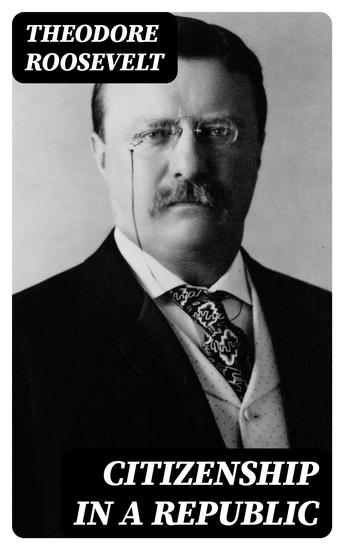
Theodore Roosevelt's "Citizenship in a Republic" is a profound exploration of the duties and responsibilities of American citizens within a democratic society. Delivered as a speech at the Sorbonne in 1910, this work combines rhetorical elegance with a persuasive call to civic engagement and moral integrity. Roosevelt's literary style is marked by his vigorous prose and passionate advocacy for a robust, participatory citizenry. This text emerges from the broader philosophical context of Progressive Era America, highlighting the emerging complexities of democracy amidst industrialization and social change. Theodore Roosevelt, the 26th President of the United States, was a prominent figure whose beliefs and political actions were deeply rooted in his commitment to social justice and national strength. Influenced by his own experiences in leadership and governance, as well as the prevailing issues of his time, Roosevelt sought to articulate a vision of citizenship that transcended mere legal status, emphasizing ethical conduct and active participation as the bedrock of democracy. "Citizenship in a Republic" is essential reading for anyone interested in the interplay between individual rights and communal responsibilities. Roosevelt's timeless insights resonate with contemporary discussions on civic duty, making this work not only a historical artifact but a relevant guide for engaged citizenship in the modern era.

In this enriched edition, we have carefully created added value for your reading experience:
- A succinct Introduction situates the work's timeless appeal and themes.
- The Synopsis outlines the central plot, highlighting key developments without spoiling critical twists.
- A detailed Historical Context immerses you in the era's events and influences that shaped the writing.
- An Author Biography reveals milestones in the author's life, illuminating the personal insights behind the text.
- A thorough Analysis dissects symbols, motifs, and character arcs to unearth underlying meanings.
- Reflection questions prompt you to engage personally with the work's messages, connecting them to modern life.
- Hand‐picked Memorable Quotes shine a spotlight on moments of literary brilliance.
- Interactive footnotes clarify unusual references, historical allusions, and archaic phrases for an effortless, more informed read.
Available since: 05/29/2022.
Print length: 22 pages.

Other books that might interest you

  • Neoliberalism Unveiled - Understanding the Shift Towards Free Market Policies - cover

    Neoliberalism Unveiled -...

    Arlo Holders

    • 0
    • 0
    • 0
    Neoliberalism is a term that has been widely used in academic, political, and economic discussions, yet its exact definition often varies depending on the context. Broadly, neoliberalism refers to a set of economic and political policies that emphasize the role of free markets in achieving economic prosperity, social well-being, and individual freedom. At its core, neoliberalism promotes the idea that markets should operate with minimal interference from the state, and that individuals should be free to pursue their economic interests without governmental restrictions. 
    The roots of neoliberalism can be traced back to the early 20th century, particularly to the ideas of economists such as Friedrich Hayek and Milton Friedman. These thinkers were critical of state intervention in the economy and argued that government control of markets often led to inefficiency and loss of individual freedoms. Hayek’s influential work, The Road to Serfdom (1944), warned against the dangers of central planning and collectivism, which he believed could lead to authoritarianism. Similarly, Friedman, through his advocacy for monetarism and the reduction of government spending, pushed for policies that emphasized the importance of individual choice and market forces over state control. Their ideas laid the intellectual foundation for what would later become neoliberalism. 
    Neoliberalism as a political and economic force began to take shape during the 1970s as many Western economies faced economic stagnation and rising inflation, often referred to as stagflation. Traditional Keynesian approaches, which advocated for government intervention to manage demand and stabilize economies, appeared to fail in addressing these new challenges. In response, neoliberal ideas gained traction, especially in the United States and the United Kingdom.
    Show book
  • "Today You Are A Citizen of the United States of America" - The Citizens Almanac - cover

    "Today You Are A Citizen of the...

    Anonymous Anonymous

    • 0
    • 0
    • 0
    This is a recording of a booklet given to new naturalized American citizens, it contains an explanation of fundamental documents, symbols and anthems of the United States. "Today you are a citizen of the United States of America— becoming “a peer of kings” as President Calvin Coolidge once said. This occasion is a defining moment that should not soon be forgotten, for it marks the beginning of a new era in your lifetime as a U.S. citizen. Naturalized citizens are an important part of our great democracy, bringing a wealth of talent, ability, and character to this Nation. Your fellow citizens recognize the sacrifices you have made to reach this milestone and with open arms we welcome you. The United States offers an abundance of freedom and opportunity for all its citizens and we wish you all the best along the way."
    Show book
  • The Fight for Privacy - Protecting Dignity Identity and Love in the Digital Age - cover

    The Fight for Privacy -...

    Danielle Keats Citron

    • 0
    • 0
    • 0
    Privacy is disappearing. From our sex lives to our workout routines, the details of our lives once relegated to pen and paper have joined the slipstream of new technology. As a MacArthur fellow and distinguished professor of law at the University of Virginia, acclaimed civil rights advocate Danielle Citron has spent decades working with lawmakers and stakeholders across the globe to protect what she calls intimate privacy—encompassing our bodies, health, gender, and relationships. When intimate privacy becomes data, corporations know exactly when to flash that ad for a new drug or pregnancy test. Social and political forces know how to manipulate what you think and who you trust, leveraging sensitive secrets and deepfake videos to ruin or silence opponents. And as new technologies invite new violations, people have power over one another like never before, from revenge porn to blackmail, attaching life-altering risks to growing up, dating online, or falling in love. 


    A masterful new look at privacy in the twenty-first century, The Fight for Privacy takes the focus off Silicon Valley moguls to investigate the price we pay as technology migrates deeper into every aspect of our lives: entering our bedrooms and our bathrooms and our midnight texts; our relationships with friends, family, lovers, and kids; and even our relationship with ourselves.
    Show book
  • Read & Riot - A Pussy Riot Guide to Activism - cover

    Read & Riot - A Pussy Riot Guide...

    Anonymous

    • 0
    • 0
    • 0
    From artist, activist, and Pussy Riot founder Nadya Tolokonnikova, a guerilla guide to radical protest and joyful political resistance. 
    The face of modern protest is wearing a brightly colored ski mask.  
    Nadya Tolokonnikova, founding member of the Russian activist group Pussy Riot, is a creative activist, professional protestor, brazen feminist, shocking visual artist, and force to be reckoned with. Her spontaneous, explosive approach to political action has involved jumping over barbed wire, kissing police officers, giving guerilla performances in crowded subway cars, and going on a hunger strike to protest the abuse of prisoners. She’s been horse-whipped by police in Sochi, temporarily blinded when officers threw green paint in her eyes, and monitored by the Russian government. But what made Nadya an activist icon overnight happened on February 21, 2012, when she was arrested for performing an anti-Putin protest song in a Moscow church.  
    She was sent to a Russian prison for 18 months and emerged as an international symbol of radical resistance, as calls to “Free Pussy Riot” resounded around the world. With her emblematic ski mask, black lipstick, and unwavering bravery, Nadya has become an emissary of hope and optimism despite overwhelming and ugly political corruption.  
    Read & Riot is structured around Nadya’s ten rules for revolution (Be a pirate! Make your government shit its pants! Take back the joy!) and illustrated throughout with stunning examples from her extraordinary life and the philosophies of other revolutionary rebels throughout history. Rooted in action and going beyond the typical “call your senator” guidelines, Read & Riot gives us a refreshing model for civil disobedience, and encourages our right to question every status quo and make political action exciting—even joyful.
    Show book
  • The Velocity of Information - Human Thinking During Chaotic Times - cover

    The Velocity of Information -...

    David P. Perrodin

    • 0
    • 0
    • 0
    As chaos erupts, alerts screech on our cell phones and torrents of conflicting-yet-urgent messages gush from media outlets. What is the magnitude of the crisis? What is its cause? And what should people do to protect themselves? Velocity of Information offers understanding to manage chaos and our complex reactions to crisis situations influenced by bias and propaganda. Recognizing indicators to judge the severity of an incident, understanding human predispositions, and joining a member check network to gauge real-time observations from people in your network provide direction to respond to the reality of a situation with impartiality, thus improving outcomes. *This audiobook has a companion PDF document.
    Show book
  • Titans of Capital - How Concentrated Wealth Threatens Humanity - cover

    Titans of Capital - How...

    Peter Phillips, Dan Kovalik

    • 0
    • 0
    • 0
    A fascinating examination of the rapid concentration of global capital, with chapters that focus on China and Russia. 


    In Titans of Capital, Peter Phillips, a political sociologist, poses three key research questions: To what extent do the wealthy influence—or even dominate—decision making that affects all of us in society? Who are the most powerful people? And how does the accumulation of capital work? 


    Networks of wealthy individuals have evolved since the COVID-19 pandemic, and Titans of Capital shows how the financial investments of transnational elites threaten human rights and the future of the planet. Phillips warns that while continued concentration of global capital increases the profits enjoyed by the global economy's "Titans,", it also increases global inequality, starvation, and civil unrest, threatening the lives of the hundreds of millions of people living in extreme poverty. It is imperative to ask how we can reverse the concentration of Titan wealth and revitalize grassroots democracy unbridled by extreme wealth. Identifying 117 global Titans by name and exposing the networks and interests that unite them provides listeners opposed to militarism and committed to economic equality with crucial tools to directly engage the power elite who endanger life on earth.
    Show book