Join us on a literary world trip!
Add this book to bookshelf
Grey
Write a new comment Default profile 50px
Grey
Subscribe to read the full book or read the first pages for free!
All characters reduced
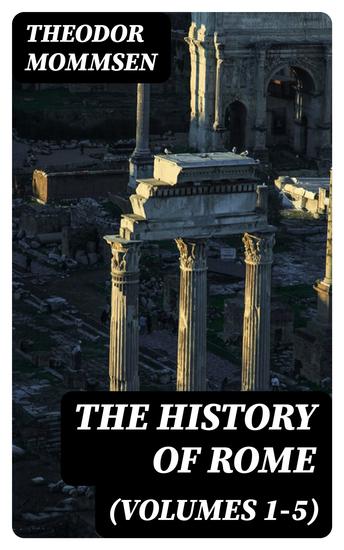
The History of Rome (Volumes 1-5) - Enriched edition - cover

The History of Rome (Volumes 1-5) - Enriched edition

Theodor Mommsen

Translator William P. Dickson

Publisher: DigiCat

  • 0
  • 0
  • 0

Summary

The History of Rome, a monumental five-volume work by Theodor Mommsen, offers a comprehensive narrative that intricately weaves politics, culture, and society throughout the rise and fall of the Roman Empire. Mommsen's erudite prose and masterful command of Latin literature illuminate the complexities of Roman governance, military conquests, and civic life. Written in the late 19th century, this historiographical masterpiece situates itself within the Romantic tradition, echoing the burgeoning nationalistic sentiments of the time while striving for objective scholarship, making informed use of primary sources and archaeological findings. Theodor Mommsen, a renowned German historian and philologist awarded the Nobel Prize in Literature in 1902, drew upon a profound understanding of classical literature and history. His deep commitment to the exploration of political ideals and the evolution of law is reflected in his scholarly background, including his tenure at the University of Berlin. Mommsen's passion for ancient Rome stemmed from both a fascination with its complexities and a quest to understand its impact on European civilization. This magnum opus is highly recommended for scholars, students, and anyone with a thirst for knowledge of ancient Rome. Its vivid storytelling not only engages the reader in the historical narrative but also provides critical insights into the enduring legacy of Rome on modern society.

In this enriched edition, we have carefully created added value for your reading experience:
- A succinct Introduction situates the work's timeless appeal and themes.
- The Synopsis outlines the central plot, highlighting key developments without spoiling critical twists.
- A detailed Historical Context immerses you in the era's events and influences that shaped the writing.
- An Author Biography reveals milestones in the author's life, illuminating the personal insights behind the text.
- A thorough Analysis dissects symbols, motifs, and character arcs to unearth underlying meanings.
- Reflection questions prompt you to engage personally with the work's messages, connecting them to modern life.
- Hand‐picked Memorable Quotes shine a spotlight on moments of literary brilliance.
- Interactive footnotes clarify unusual references, historical allusions, and archaic phrases for an effortless, more informed read.
Available since: 06/02/2022.
Print length: 2302 pages.

Other books that might interest you

  • The Urban Poor - Socioeconomic Challenges and Solutions - cover

    The Urban Poor - Socioeconomic...

    Lyric Vale

    • 0
    • 0
    • 0
    Urban poverty has emerged as one of the most pressing social and economic issues of the modern world. As the global population increasingly shifts toward urban centers, the face of poverty is no longer limited to rural areas. Cities, which were once seen as hubs of opportunity, now grapple with growing disparities between the rich and the poor. The urban poor live in environments that offer limited access to basic services such as housing, healthcare, education, and employment opportunities, making it difficult for them to escape the cycle of poverty. 
    The rapid pace of urbanization, especially in developing countries, has led to the creation of sprawling slums and informal settlements where millions of people struggle to survive. These areas are often characterized by overcrowded living conditions, inadequate infrastructure, and limited access to clean water and sanitation. As cities expand, they fail to provide adequate housing for their increasing populations, and the urban poor are forced to live in substandard conditions with few opportunities for upward mobility. 
    Urban poverty is not just about a lack of income; it is about a lack of access to the resources and services that are essential for a decent quality of life. The urban poor are often marginalized and excluded from the formal economy, finding themselves in low-wage, insecure jobs or relying on informal employment. This lack of stable income exacerbates their poverty and limits their ability to meet basic needs such as food, healthcare, and education.
    Show book
  • How to English: Conversations - A Practical Guide to Mastering Everyday Conversations - cover

    How to English: Conversations -...

    David Tobin

    • 0
    • 0
    • 0
    Speak confidently. Connect naturally. 
    Ready to boost your fluency and speak English with ease? How to English: Conversations is your go-to guide for mastering real-life conversations. Designed for intermediate and advanced learners, this audiobook offers practical tips, real-world examples, and essential expressions to help you sound natural and confident. 
    Inside, you’ll learn how to: 
    Start and sustain engaging conversations 
    Express opinions and handle disagreements smoothly 
    Use idioms and phrasal verbs like a native speaker 
    Navigate casual and professional interactions with confidence 
    Packed with exercises, relatable scenarios, and cultural insights, How to English: Conversations helps you go beyond grammar—so you can speak comfortably, respond authentically, and build meaningful connections in English.
    Show book
  • World Brain - cover

    World Brain

    H. G. Wells

    • 0
    • 0
    • 0
    World Brain is a collection of essays and addresses by the English science fiction pioneer, social reformer, evolutionary biologist and historian H. G. Wells, dating from the period of 1936–1938. Throughout the book, Wells describes his vision of the World Brain: a new, free, synthetic, authoritative, permanent "World Encyclopaedia" that could help world citizens make the best use of universal information resources and make the best contribution to world peace.
    Show book
  • Little Women Podcast Q&A Your Questions Answered - cover

    Little Women Podcast Q&A Your...

    Niina Niskanen

    • 0
    • 0
    • 0
    How did I get started in Louisa May Alcott's research? Is Beth really just part of the sick girl trope or is there more in her? and why is Friedrich from Germany? Why did the film-makers erase Laurie's backstory? What is Amy's relationship with Catholicism? was Louisa May Alcott religious? Did she want to get married? are Fritz and Laurie really based on men in her life? I've got so many questions from you guys that I will answer them in this excellent Little Women Q&A. One thing that surprised me was that it was really difficult to find studies on Laurie. I was interested in Laurie as an individual, and why he behaves the way he does. I was expecting to find a lot about him because Laurie is a popular character, at least according to the filmmakers, a lot more popular than Friedrich, and I didn't find anything about him. Nothing about him being an orphan. The tricky relationship that he has with his grandfather or why he's hanging in Jo´s apron strings. There are scenes in Little Women where Laurie is annoyed when Jo is lecturing him, but he's still addicted to her care. Maybe Amy's screen portrayals are the reason why there hasn't been that much research made on May Alcott by scholars .I think the same applies to Laurie and Friedrich in films. Laurie is this pretty guy who Jo rejects. Then in a lot of the studies that I read, the writer was asking why did Louisa May Alcott marry Jo to an old German and not to the rich and handsome young Laurie? Okay. Friedrich is not old. He's 39. If you read letters between Louisa and her publisher, Thomas Niles, Louisa was the one who came up with all the marriages.When I was reading these essays, it was so frustrating because the book doesn't show Laurie as this manic pixie dream boy, as the movies do, but more as a seriously troubled young man.
    Show book
  • The First Advent in Palestine - Reversals Resistance and the Ongoing Complexity of Hope - cover

    The First Advent in Palestine -...

    Kelley Nikondeha

    • 0
    • 0
    • 0
    When we picture the first Advent, we see Mary and Joseph huddled by a manger. We picture Gabriel, magi, and shepherds tending their flocks. A shining star against a midnight sky. But this harmonized version has lifted the Advent story out of its context--those who experienced the first Advent had to travel through great darkness to reach the hope that shining star announced. Trusted scholar and community organizer Kelley Nikondeha takes us back, to where the landscape of Palestine is once again the geographic, socioeconomic, and political backdrop for the Advent story. 
    Reading the Advent narratives of Luke and Matthew anew, in their original context, changes so much about how we see the true story of resistance, abusive rulers and systems of oppression, and God coming to earth. In Luke, Rome and Caesar loom, and young Mary's strength and resolve shine brightly as we begin to truly understand what it meant for her to live in the tumultuous Galilee region. In Matthew, through Joseph's point of view, we see the brutality of Herod's rule and how the complexities of empire weighed heavily on the Holy Family. We bear witness to the economic hardship of Nazareth, Bethlehem, and the many villages in between--concerns about daily bread, crushing debt, land loss, and dispossession that ring a familiar echo to our modern ears. Throughout her explorations, Nikondeha features the stories of modern-day Palestinians, centering their voices to help us meet an Advent recognizable for today. This thought-provoking examination invites us into a season of discovery, one that is realistic and honest, and that still wonders at the goodness of God's grace.
    Show book
  • The Fall of Rome - End of a Superpower - cover

    The Fall of Rome - End of a...

    Nick Holmes

    • 0
    • 0
    • 0
    A skilled storyteller, Holmes presents a riveting account of the wars, intrigues and personalities that contributed to Rome's decline, with entire chapters devoted to single battles.' Kirkus Reviews 


    Why did Rome Fall? 


    In this gripping retelling of one of the most momentous chapters in history, Nick Holmes presents a new interpretation of an old story. The fate of Rome was decided not just by emperors, soldiers, and barbarians but also by an environmental disaster. 


    A catastrophic megadrought on the Asian steppes in the fourth century AD forced the migration of entire peoples—Huns, Goths, Vandals, and others—west into the Roman Empire. They met an empire weakened from war with Persia. Rome's misfortunes multiplied as it made tactical errors on the battlefield. Civil war, religious unrest, and political incompetence compounded a worsening situation. The result was one of the greatest disasters in the ancient world—the sack of Rome by the Goths in AD 410.
    Show book